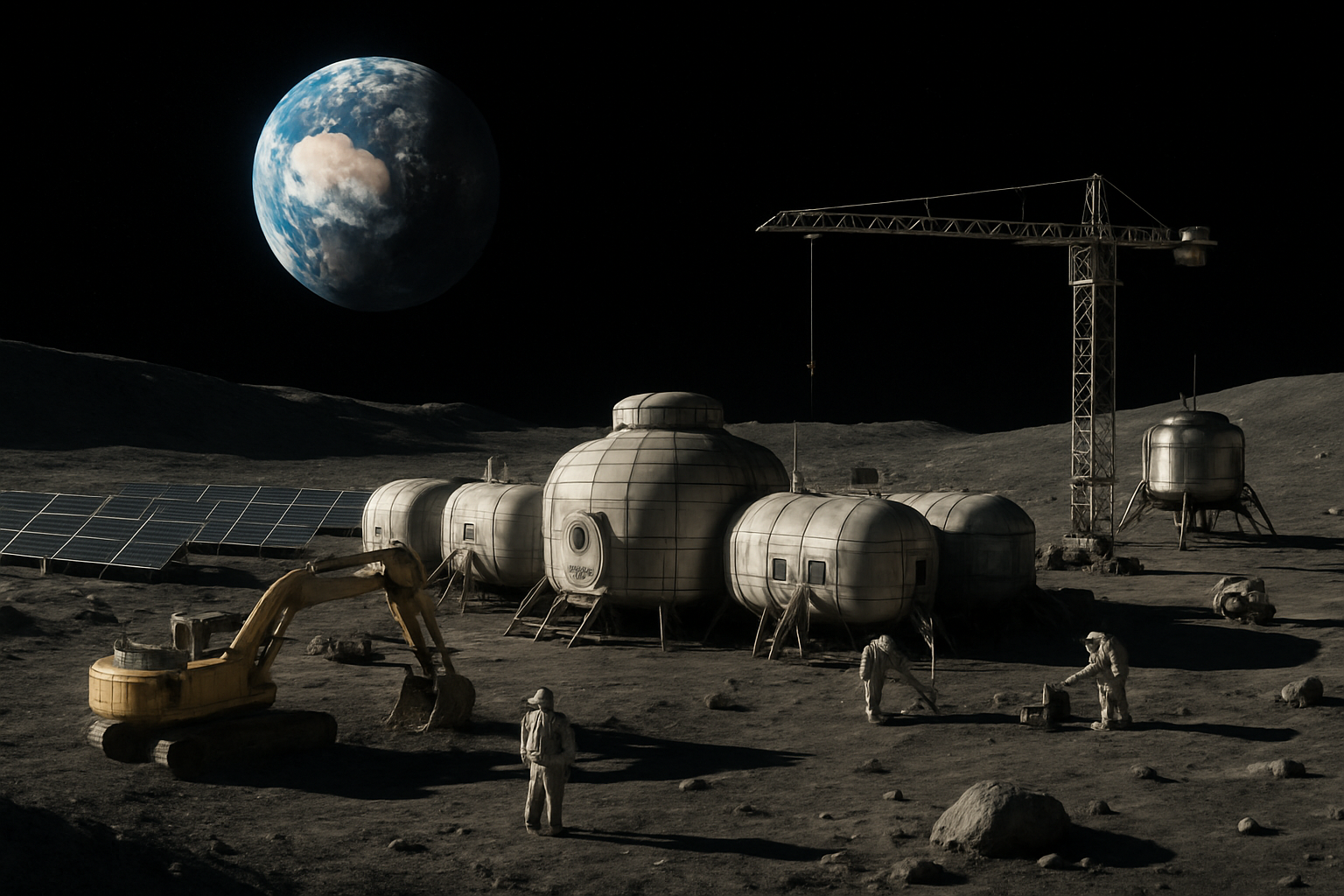
NASA Administrator Jared Isaacman announced on March 24 a strategic pivot that will fundamentally reshape America's lunar exploration strategy, canceling the long-planned Lunar Gateway space station to fund a $20 billion permanent base on the Moon's surface by 2030.
The dramatic shift, announced at NASA headquarters in Washington to contractors and government officials, represents one of the most significant changes to the Artemis program since its inception. The decision responds directly to a December presidential directive demanding accelerated lunar presence capabilities.
Strategic Pivot from Orbit to Surface
"It should not really surprise anyone that we are pausing Gateway in its current form and focusing on infrastructure that supports sustained operations on the lunar surface," Isaacman told delegates at the day-long event outlining the comprehensive overhaul.
The Lunar Gateway station, largely constructed by contractors Northrop Grumman and Vantor (formerly Maxar), was designed as a space station parked in lunar orbit to serve as a staging area for moon missions. Under the new plan, NASA will repurpose many Gateway components for the surface base, though the transition presents significant engineering challenges.
"The new $20 billion project aims to establish a permanent human outpost by 2030, fundamentally changing our approach from temporary visits to sustained presence."
— NASA Administrator Jared Isaacman
Timeline and Technical Challenges
The seven-year timeline represents an ambitious acceleration of lunar surface operations, particularly given the ongoing technical challenges facing the broader Artemis program. The Artemis II mission, originally scheduled for February 2026, has faced multiple delays due to persistent hydrogen leak issues and helium system failures affecting the Space Launch System (SLS) rocket.
The four-astronaut crew—Canadian Jeremy Hansen, NASA's Reid Wiseman, Christina Koch, and Victor Glover—continues to await their historic 10-day lunar flyby, which would mark the first crewed mission beyond Earth orbit since Apollo 17 in December 1972.
International Competition Context
The strategic shift occurs amid intensifying international competition in lunar exploration. China has announced plans for crewed lunar missions by 2030, while their Shenlong reusable spacecraft program continues advancing. Pakistan has selected astronaut candidates for China's Tiangong space station missions planned for October-November 2026, demonstrating the democratization of space capabilities.
European nations are also expanding their space independence through initiatives like Germany's €10 billion SATCOMBw 4 satellite system and Isar Aerospace's Swedish rocket testing facilities, which produce 30 engines monthly.
Economic and Commercial Implications
The announcement coincides with what analysts term the transition from the "AI revolution to space economy golden age." SpaceX is preparing for a potential June 2026 IPO that could value the company at over $1 trillion, while space-based data centers emerge as solutions to the global memory crisis affecting semiconductor manufacturers like Samsung, SK Hynix, and Micron.
The lunar base project represents one of the largest single space infrastructure investments in history, positioning the United States as a leader in the emerging space economy projected to exceed $1 trillion by 2030.
Scientific Research Benefits
The surface base will enable unprecedented scientific research opportunities, building on current International Space Station investigations. French astronaut Sophie Adenot's record eight-month mission is conducting crucial research on lung tissue cultivation and Space-Associated Neuro-Ocular Syndrome (SANS), which affects astronaut vision during extended missions—research directly applicable to permanent lunar settlements.
Recent breakthroughs in lunar agriculture, including successful chickpea cultivation in simulated lunar soil using worm compost and specialized fungi, provide proof-of-concept for sustainable food production on the Moon's surface.
Technical Infrastructure Requirements
The permanent lunar base will require substantial infrastructure development, including:
- Radiation shielding using lunar regolith materials
- In-situ resource utilization for water extraction and oxygen production
- Advanced life support systems tested on the ISS
- Solar power arrays and backup nuclear systems
- Communication networks for real-time Earth contact
- Landing pads for regular cargo and crew rotations
Safety and Lessons Learned
NASA's approach reflects institutional learning from decades of space exploration, including recent challenges. The Boeing Starliner mission was classified as a "Type A" mishap—the same severity level as the Challenger and Columbia disasters—underscoring the agency's renewed focus on comprehensive safety protocols.
The methodical approach prioritizes crew protection over schedule adherence, building long-term confidence in deep space transportation systems essential for sustainable lunar presence.
International Cooperation Framework
Despite competitive dynamics, international cooperation continues through established frameworks. The Artemis Accords provide a foundation for peaceful lunar exploration, with Canadian participation through Jeremy Hansen demonstrating successful partnership integration.
The lunar base project will likely involve international contributions in specialized technologies, scientific instruments, and operational support, similar to the successful ISS model.
Future Mars Implications
The permanent lunar base serves as a crucial stepping stone for Mars exploration, providing a testing ground for technologies and procedures required for interplanetary missions. The Moon's 3-day travel time from Earth enables rapid resupply and emergency response capabilities impossible for Mars missions.
SpaceX's strategic pivot from Mars to lunar colonization, with Elon Musk targeting self-sustaining lunar cities within 10 years, aligns with NASA's surface-focused approach and creates potential for enhanced public-private collaboration.
Looking Forward
The $20 billion lunar base represents more than infrastructure investment—it symbolizes humanity's transition from brief extraterrestrial visits to permanent space settlement. Success will establish precedents for resource utilization, international cooperation, and technological development that could define human expansion throughout the solar system.
As Administrator Isaacman emphasized, the shift from orbiting station to surface base reflects practical recognition that sustainable lunar presence requires robust ground infrastructure rather than temporary orbital waypoints. The 2030 timeline, while ambitious, positions the United States at the forefront of humanity's next giant leap into becoming a truly spacefaring civilization.