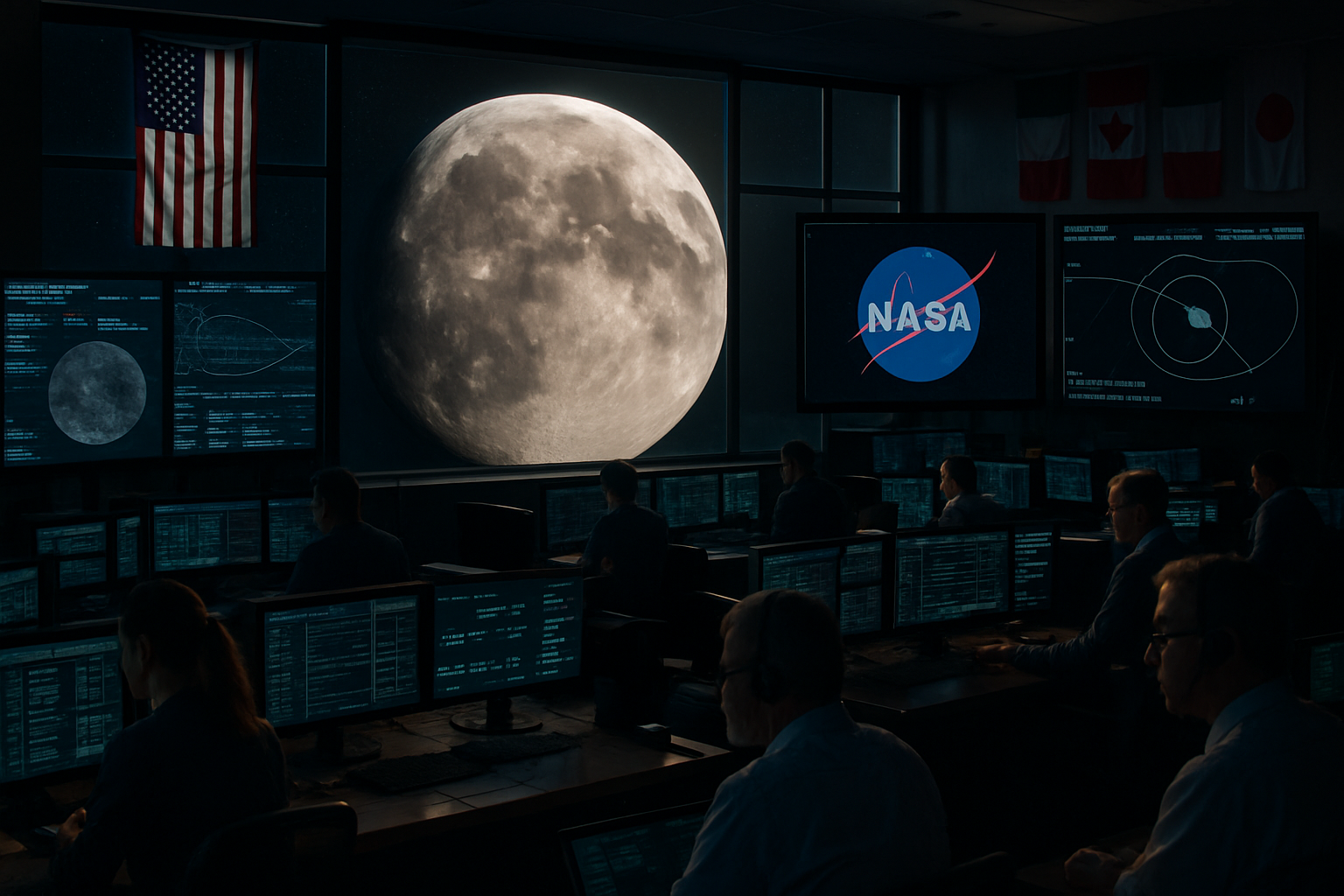
NASA Administrator Jared Isaacman announced on Tuesday a fundamental restructuring of America's lunar exploration strategy, canceling the planned Lunar Gateway orbital station and redirecting $20 billion toward constructing a permanent surface base on the Moon by 2030.
The unprecedented strategic pivot, unveiled during a press conference at Kennedy Space Center, represents the most significant shift in NASA's approach to lunar exploration since the Apollo program concluded in 1972. The decision comes amid intensifying international competition in space, with China planning to deploy lunar crews by 2030 and commercial space companies preparing trillion-dollar market entries.
Strategic Overhaul Details
"We're moving beyond temporary visits to establish a permanent American presence on the lunar surface," Isaacman declared, outlining a seven-year timeline that will repurpose components originally designed for the Lunar Gateway orbital station. The initiative includes plans for nuclear-powered spacecraft development and expanded robotic missions to support the ambitious timeline.
The Gateway cancellation affects major contractors including Northrop Grumman and Vantor, whose orbital station components will now be redesigned for surface infrastructure rather than the planned orbiting outpost. This strategic shift reflects presidential directives issued in December for accelerated lunar presence amid growing international competition.
"The Moon is only the beginning of our cosmic journey, but we must establish sustainable operations there before reaching for Mars."
— Jared Isaacman, NASA Administrator
Nuclear-Powered Mars Ambitions
Concurrent with the lunar base announcement, NASA unveiled plans for Space Reactor 1 Freedom, a nuclear-powered spacecraft designed for Mars exploration. The nuclear system will provide the energy density necessary for interplanetary missions where solar power proves insufficient, representing a critical technological leap for deep space operations.
The nuclear initiative addresses fundamental challenges of sustained space exploration beyond Earth's orbit, where traditional solar power systems face significant limitations. Industry experts suggest nuclear propulsion could reduce Mars transit times while enabling unprecedented operational capabilities on the Red Planet.
Technical Challenges and Artemis Delays
The ambitious lunar base timeline faces significant technical hurdles, exemplified by ongoing delays to the Artemis II mission. Despite targeting an April 1, 2026 launch, the program has encountered persistent hydrogen leak issues and helium system failures affecting the Space Launch System rocket's upper stage.
The four-astronaut Artemis II crew—Canadian Jeremy Hansen, NASA's Reid Wiseman, Christina Koch, and Victor Glover—continues awaiting their historic 10-day lunar flyby, which would mark the first crewed mission beyond Earth orbit since Apollo 17 in December 1972. The mission represents a crucial stepping stone toward the permanent base objectives.
International Competition Intensifies
NASA's strategic acceleration occurs against a backdrop of intensifying global space competition. China's advancing Shenlong reusable spacecraft program and plans for lunar crews by 2030 have prompted American policymakers to reassess timelines and priorities. Pakistan's selection of astronaut candidates for China's Tiangong station, scheduled for October-November 2026, demonstrates the democratization of space capabilities beyond traditional space powers.
European nations are simultaneously pursuing space independence through Germany's €10 billion satellite investments and Isar Aerospace's Swedish facility expansion, capable of testing 30 engines monthly. This technological proliferation creates a complex competitive landscape where sustained lunar presence could determine future resource access and scientific leadership.
Canadian Partnership Implications
The Gateway cancellation creates uncertainty for Canadian space industry contributions, particularly the Canadarm3 robotic system developed by MDA Systems in Brampton, Ontario. While Jeremy Hansen's participation in Artemis missions continues, Canada's broader space industry must adapt to the surface-focused strategy.
Canadian officials express confidence that bilateral partnerships will continue, with potential roles in lunar base construction and operations. The shift from orbital to surface infrastructure may actually enhance Canadian involvement in permanent settlement establishment rather than temporary orbital facilities.
Scientific and Economic Implications
The permanent lunar base strategy builds upon critical research conducted aboard the International Space Station, including Sophie Adenot's record eight-month mission focusing on lung tissue cultivation and Space-Associated Neuro-Ocular Syndrome studies. This space medicine research directly informs protocols necessary for extended lunar habitation.
Economic implications extend beyond the $20 billion commitment, potentially positioning the United States for leadership in emerging space economy markets projected to exceed $1 trillion by 2030. Permanent lunar presence enables resource extraction, technology demonstration, and Mars crew training while establishing strategic space economy positioning.
Technical Requirements and Challenges
Establishing a permanent lunar base requires solving fundamental challenges including radiation shielding, in-situ resource utilization, and advanced life support systems. The lunar environment presents extreme temperature variations, micrometeorite impacts, and radiation exposure levels that demand sophisticated habitat design and construction techniques.
Recent breakthroughs in lunar agriculture, including successful chickpea cultivation in simulated lunar regolith, provide encouraging signs for self-sustaining operations. These developments suggest biological life support systems could complement technological solutions for permanent settlement viability.
Governance and International Frameworks
Permanent lunar settlement raises complex governance questions requiring new international agreements addressing resource utilization, environmental protection, and peaceful space use. The existing Artemis Accords provide a foundation, but permanent habitation demands detailed frameworks for territorial claims, resource sharing, and emergency protocols.
Thailand's current leadership of UN space governance initiatives highlights the global interest in establishing sustainable space exploration frameworks. These diplomatic efforts become increasingly critical as multiple nations pursue lunar capabilities simultaneously.
Timeline and Future Prospects
The 2030 target timeline requires resolving current Artemis technical issues, establishing reliable cargo delivery systems, and constructing radiation-hardened habitats capable of supporting human life indefinitely. Success would mark humanity's transition from temporary space visits to permanent cosmic settlement, establishing foundations for eventual Mars colonization.
This strategic pivot represents NASA's most significant programmatic change since Space Shuttle retirement, reflecting both technical realities and competitive pressures. The permanent lunar base could serve as humanity's first extraterrestrial city, fundamentally altering our species' relationship with the cosmos while preparing for eventual interplanetary expansion.