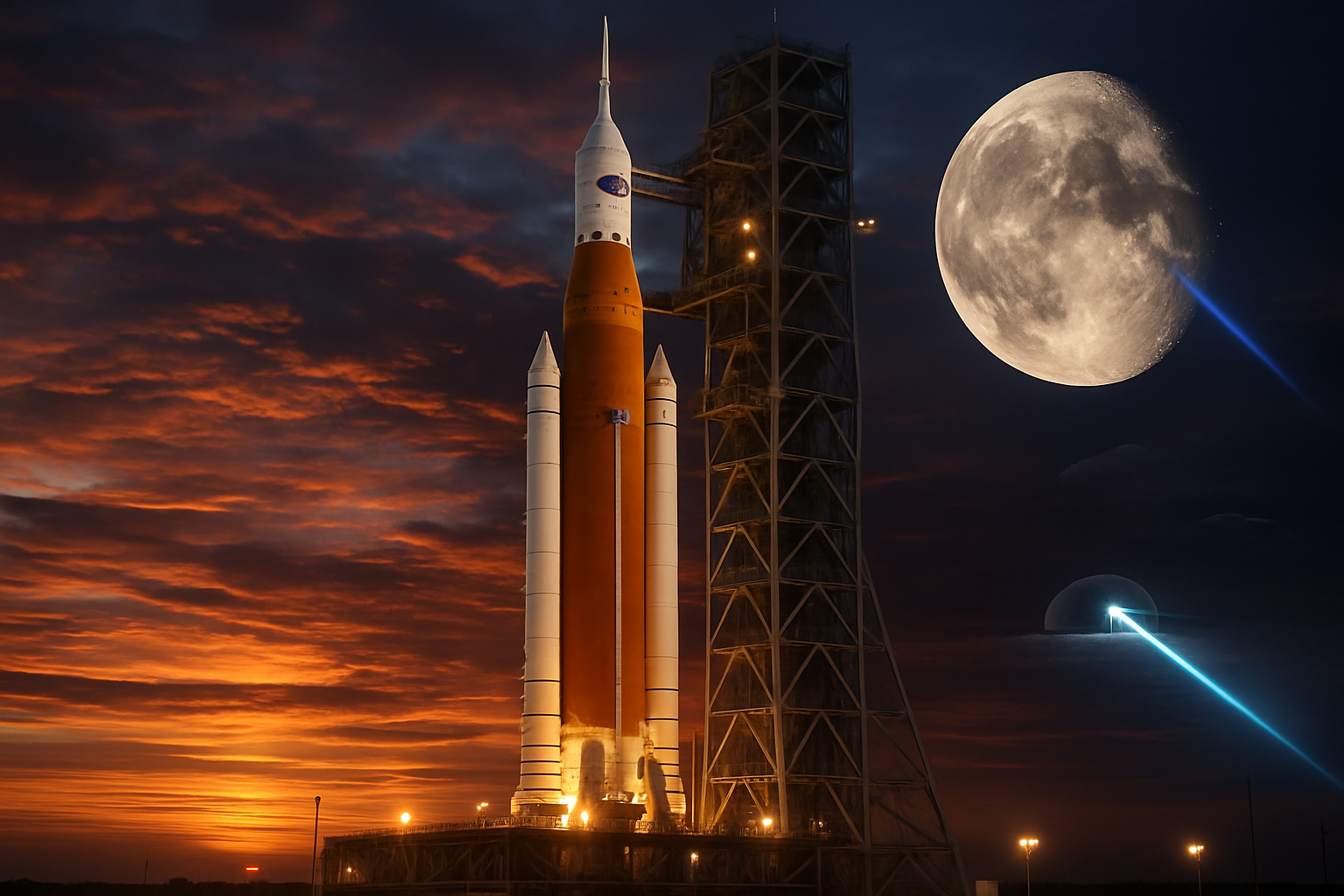
NASA has successfully completed crucial launch rehearsals for its upcoming Artemis II lunar mission in February 2026, marking a significant milestone in humanity's return to the Moon despite ongoing technical challenges with spacecraft systems and a sobering reassessment of past mission failures.
The space agency conducted a successful rehearsal of launch events for the Artemis II mission that will carry four astronauts, including Canadian Space Agency's Jeremy Hansen alongside NASA crew members Reid Wiseman, Christina Koch, and Victor Glover, around the Moon in what represents the first crewed mission beyond Earth orbit since Apollo 17 in 1972.
Artemis Program Shows Resilience Despite Technical Hurdles
The successful rehearsal comes as NASA continues to address persistent hydrogen leak issues that have delayed the mission multiple times. Originally scheduled for February, Artemis II has been pushed to March 2026 as engineers work to resolve fuel system problems identified during wet dress rehearsal testing. The delays underscore NASA's commitment to safety-first protocols, with teams refusing to proceed until all technical concerns are fully addressed.
"We will only launch when we believe we are ready," NASA Administrator Jared Isaacman emphasized, reflecting lessons learned from previous space tragedies. The approach demonstrates how the agency has evolved its risk management philosophy, prioritizing astronaut safety over schedule pressures even as international partners await the historic lunar flyby.
"This is a critical stepping stone to Artemis III lunar landing planned for 2027, establishing the foundation for sustained lunar presence."
— NASA Mission Operations
Revolutionary Lunar Navigation Technology Proposed
While NASA prepares for its return to lunar orbit, international scientists are proposing groundbreaking technologies that could revolutionize future lunar operations. Researchers have unveiled plans to construct an ultra-stable laser system inside a lunar crater, designed to assist future missions in landing safely during periods of darkness and navigating the surface with unprecedented precision.
This innovative approach would create the first permanent navigation beacon on the Moon's surface, potentially transforming how spacecraft approach and land on Earth's celestial neighbor. The laser system could also serve dual purposes, with scientists suggesting it might revolutionize timekeeping systems on Earth through its ultra-stable light source capabilities.
The proposal, detailed in research papers, represents a convergence of multiple space technologies: precision optics, power generation systems capable of operating in the lunar environment, and advanced positioning algorithms that could guide spacecraft with centimeter-level accuracy.
Space Safety Under Intense Scrutiny
NASA's commitment to enhanced safety protocols has been reinforced by a comprehensive review of past mission failures. The agency recently released a highly critical assessment of Boeing's Starliner spacecraft mission in 2024, which left two astronauts stranded in space. The evaluation classified the incident as a "Type A" mishap—the same severity level assigned to the Challenger and Columbia shuttle disasters.
The report detailed what NASA called "engineering vulnerabilities" in Boeing's spacecraft design, coupled with internal agency mistakes that contributed to the mission's failure. This frank assessment demonstrates NASA's determination to learn from past errors and implement systemic improvements across all spaceflight programs, including the Artemis initiative.
The classification reflects NASA's recognition of the "potential for a significant mishap," emphasizing how close the Starliner mission came to catastrophic failure. This thorough review process directly informs safety protocols being applied to Artemis missions, where crew safety remains the absolute priority.
International Space Collaboration Continues
The Artemis II mission exemplifies international cooperation in space exploration, with Canadian astronaut Jeremy Hansen representing a key partnership that extends beyond national boundaries. Canada's participation brings specialized expertise in robotic systems and advanced life support technologies developed through decades of International Space Station operations.
This collaborative approach occurs within a broader context of expanding global space capabilities. Recent developments include successful Chinese spacecraft launches, European rocket testing facilities, and emerging nations like Pakistan selecting astronaut candidates for missions to China's Tiangong space station, demonstrating the democratization of space access.
Technology Integration and Future Implications
The current wave of space technology advancement represents a convergence of artificial intelligence, advanced materials science, and precision engineering. NASA's recent success with fully AI-planned Mars rover missions in December 2025 showcased how autonomous systems can operate effectively across cosmic distances, reducing dependence on Earth-based control systems.
These technological capabilities directly support Artemis mission objectives, enabling spacecraft to make real-time navigation decisions and respond to unexpected situations without waiting for instructions across the 240,000-mile distance to Earth. The integration of AI systems with human crew operations represents a fundamental evolution in space exploration methodology.
Moreover, the proposed lunar laser navigation system would create infrastructure supporting not just NASA missions but potentially international lunar operations, establishing the Moon as a staging ground for deeper space exploration to Mars and beyond.
Economic and Strategic Implications
The advancement of space technologies occurs during what industry analysts describe as the transition from the "AI revolution to space economy golden age." Commercial space companies are preparing major public offerings, with SpaceX reportedly considering a June 2026 IPO that could value the company at over $1 trillion.
This commercial growth complements government space programs, creating a dynamic ecosystem where public and private sectors collaborate on increasingly ambitious projects. The success of Artemis missions could catalyze broader commercial lunar activities, from resource extraction to space-based manufacturing and tourism.
NASA's systematic approach to safety, demonstrated through rigorous testing and frank assessments of past failures, builds confidence among international partners and commercial entities considering substantial investments in space infrastructure.
Looking Toward Sustainable Lunar Presence
The current technical advances represent more than individual achievements—they establish the foundation for sustained human presence beyond Earth. The combination of reliable transportation systems (Artemis), advanced navigation infrastructure (lunar lasers), and robust safety protocols positions humanity for a new era of space exploration.
Future missions will build upon these capabilities, potentially establishing permanent lunar bases that serve as stepping stones for Mars exploration and deeper space missions. The technologies being developed today will determine whether humanity can successfully transition from brief lunar visits to permanent extraterrestrial settlements.
As NASA prepares for the March 2026 Artemis II launch, the successful completion of launch rehearsals signals that despite technical challenges and sobering lessons from past failures, the agency remains committed to advancing human space exploration through methodical, safety-focused approaches that honor both the risks and rewards of venturing beyond our home planet.