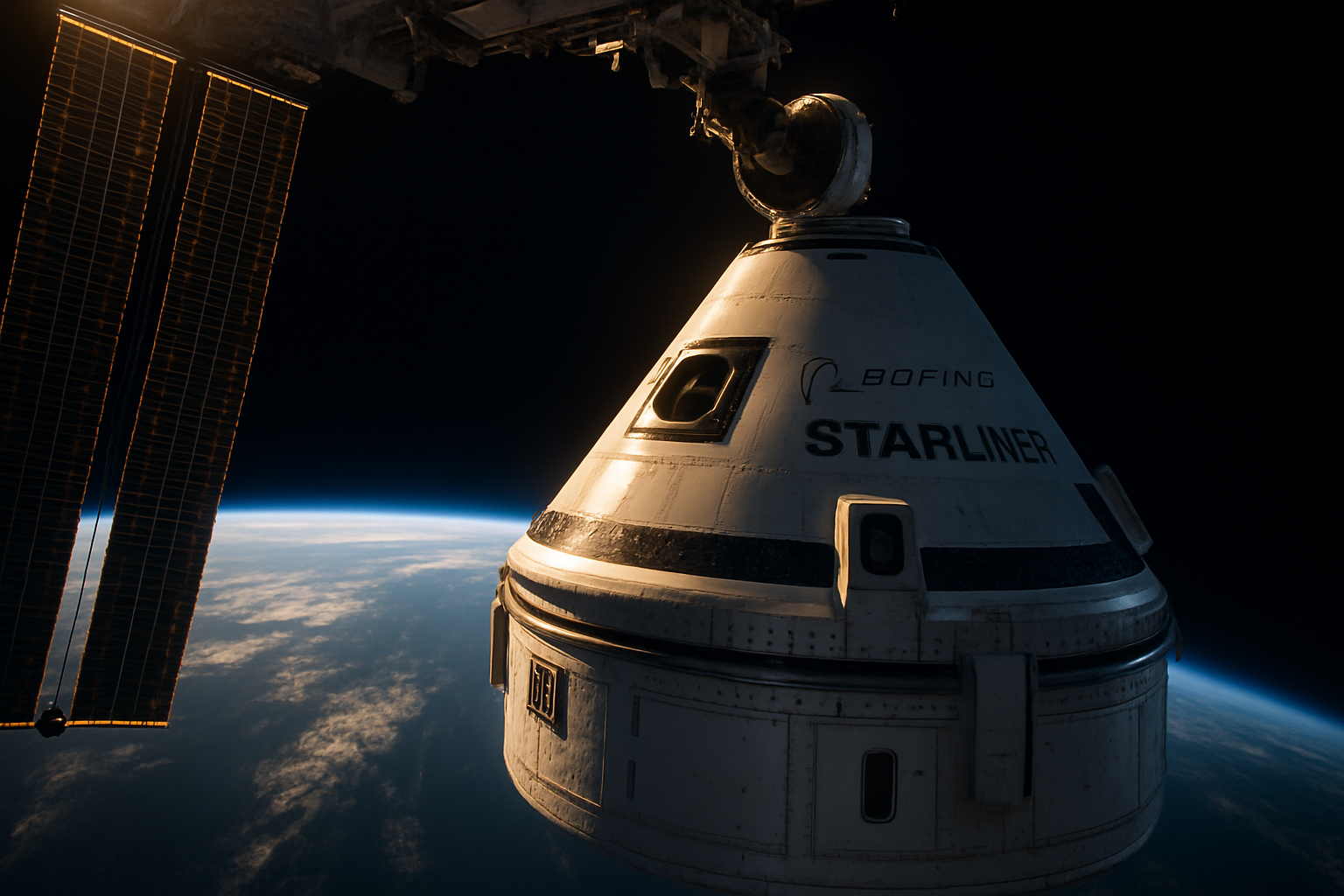
NASA has released a detailed investigation report into the Boeing Starliner mission failure that resulted in two astronauts spending nine months aboard the International Space Station instead of the originally planned one-week duration, marking one of the most significant mission extensions in space exploration history.
The comprehensive report, published February 21, 2026, provides unprecedented insight into the technical failures and decision-making processes that transformed what should have been a routine crew rotation into an extended orbital stay. The investigation reveals a cascade of engineering problems and institutional shortcomings that prevented the safe return of Boeing astronauts Butch Wilmore and Suni Williams.
Mission Classification and Safety Implications
According to NASA's internal assessment system, the Starliner mission has been classified as a "Type A" mishap - the same severity level assigned to the Space Shuttle Challenger and Columbia disasters. This classification underscores the gravity of the situation and places the Starliner failure among NASA's most serious operational setbacks in decades.
The report details "engineering vulnerabilities" within Boeing's spacecraft systems, coupled with "internal agency mistakes" that contributed to the astronauts' unplanned extended stay. These findings represent a stark acknowledgment of systemic issues affecting both contractor performance and NASA oversight capabilities.
"This comprehensive review demonstrates NASA's commitment to safety-first culture and our willingness to examine our own processes with complete transparency,"
— NASA Administrator, Mission Safety Review
Technical Failures and Engineering Challenges
The investigation identified multiple technical failures across Starliner's critical systems. Primary among these were propulsion system anomalies that prevented normal de-orbit procedures, life support complications that required constant monitoring, and communication system irregularities that hampered ground-based mission control operations.
Boeing's Starliner, designed as NASA's second commercial crew capability alongside SpaceX's Dragon capsule, experienced thruster failures during approach to the ISS. The spacecraft's reaction control system thrusters, essential for precise orbital maneuvering and safe return to Earth, exhibited unexpected performance degradation that made autonomous return too risky.
Additional complications arose from helium leaks in the propulsion system, software glitches affecting automated docking procedures, and thermal management issues that emerged during extended orbital operations. These technical problems compounded to create a situation where NASA determined the safest option was to keep the astronauts aboard the ISS until alternative return arrangements could be made.
Broader Space Industry Context
The Starliner mission failure occurs during what space industry analysts term the "space economy golden age" - a period of unprecedented commercial space activity and international cooperation. However, the incident highlights persistent challenges in transitioning from government-led space programs to commercial partnerships.
This setback contrasts sharply with recent space exploration successes, including NASA's achievement of fully AI-planned Mars rover missions in December 2025, the successful restoration of ISS operations to full seven-person capacity through SpaceX Crew-12, and the ongoing preparation for Artemis II's historic lunar flyby scheduled for March 2026.
The extended mission duration provided unexpected research opportunities for space medicine studies, including crucial investigations into Space-Associated Neuro-Ocular Syndrome (SANS) and lung tissue cultivation research essential for future lunar settlements and Mars exploration. These studies, while unplanned, contribute valuable data for long-duration spaceflight preparation.
International Space Cooperation Continues
Despite the Starliner challenges, international space cooperation has demonstrated remarkable resilience. The ISS continues operating with crew members from NASA, ESA, and Roscosmos, exemplifying sustained collaboration amid terrestrial tensions. Recent milestones include French astronaut Sophie Adenot's historic eight-month mission and Pakistan's selection of astronaut candidates for China's Tiangong station.
The space industry is experiencing remarkable diversification, with emerging nations gaining capabilities through educational initiatives and strategic partnerships. Thailand's appointment as UN space governance chair, Germany's Isar Aerospace expanding rocket testing facilities in Sweden, and breakthrough astronomical discoveries from international teams demonstrate the increasingly global nature of space exploration.
Safety-First Culture Evolution
NASA's frank assessment of the Starliner mission reflects the agency's evolution toward a more transparent safety culture following historical tragedies. The willingness to classify this mission as a Type A mishap and publicly acknowledge internal mistakes demonstrates institutional learning and commitment to continuous improvement.
This approach aligns with NASA's broader safety-first philosophy evident in recent Artemis II delays due to hydrogen leak issues. Rather than rushing to meet arbitrary deadlines, the agency prioritizes astronaut safety and mission success, building confidence among international partners and commercial providers.
The investigation's findings will directly influence future commercial crew program oversight, Boeing's Starliner improvements, and NASA's risk assessment protocols. Lessons learned from this extended mission will enhance safety measures for upcoming deep space missions, including lunar exploration and eventual Mars expeditions.
Technology Integration and Future Implications
The space industry's transition period showcases remarkable technological convergence. AI integration in space operations, demonstrated through autonomous Mars rover navigation and weather satellite forecasting, provides new capabilities for mission planning and real-time decision-making across cosmic distances.
Space-based infrastructure development, driven by global memory crisis and semiconductor shortages, represents a paradigm shift toward orbital computing capabilities. Companies like SpaceX are exploring space-based data centers as solutions to terrestrial constraints, potentially revolutionizing both space operations and Earth-based computing.
These developments occur alongside breakthrough scientific discoveries, including detection of cosmic rays in star-forming regions 400 light-years away, identification of the largest sulfur-containing organic molecules in interstellar space, and revelations about Jupiter's actual size from NASA's Juno mission.
Looking Forward: Lessons and Adaptations
The Starliner mission failure, while disappointing, provides crucial data for improving human spaceflight safety and reliability. NASA's comprehensive investigation establishes new standards for commercial crew oversight and demonstrates the agency's commitment to learning from setbacks.
As the space industry prepares for an unprecedented expansion of human presence beyond Earth orbit, including permanent lunar settlements and Mars exploration, the lessons from this extended mission will prove invaluable. The experience gained from nine months of unplanned orbital operations contributes to understanding long-duration spaceflight challenges and solutions.
The convergence of commercial capabilities, international cooperation, and scientific discovery positions humanity for an era of sustained space exploration. Despite setbacks like the Starliner mission, the trajectory toward a spacefaring civilization continues, guided by hard-won experience and unwavering commitment to safety.