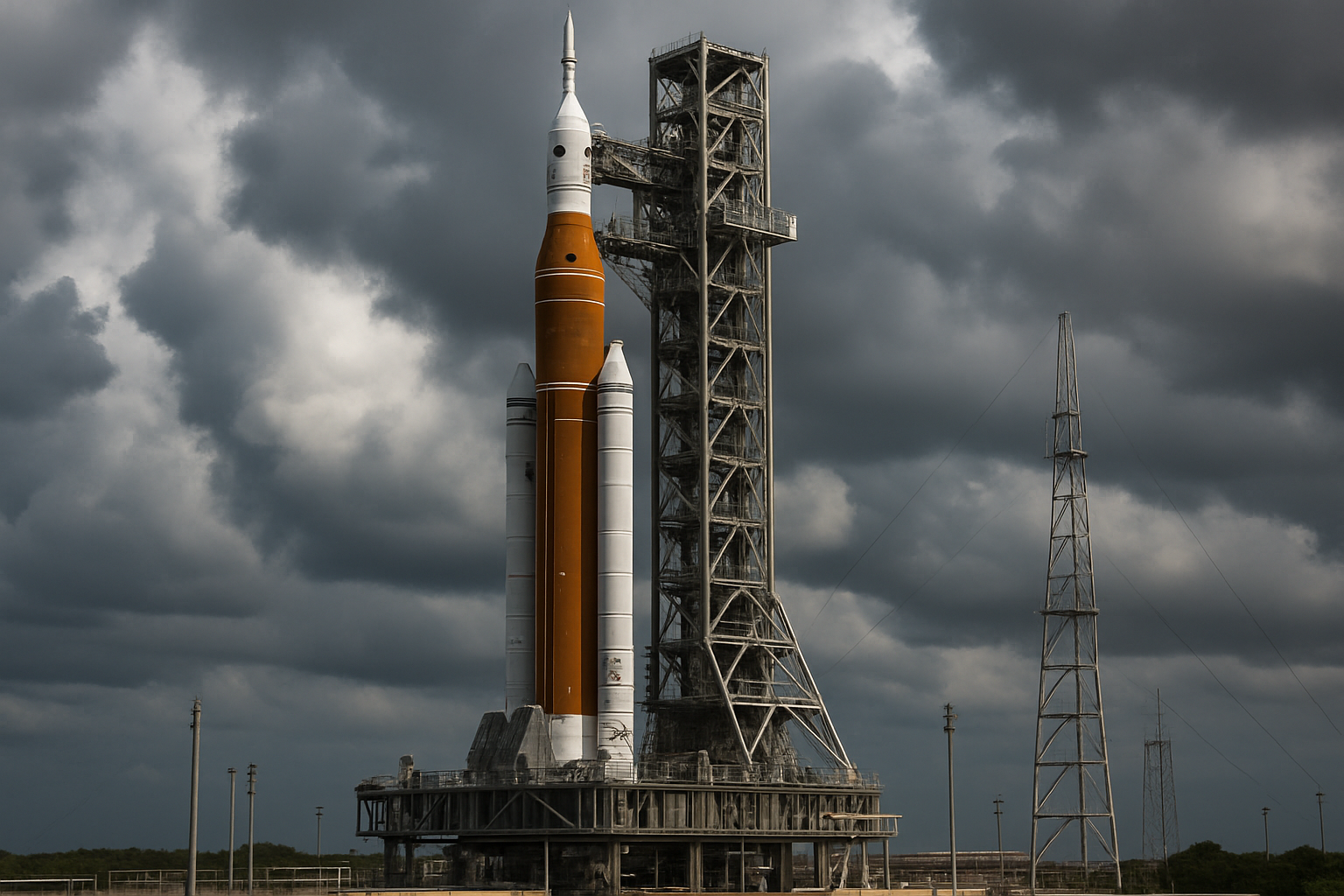
NASA is targeting early March 2026 to launch the historic Artemis II mission, sending four astronauts on humanity's furthest journey into space in more than half a century. The lunar flyby represents a critical milestone in America's return to the Moon, though the mission has faced repeated delays due to persistent technical challenges with the Space Launch System rocket.
The announcement comes as NASA Administrator Jared Isaacman continues to emphasize the agency's safety-first approach, stating "we will only launch when we believe we are ready." This philosophy has guided the mission through multiple postponements from its original February 2026 launch window, as engineers work to resolve complex technical issues that have plagued the program.
Mission Details and Historic Significance
Artemis II will carry four astronauts on a 10-day journey around the Moon, covering approximately 600,000 miles in what will be the first crewed mission beyond Earth orbit since Apollo 17 in December 1972. The international crew includes Canadian Space Agency astronaut Jeremy Hansen alongside three NASA astronauts: Reid Wiseman (commander), Christina Koch, and Victor Glover.
The mission utilizes NASA's most powerful rocket ever built - the 322-foot Space Launch System (SLS) - paired with the Orion spacecraft. When fully fueled, the massive rocket system weighs 5.75 million pounds and requires more than 700,000 gallons of liquid hydrogen and liquid oxygen propellants.
This lunar flyby serves as a crucial stepping stone toward Artemis III, planned for 2027, which aims to land the first humans on the Moon since the Apollo era. The success of Artemis II is essential for establishing sustainable lunar exploration capabilities and eventual Mars missions.
Technical Challenges and Safety Priorities
The mission has faced significant technical hurdles, particularly with the SLS rocket's complex propulsion systems. Recent delays stem from persistent hydrogen leak issues discovered during wet dress rehearsal testing, where teams load the rocket with propellants and conduct full countdown simulations.
Additional concerns have emerged with helium system failures affecting the rocket's upper stage - critical components responsible for engine purging and fuel tank pressurization. These safety-critical functions cannot be compromised, requiring methodical resolution before NASA approves crew launch.
"The hydrogen leak problems during wet dress rehearsal testing that caused the initial February to March delay demonstrate our commitment to comprehensive testing over schedule pressure."
— NASA Engineering Team Assessment
The technical complexity extends beyond the rocket itself. NASA recently released a comprehensive analysis of Boeing's Starliner mission, classified as a "Type A" mishap - the same severity level as the Challenger and Columbia disasters. This assessment reinforces NASA's institutional commitment to learning from past tragedies while maintaining rigorous safety standards.
International Cooperation and Global Context
The Artemis II mission exemplifies international space cooperation, particularly through Canadian Space Agency participation via Jeremy Hansen. This collaboration builds upon successful models established through International Space Station operations, despite intensifying global space competition.
The mission occurs during what industry analysts describe as a transition from the "AI revolution to space economy golden age." Major developments include SpaceX's preparation for a potential June 2026 IPO valued over $1 trillion, China's advancing Shenlong reusable spacecraft program, and Pakistan's selection of astronaut candidates for China's Tiangong station mission scheduled for October-November 2026.
European space capabilities continue expanding through Germany's Isar Aerospace, which is constructing rocket testing facilities in Sweden capable of testing 30 engines monthly. These developments underscore the democratization of space technology and the growing global competition in human spaceflight capabilities.
Scientific and Strategic Implications
Beyond its symbolic importance, Artemis II will validate critical deep space systems including life support, radiation protection, and navigation capabilities operating beyond Earth's protective magnetic field. The mission provides essential data for future lunar base construction and Mars exploration preparations.
Research conducted during the mission will build upon recent International Space Station achievements, including Sophie Adenot's record-setting eight-month European astronaut mission. Current ISS research focuses on lung tissue cultivation and Space-Associated Neuro-Ocular Syndrome (SANS) studies - both crucial for understanding human adaptation to extended space missions.
The timing coincides with remarkable astronomical events, including the six-planet alignment scheduled for February 28, 2026, featuring Mercury, Venus, Mars, Jupiter, Saturn, and Uranus. This celestial convergence adds symbolic significance to humanity's renewed lunar exploration efforts.
Economic and Industry Impact
The Artemis program represents billions of dollars in space infrastructure investment, supporting thousands of jobs across multiple states and international partners. Success will validate NASA's Space Launch System as a reliable deep space transportation system, potentially opening commercial opportunities for lunar missions.
The mission occurs amid a global memory crisis, with semiconductor prices increasing sixfold, driving interest in space-based data center development. Companies like SpaceX are exploring extraterrestrial computing infrastructure, highlighting the convergence of space exploration with commercial technology needs.
Economic implications extend beyond direct space industry benefits. Successful lunar missions could accelerate resource extraction capabilities, space-based manufacturing, and tourism opportunities, contributing to what experts project will become a trillion-dollar space economy.
Looking Toward the Future
Artemis II represents more than a single mission - it embodies humanity's commitment to expanding beyond Earth despite significant technical and financial challenges. The methodical approach to problem-solving, prioritizing crew safety over schedule adherence, demonstrates institutional maturity gained from decades of human spaceflight experience.
The mission's success will enable the next phase of human space exploration, including permanent lunar settlements and eventual Mars missions. Recent achievements in AI-planned Mars rover missions and autonomous navigation capabilities suggest that human crews will be supported by unprecedented technological capabilities.
As NASA prepares for this historic launch, the agency continues building on lessons learned from both successes and failures. The comprehensive safety assessments, international cooperation frameworks, and technological innovations established through Artemis II will serve as foundations for humanity's expansion into the solar system.
With March 2026 now targeted as the launch window, the world watches as NASA prepares to write the next chapter in human space exploration, carrying the hopes and ambitions of nations united in the pursuit of cosmic discovery.