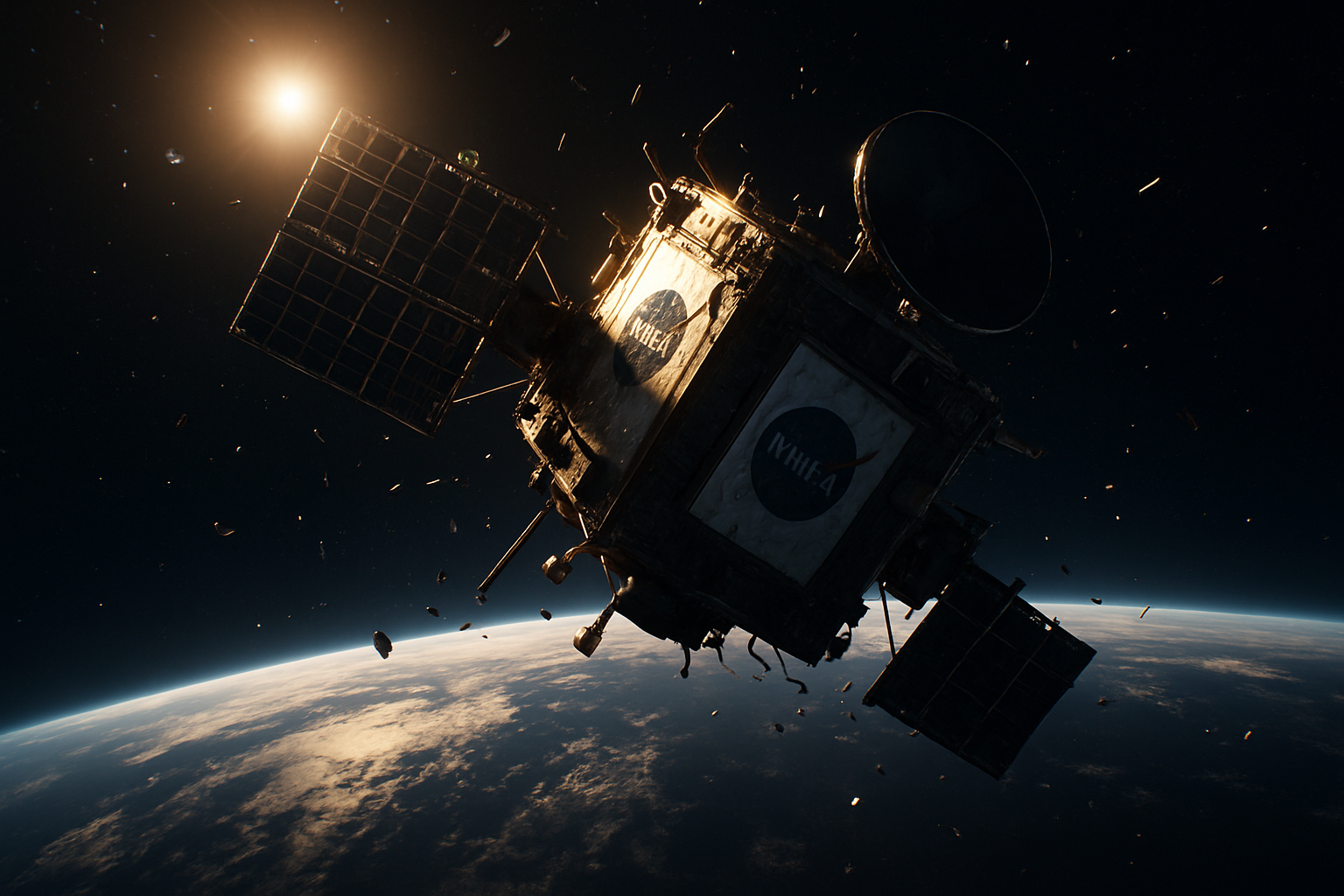
A 600-kilogram NASA space probe designed for an eight-year mission is careening toward Earth in an uncontrolled descent, while a critical Russian communications satellite has mysteriously failed, exposing the mounting vulnerabilities facing space infrastructure as the industry transitions into what analysts call the "space economy golden age."
NASA's Van Allen Probe A, traveling at speeds exceeding 27,000 kilometers per hour, is expected to transform into a fireball during atmospheric reentry. While most of the spacecraft will disintegrate, some fragments may survive to impact Earth's surface, according to mission controllers who are providing real-time tracking updates.
Cascading Satellite Failures Threaten Critical Infrastructure
The Van Allen Probe crisis coincides with Russia's announcement that its state-owned Express-AT1 communications satellite stopped functioning abruptly on March 4 for unknown reasons, disrupting television services for Russian providers. The timing of these failures underscores growing concerns about the resilience of space-based infrastructure that modern civilization increasingly depends upon.
The Russian Satellite Communications Company's terse statement provided no explanation for the Express-AT1 failure, leaving industry analysts to speculate whether the malfunction stems from technical issues, space debris impacts, or other factors affecting orbital operations.
"The space environment is becoming dangerously overcrowded with over 34,000 tracked objects larger than 10 centimeters, plus millions of smaller untrackable debris pieces capable of catastrophic damage at 17,500 mph orbital speeds,"
— Holger Krag, ESA Space Safety Programme Director
From Experimental to Essential: The New Space Economy
These incidents occur during what experts describe as a pivotal transition from the "AI revolution" (2020-2025) to the "space economy golden age," with commercial space activities shifting from experimental ventures to essential infrastructure supporting global communications, navigation, weather forecasting, and emerging technologies.
The European Space Agency has been developing active debris removal technologies, including "space janitor" spacecraft equipped with robotic arms and nets to capture defunct satellites for controlled atmospheric reentry. However, such systems would be overwhelmed by the proposed scale of future satellite constellations, with SpaceX alone considering deploying up to one million satellites.
NASA's breakthrough DAGGER AI system now enables 30-minute geomagnetic storm predictions, protecting satellite infrastructure worth billions of dollars. This technological advance becomes increasingly critical as space-based systems become integral to modern civilization's functioning.
International Competition and Cooperation at Crossroads
The satellite failures highlight tensions between growing international space competition and the need for coordinated approaches to space safety. While companies like SpaceX prepare for a potential trillion-dollar IPO in June 2026, and China advances its Shenlong reusable spacecraft program, the fundamental challenges of operating in the hostile space environment affect all nations equally.
Pakistan's historic selection of astronaut candidates for China's Tiangong space station mission in October-November 2026 demonstrates the democratization of space capabilities. Thailand's leadership of UN space governance initiatives reflects emerging nations' growing influence in establishing international frameworks for space activities.
However, the Van Allen Probe and Express-AT1 incidents underscore that technological sophistication alone cannot eliminate the inherent risks of space operations.
Technical Challenges Mount Amid Rapid Expansion
The Van Allen Probe's premature mission end comes as NASA faces delays with its Artemis II lunar mission due to persistent hydrogen leak issues and helium system failures. The complexity of operating in space becomes apparent as even routine missions encounter unexpected technical challenges.
Austrian scientists have documented the first direct measurements of atmospheric pollution from rocket debris, finding lithium concentrations elevated tenfold above normal levels. This environmental impact assessment becomes increasingly important as launch frequency accelerates to support expanding satellite constellations.
The global memory crisis, with semiconductor prices increasing sixfold, has driven interest in space-based data centers as a solution. However, the reliability issues demonstrated by recent satellite failures raise questions about the resilience of such ambitious space-based infrastructure projects.
Economic Stakes Rise as Dependencies Deepen
The economic implications of satellite failures are becoming more severe as society's dependence on space-based services deepens. Modern agriculture, transportation, emergency services, and financial systems all rely heavily on satellite communications and GPS navigation that remain vulnerable to technical failures, space debris, and solar storms.
SpaceX's strategic pivot from Mars colonization to lunar city development within 10 years reflects industry maturation toward achievable near-term objectives. However, the fundamental challenges of operating safely in space remain whether missions target low Earth orbit or deep space destinations.
Prevention vs. Reaction: The Critical Choice Ahead
Industry experts warn that the window for implementing effective space debris remediation is narrowing rapidly. The current approach of reactive damage control may prove inadequate as the number of active satellites and space debris continues to multiply exponentially.
Success in managing the space environment will determine humanity's long-term access to space for communications, navigation, weather monitoring, and scientific research systems that have become essential to modern civilization. Failure could create a cascade effect that renders orbital regions unusable, potentially trapping civilization on Earth and cutting off space-based infrastructure.
International cooperation, sustained funding, and political will prioritizing sustainability over short-term commercial interests will be essential for addressing what many consider the most critical technological and policy challenge determining the future of human-space relationships.
Looking Ahead: Balancing Innovation with Responsibility
As the Van Allen Probe continues its uncontrolled descent toward Earth and investigators work to understand the Express-AT1 failure, the space industry faces fundamental questions about balancing rapid expansion with long-term sustainability.
The transition to the "space economy golden age" demands not only technological innovation but also the development of comprehensive regulatory frameworks, international coordination mechanisms, and environmental protection standards that can keep pace with the accelerating commercialization of space.
The next few months will be critical in determining whether the space industry can successfully navigate these challenges while maintaining the momentum that has made 2026 a watershed year for human space activities. The stakes could not be higher for humanity's cosmic future.