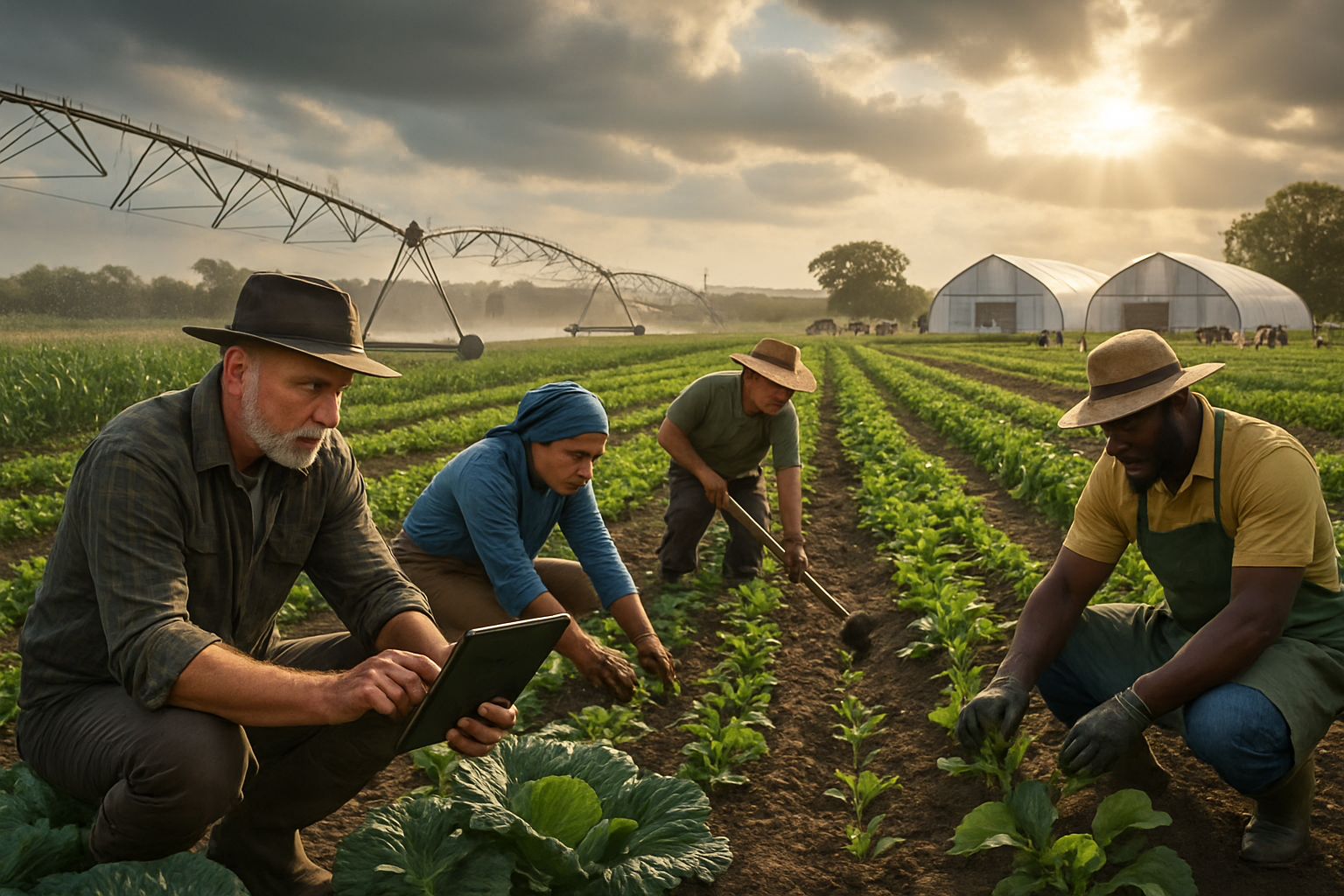
Nations across three continents are implementing ambitious agricultural programs aimed at strengthening food security, with Guyana expanding its Black Belly Sheep initiative to over 3,000 animals, Qatar rolling out comprehensive supply chain strategies, and Nicaragua maintaining stable food prices during a period of global agricultural transformation.
The coordinated agricultural development efforts come during the 20th consecutive month of global temperatures exceeding 1.5°C above pre-industrial levels, demonstrating nations' determination to adapt their food systems to unprecedented climate pressures while building domestic production capacity.
Guyana's Livestock Revolution
Guyana's Black Belly Sheep programme has achieved remarkable success since its launch in Region Five in March 2022, with the national herd now exceeding 3,000 animals. Agriculture Minister Zulfikar Mustapha revealed this milestone during meetings with a Barbados delegation led by Minister Dr. Shantal Munro-Knight.
The programme represents a strategic shift toward developing a regional Caribbean brand of mutton through sophisticated cross-breeding techniques. This initiative directly addresses the region's food security challenges by reducing dependence on mutton imports while creating sustainable rural employment opportunities.
"The success of our Black Belly Sheep programme demonstrates how traditional livestock management combined with modern breeding techniques can create food security solutions that benefit entire regions," said an official familiar with the programme.
Qatar's Multi-Tiered Food Security Strategy
Qatar has implemented a comprehensive multi-tiered strategy through Hassad Food to reinforce national food security and maintain stable supply chains. The initiative focuses on enhanced monitoring systems, strategic supply chain investments, and robust contingency planning to ensure stable food availability across the emirate.
The programme addresses vulnerabilities exposed by recent global supply chain disruptions, incorporating lessons from the ongoing Middle East energy crisis that has affected food distribution networks throughout the Gulf region. Qatar's approach emphasizes diversification of supply sources and strategic stockpiling to maintain food accessibility during periods of international volatility.
The timing of these initiatives coincides with broader regional food security challenges, as Iran's indefinite suspension of agricultural exports in early March created supply gaps that required rapid adaptation by importing nations throughout the Middle East.
Nicaragua's Price Stabilization Success
Nicaragua's Ministry of Industry, Commerce and Development (MIFIC) has successfully maintained stable prices for basic food basket products, providing crucial economic relief for Nicaraguan families during a period of global food price volatility. The price stability achievement represents sophisticated market management during challenging economic conditions.
This accomplishment contrasts sharply with global food inflation trends affecting many regions worldwide. New Zealand recently experienced 4.5% annual food price increases, with beef mince recording the largest price surge in two decades at 23.2% year-over-year growth.
Nicaragua's success demonstrates how strategic domestic policies can insulate populations from international food price pressures, providing templates for other nations seeking to protect vulnerable communities from market volatility.
Technology-Traditional Knowledge Integration
The agricultural initiatives across all three nations demonstrate sophisticated integration of cutting-edge technology with traditional farming wisdom. This approach has proven more effective than purely technological solutions that ignore local agricultural knowledge and community structures.
Guyana's breeding programme combines modern genetic selection with established Caribbean livestock management practices. Qatar's supply chain strategy incorporates advanced logistics technology while maintaining traditional trading relationships that have sustained the region for generations.
"The most successful agricultural adaptations combine modern innovation with generations of farming wisdom, creating hybrid approaches that respect cultural contexts while incorporating beneficial innovations."
— Agricultural Development Expert
South-South Cooperation Emergence
These initiatives reflect a broader trend toward South-South cooperation in agricultural development, where developing nations share expertise through peer partnerships rather than relying on traditional North-South aid models. This approach has proven more culturally appropriate and economically sustainable than conventional development assistance.
The Guyana-Barbados collaboration exemplifies this peer-to-peer knowledge transfer, where Caribbean nations share similar climate challenges and agricultural contexts. Qatar's regional supply chain partnerships demonstrate how neighboring nations can create mutual resilience against global market disruptions.
Recent examples of this cooperation include Zimbabwe's donation of 370 metric tonnes of maize to Malawi, Bolivia-India agricultural partnerships, and extensive collaboration under the African Continental Free Trade Agreement framework.
Climate Adaptation Imperative
All three agricultural programmes operate within the context of accelerating climate change, requiring rapid adaptation strategies that combine traditional knowledge with climate-responsive technologies. The sustained warming over 20 consecutive months has fundamentally altered farming cycles, water availability, and pest management patterns worldwide.
Guyana's livestock programme addresses climate resilience by developing breeds adapted to Caribbean environmental conditions. Qatar's supply chain diversification reduces vulnerability to climate-related disruptions in any single region. Nicaragua's price stabilization protects consumers from climate-induced market volatility.
These adaptations build on a global agricultural renaissance documented throughout 2026, including Malaysia's outcome-driven agricultural delivery transformation, Kenya's irrigation rehabilitation benefiting over 10,000 farmers, and Algeria's innovative date waste conversion for livestock feed.
Economic Development Engine
The agricultural initiatives function as comprehensive economic development engines extending beyond farm-level improvements. Guyana's sheep programme creates employment in transportation, processing, and veterinary services while reducing import costs. Qatar's supply chain investments generate employment across logistics sectors while enhancing food accessibility.
Nicaragua's price stability protects consumer purchasing power, enabling families to allocate resources to other economic activities. These multiplier effects include infrastructure development, market access enhancement, and rural economic strengthening that benefits entire communities.
The programmes demonstrate how agricultural development can serve broader economic objectives while maintaining focus on food security and environmental sustainability.
Implementation Challenges and Success Factors
Despite their successes, these programmes face common implementation challenges including funding sustainability, technical capacity building requirements, and climate unpredictability that disrupts project timelines. Success factors identified across all initiatives include community ownership, transparent governance, sustained political commitment, and adaptive management capabilities.
International cooperation has proven essential, whether through Caribbean regional partnerships, Gulf Cooperation Council coordination, or broader multilateral frameworks. The programmes succeed when they respect local autonomy while providing access to technical expertise and financial resources.
The diversity of approaches provides resilience against single-solution dependencies, offering multiple adaptation pathways suited to different national circumstances and agricultural contexts.
Global Food Security Templates
These three-nation initiatives provide complementary templates for addressing global food security challenges through livestock development, supply chain management, and market intervention. The success of these diverse approaches demonstrates that effective food security strategies must be adapted to local contexts while contributing to broader international cooperation.
The programmes occur during a critical window for building resilient food systems, as climate change acceleration and population growth increase demands on agricultural resources. The tools and knowledge exist for comprehensive responses, but success depends on sustained political commitment and international cooperation.
Window for establishing resilient, equitable food systems is narrowing rapidly as environmental pressures intensify, making the coordination demonstrated by Guyana, Qatar, and Nicaragua increasingly crucial for global food security during the critical climate action decade ahead.