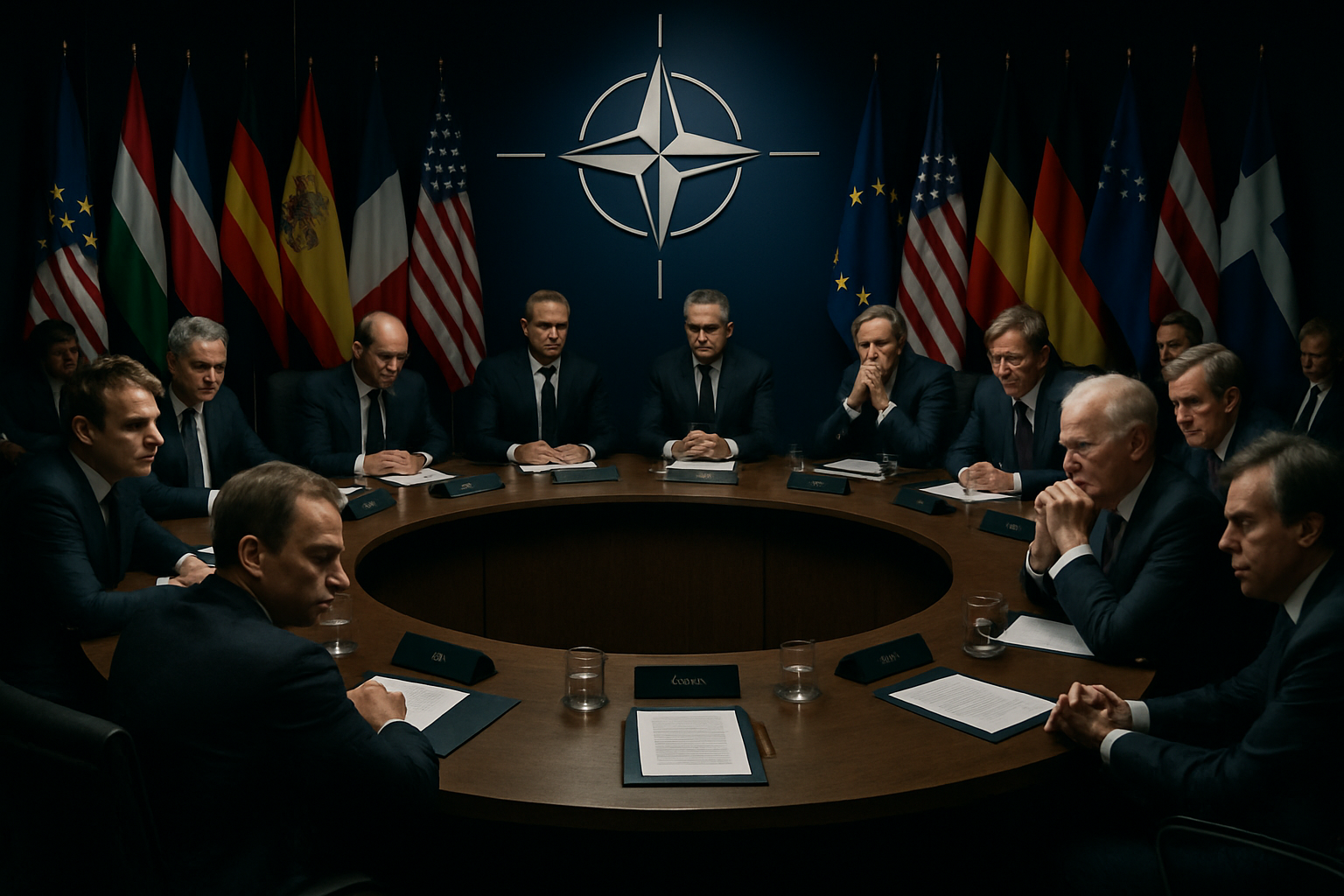
NATO faces its most serious existential crisis since the alliance's founding in 1949, as President Donald Trump escalates threats to withdraw the United States from the transatlantic security framework while European allies demonstrate unprecedented strategic autonomy through selective cooperation and resistance to American military demands.
The crisis reached a critical juncture this week as NATO Secretary-General Mark Rutte prepared for an emergency visit to Washington, following a series of dramatic confrontations between the Trump administration and key European allies over burden-sharing, military support, and fundamental alliance obligations.
European Allies Deliver Historic Rejection
In an unprecedented display of coordinated resistance, European NATO members have delivered crushing rejections to multiple Trump administration requests for military support. German Defense Minister Boris Pistorius led the opposition, asking pointedly, "What does Donald Trump expect a handful of European frigates to do that the powerful US Navy cannot?"
The rejection extended across the alliance, with France explicitly declining warship deployments, while Japan and Australia refused naval vessel contributions despite their critical dependence on affected trade routes. Sweden's Prime Minister Ulf Kristersson refused assistance entirely, citing "Iraq lessons" and the need to avoid repeating historical mistakes.
"We no longer 'need' or want assistance from NATO countries—IN FACT, WE NEVER NEEDED IT!"
— Donald Trump, Truth Social Post
This coordinated European response represents the most comprehensive rejection of American military leadership since the 2003 Iraq War, fundamentally challenging traditional alliance frameworks that have underpinned Western security for over seven decades.
Spain's Unprecedented Stand
Spain has emerged as the most vocal opponent of American military ventures, with Prime Minister Pedro Sánchez taking the extraordinary step of closing Spanish airspace to US military aircraft involved in Middle East operations. This escalation goes far beyond the earlier denial of access to Rota Naval Station and Morón Air Base.
"We refuse to participate in or contribute to a war which was initiated unilaterally and against international law," declared Spanish Economy Minister Carlos Cuerpo, defending the airspace closure as a matter of principle.
Trump's response has been characteristically aggressive, threatening to "cut off all trade" with Spain and ordering Treasury Secretary Scott Bessent to "cut off all dealings" with Madrid. The President has called Spain a "terrible ally," marking the first time since the 1950s defense agreements that Spain has explicitly denied access to major US operations.
European Strategic Autonomy in Practice
The Spanish position illustrates a sophisticated European approach to strategic autonomy—distinguishing between territorial defense obligations and discretionary military interventions. While refusing support for American operations in the Middle East, Spain immediately joined a four-nation naval coalition to protect Cyprus following Iranian drone strikes on British sovereign bases.
This selective cooperation demonstrates Europe's emerging doctrine: unwavering solidarity in defending European territory while rejecting participation in what officials privately describe as "American military adventures."
NATO's Arctic Strategy Under Pressure
Amid these tensions, European allies have paradoxically demonstrated unprecedented military cooperation in other theaters. The NATO Arctic Sentry mission represents the alliance's most comprehensive Arctic security response since the Cold War, with European nations taking clear leadership roles.
The United Kingdom has committed to doubling its troop presence in Norway from 1,000 to 2,000 personnel over three years. Sweden is deploying Gripen jets for Greenland exercises, while Finland contributes operational planning expertise developed through decades of Arctic military experience.
This European-led initiative directly addresses the 23% increase in Russian Arctic military activity since Finland and Sweden joined NATO, while also responding to climate change-driven competition for newly accessible shipping routes and natural resources.
Canadian Defense Transformation
Canada's response to alliance pressures has been particularly significant, with Prime Minister Mark Carney unveiling a $6.6 billion Defence Industrial Strategy designed to achieve 5% of GDP military spending by 2035—more than double NATO's standard 2% target.
The strategy promises 125,000 new jobs over 10 years and aims to shift 70% of defense contracts to Canadian companies, reversing the current 70% allocation to American products. This represents the most significant transformation of Canada's defense industry since World War II and directly addresses Trump administration demands for burden-sharing while reducing dependence on American suppliers.
Nuclear Governance Crisis Deepens Tensions
The alliance crisis unfolds against a backdrop of unprecedented nuclear governance challenges. The expiration of the New START Treaty in February 2026 marked the first time in over 50 years that the United States and Russia operate without bilateral nuclear constraints.
European leaders have responded by initiating the most serious nuclear deterrence discussions since the Cold War ended. German Chancellor Friedrich Merz has confirmed direct negotiations with French President Emmanuel Macron about expanding France's nuclear deterrent beyond national scope, with preliminary conversations involving Germany, Poland, and Finland about extended deterrence arrangements.
"Europe must become a geopolitical power providing its own security."
— Emmanuel Macron, French President
Congressional and Public Opposition
Trump's alliance management faces unprecedented domestic opposition, with bipartisan lawmakers demanding comprehensive briefings on strategy, costs, and the potential deployment of ground troops in various global hotspots. Senator Richard Blumenthal has expressed being "more concerned than ever" about escalating military commitments.
Public support for Trump's confrontational approach remains historically low at approximately 25%, creating significant political constraints on the administration's foreign policy options. Financial markets have emerged as what analysts describe as the "ultimate constraint" on prolonged military escalation, with regional conflicts producing instant global economic consequences.
Alliance Adaptation or Fragmentation
The current crisis represents what UN Secretary-General António Guterres has called "the greatest test of multilateral cooperation in the modern era." The rapid transition from diplomatic engagement to military confrontation demonstrates the fragility of crisis management mechanisms in an increasingly multipolar world.
European strategic autonomy has evolved from aspiration to operational reality, with concrete demonstrations of independent defense coordination while maintaining selective cooperation with the United States. This paradigm shift challenges fundamental assumptions about alliance obligations versus national sovereignty that have governed Western security architecture since 1949.
Template for 21st Century Security
The resolution of these tensions will establish precedents for international relations that extend far beyond current events. Success in managing alliance disagreements through diplomatic institutions could strengthen frameworks for addressing other 21st-century challenges, from climate security to technological disruption and authoritarian resistance.
Failure, however, could accelerate Western fragmentation at a critical moment when coordinated responses are essential for addressing great power competition, nuclear proliferation, and global governance challenges.
Looking Forward
NATO Secretary-General Mark Rutte's Washington visit represents a critical moment for the alliance's future trajectory. The stakes extend beyond immediate policy disagreements to fundamental questions about democratic nations' capacity for coordinated defense in an era of great power competition.
The crisis tests whether NATO's institutional resilience can accommodate radical restructuring while maintaining unity and democratic principles. European allies have demonstrated their willingness to assume greater leadership roles and financial responsibility while insisting on sovereign decision-making authority regarding military interventions.
As the alliance approaches its 75th anniversary, the current tensions may ultimately determine whether NATO adapts to become a more balanced partnership between equals or faces its most serious existential crisis since the Suez Crisis of 1956. The difference lies in today's multipolar context, where alternative security arrangements and partnerships offer viable alternatives to traditional Western frameworks.
The coming weeks will test decades of US-European partnership and broader NATO unity against what many analysts describe as the most unprecedented challenge to alliance cohesion in its history. Whether democratic nations can coordinate effective defense while preserving sovereignty and principles may well determine the trajectory of international relations for decades to come.