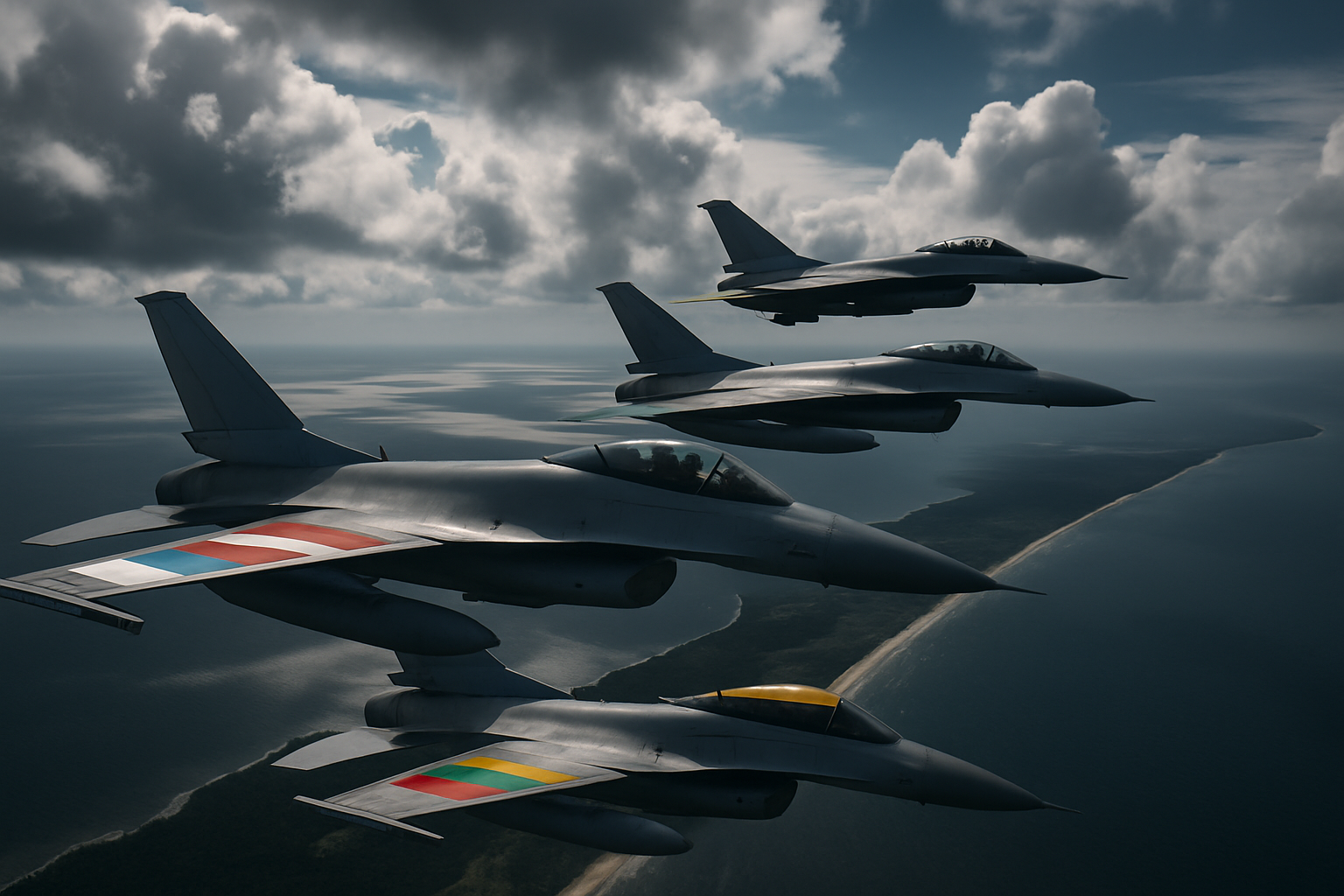
NATO fighter jets conducting air policing missions over the Baltic states scrambled six times this week to intercept and escort Russian aircraft that violated international flight regulations, according to Lithuania's Defense Ministry, marking the latest escalation in a pattern of provocative military activities that have intensified since the Nordic expansion of the alliance.
The incidents, reported by Lithuania's Ministry of National Defense (KAM), represent a significant uptick in Russian aerospace violations across Estonian, Latvian, and Lithuanian airspace. NATO's Baltic Air Policing mission, which has protected the region's skies since the Baltic states joined the alliance in 2004, has recorded a 23% increase in Russian military reconnaissance activities since Sweden and Finland's NATO membership fundamentally altered the strategic balance in the region.
Systematic Pattern of Provocations
These latest violations are part of a broader escalation that security analysts describe as a coordinated campaign of hybrid warfare tactics. Recent incidents include Russian drones penetrating Estonian and Latvian airspace, with one striking Estonia's critical Auvere power station on March 25, and another crashing in Latvia's Krāslava region. The March incidents marked the most serious Baltic security breach since NATO expansion, according to regional intelligence assessments.
Estonian Defense Forces confirmed that Ukrainian military drones have also inadvertently entered Baltic airspace during operations targeting Russian energy infrastructure, creating complex operational challenges as NATO allies navigate supporting Ukraine's defensive operations while maintaining territorial sovereignty. Colonel Uku Arold of the Estonian Defense Forces stated that several Ukrainian drones "apparently went off course" during attacks on Russian Baltic coastal facilities, highlighting the spillover effects of the ongoing conflict.
"The frequency of these incidents may increase as both Ukrainian long-range capabilities expand and Russian provocations intensify. Our enhanced cooperation and early warning systems have proven effective in preventing casualties while maintaining regional security."
— Estonian Defense Official
NATO Arctic Sentry Mission Response
The alliance has responded to escalating tensions with NATO Arctic Sentry, the most comprehensive northern defense initiative since the Cold War. This European-led mission encompasses enhanced intelligence sharing, satellite surveillance, and maritime patrols across the Nordic-Baltic region. The UK has doubled its Norway troop presence from 1,000 to 2,000 over three years, while Sweden deploys Gripen jets for Greenland exercises and Finland contributes crucial operational planning expertise.
Estonia has emerged as a critical regional defense hub, hosting a €10 million HIMARS maintenance center through partnership with Lockheed Martin—the first regional facility for advanced rocket systems. This facility enables rapid repair and maintenance without transport to distant locations, significantly improving operational readiness for NATO allies and reducing dependence on distant supply chains.
Intelligence Warnings and Timeline Assessments
Lithuanian intelligence agencies have issued unprecedented warnings that Russia could be ready for "limited military conflict" within 3-5 years if a Ukraine ceasefire permits force reconstitution. This timeline assessment is based on Russian stockpile rebuilding requirements and tactical development specifically adapted for Baltic terrain and NATO defensive capabilities.
The intelligence warnings coincide with observations of Russia developing new regional frameworks specifically focused on the Baltic Sea. Security officials report systematic patterns of submarine incursions, GPS jamming, underwater cable sabotage, and systematic reconnaissance targeting NATO assets—including the recent drone incident near the French aircraft carrier Charles de Gaulle launched from Russian vessel Zhigulevsk.

Nuclear Policy Transformation
The regional security transformation has prompted historic shifts in Nordic nuclear policies. Finland's Defense Minister Antti Häkkänen announced plans to lift the country's comprehensive nuclear weapons ban "as soon as possible," stating that current legislation is inadequate for NATO membership requirements. Meanwhile, Sweden has expressed willingness to host nuclear weapons during wartime conditions, breaking an 80-year Nordic nuclear taboo.
These policy reversals occur against the backdrop of the New START Treaty's expiration on February 5, 2026—the first time in over 50 years without US-Russia nuclear constraints. With both superpowers controlling 80% of global nuclear weapons, UN Secretary-General António Guterres has warned of nuclear risks being at their "highest in decades," creating urgency for European alternative deterrence options.
Energy Infrastructure Vulnerability
The targeting of critical infrastructure has emerged as a particular concern, with Estonia's Auvere power station strike highlighting vulnerabilities despite the country's renewable energy leadership. Estonia generates 88% of its electricity from renewable sources and operates continental Europe's largest battery storage facility, providing a template for regional energy independence while exposing the risks of systematic infrastructure targeting.
Ukrainian strikes on Russian energy facilities have created complex spillover effects, with dozens of shadow fleet tankers stranded in the Gulf of Finland after successful targeting of Ust-Luga and Primorsk terminals. This energy warfare demonstrates the interconnected nature of regional security challenges, where defensive operations in one area create diplomatic complexities for neighboring NATO members.
Enhanced Regional Cooperation Framework
Baltic states have pioneered innovative approaches to regional security cooperation that extend beyond traditional military measures. In an unprecedented move, Baltic national libraries have strengthened cooperation specifically to address geopolitical challenges and protect cultural heritage—representing the first time cultural institutions have played a formal role in democratic resilience and regional security frameworks.
Estonia's technological leadership extends beyond energy independence to comprehensive digital governance innovations. The country hosts the Tallinn Cyber Diplomacy Winter School for 33 countries and leverages advanced surveillance technologies including AI-powered monitoring systems and real-time analytics to protect transportation networks and critical infrastructure.
"The Baltic approach provides a template for small nation coordination in a volatile international environment. Our success in combining traditional security measures with cultural institution integration represents an innovative approach to 21st-century regional cooperation."
— Baltic Security Analyst
International Diplomatic Context
The intensifying regional tensions occur alongside broader diplomatic developments, including suspended Ukraine peace talks and ongoing negotiations over territorial disputes. The February breakthrough that achieved a 314-prisoner exchange and restored US-Russia military communications has stalled amid the broader Iran crisis, while European strategic autonomy discussions have gained unprecedented urgency.
France has explored nuclear deterrent expansion talks with Germany, Poland, and Finland—the first serious European nuclear cooperation discussions since the Cold War's end. These conversations reflect growing questions about US reliability guarantees and the need for European alternative security arrangements in an increasingly multipolar world.
Looking Forward: Implications and Challenges
The current security dynamics in the Baltic region represent more than localized tensions—they serve as a testing ground for 21st-century alliance coordination, hybrid warfare responses, and democratic resilience under pressure. The success or failure of NATO's adaptive responses will influence global security architecture for decades to come.
As Ukrainian long-range capabilities continue to expand and Russian provocations persist, the frequency of airspace incidents may increase, requiring ever more sophisticated diplomatic coordination to distinguish between hostile provocations and friendly navigation errors. The Baltic experience in managing complex spillover effects provides crucial templates for other regions facing similar challenges.
The enhanced cooperation mechanisms, early warning systems, and diplomatic coordination protocols developed through these crises have proven effective in preventing casualties and major escalations while supporting legitimate defensive operations. However, the 3-5 year timeline for potential Russian military action adds urgency to continued defense enhancement and diplomatic engagement efforts.
Regional energy independence models, technological innovation in surveillance and defense, and the integration of cultural institutions with traditional security measures represent innovative approaches that may influence global democratic cooperation strategies. The stakes extend far beyond the Baltic region, affecting European security architecture evolution, international law enforcement credibility, and the viability of multilateral cooperation in addressing contemporary security threats.