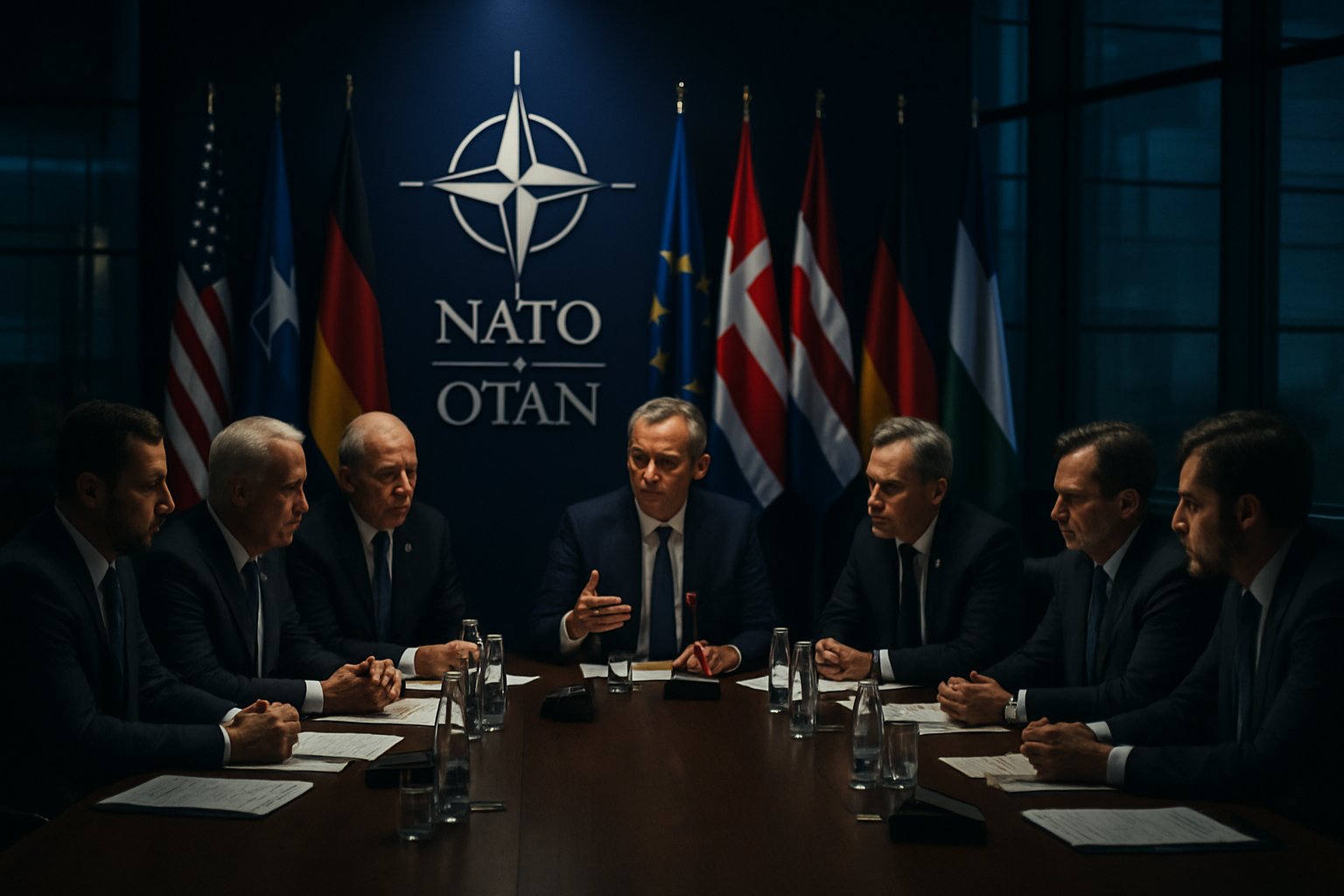
The NATO alliance is experiencing its most severe crisis since formation as President Donald Trump delivered an unprecedented attack on European allies, calling them "cowards" and declaring NATO without the United States is "a paper tiger" after allies delivered a crushing rejection of his demands for military support in the ongoing Iran crisis.
The dramatic diplomatic fracture emerged Friday as Trump escalated his pressure on NATO partners to send warships to secure the Strait of Hormuz, which carries 40% of global oil transit and has been effectively closed by Iranian mining operations. European leaders, led by German Defense Minister Boris Pistorius, delivered a coordinated rejection that marks the most comprehensive refusal of American military leadership since the 2003 Iraq War.
European Allies Deliver Historic Rejection
In what diplomatic observers are calling a watershed moment for transatlantic relations, major NATO allies systematically refused Trump's demands for a naval coalition to reopen the strategic waterway. German Defense Minister Pistorius led the resistance with a pointed question: "What does Donald Trump expect a handful of European frigates to do that the powerful US Navy cannot?"
France explicitly rejected warship deployment requests despite Trump's direct appeals, while Japan and Australia declined to send naval vessels despite their heavy dependence on Middle Eastern oil. Sweden's Prime Minister Kristersson refused assistance entirely, and even close allies like the United Kingdom faced Trump's criticism for what he called "lukewarm support" that was "not Winston Churchill's Britain."
The coordinated European response reflects what officials privately describe as "Iraq lessons" — a determination not to repeat what they view as the mistakes made in Iraq two decades ago. European leaders have invoked international law and UN Charter compliance as the basis for their refusal to participate in what they characterize as optional military operations rather than collective defense necessities.
Trump's Furious Response
The president's reaction was swift and unprecedented in its harshness toward traditional allies. In a Truth Social post Friday, Trump declared: "Without the United States, NATO is a paper tiger. They didn't want to go to war to stop a nuclear-armed Iran." He followed this with an even more direct attack: "The United States has been informed by most NATO 'allies' that they do not want to participate in our military operation against Iran. We no longer 'need' or want assistance from NATO countries—IN FACT, WE NEVER NEEDED IT!"
This represents a complete policy reversal from coalition-building to unilateral approach, demonstrating Trump's growing isolation from traditional alliance partners. The president had earlier demanded that China, France, Japan, South Korea, and the UK send warships to jointly secure the Strait of Hormuz, warning of "very bad consequences" if allies failed to assist.
"NATO allies who refuse to help secure shipping routes while complaining about high oil prices are cowards. We're doing the work while they benefit from our sacrifice."
— President Donald Trump, Truth Social
NATO Mission Withdrawal
The alliance crisis has already produced concrete consequences beyond diplomatic tensions. NATO announced Friday that it is temporarily relocating its Iraq mission personnel to Europe, with the alliance describing this as a "reconfiguration of our deployment" in response to the deteriorating security environment.
Norwegian media reports confirm that NATO's entire Iraq operation has been "safely" moved to Europe, according to both Reuters and AFP news agencies. The mission, which provided non-combat advisory and capability-building assistance to Iraqi forces, will continue operations from Joint Force Command Naples under the direction of General Alexus Grynkewich, Supreme Allied Commander Europe.
European Strategic Autonomy in Action
Despite refusing to support Trump's Gulf operations, European nations have demonstrated unprecedented unity in defending their own territory. When Iranian drones struck RAF Akrotiri in Cyprus — the first attack on European soil since World War II — the response was swift and coordinated.
A four-nation naval coalition rapidly deployed to protect Cyprus, including HMS Dragon, Spanish frigates, and vessels from Italy, France, the Netherlands, and Greece. The European Union activated its ESTIA evacuation plan for the first time in the bloc's history, managing the crisis through emergency Foreign Affairs Council sessions.
This selective cooperation highlights the frustration European leaders feel with what they characterize as Trump's "optional war" versus defensive necessity. EU foreign policy chief Kaja Kallas has suggested expanding the Red Sea Aspides operation into the Persian Gulf, though Spain and Germany oppose changing the mandate to include military operations.
Global Crisis Escalates
The diplomatic crisis unfolds against the backdrop of the most dangerous international situation since the Cold War. Iran's Revolutionary Guard has deployed an estimated 2,000-6,000 naval mines throughout the Strait of Hormuz, effectively closing the waterway that carries 40% of global seaborne oil transit. Over 150 oil tankers worth billions of dollars remain stranded in the Persian Gulf.
The economic impact has been immediate and severe. Oil prices have surged past $100 per barrel for the first time since 2022, with Brent crude reaching $119.50 and WTI experiencing a record 18.98% single-day jump. The International Energy Agency has authorized the largest strategic petroleum reserve release in its 50-year history — 400 million barrels from 32 countries.

The aviation industry faces COVID-scale disruption, with over 18,000 flights cancelled worldwide — the most extensive disruption since the pandemic. Eight Middle Eastern countries have closed their airspace simultaneously, creating what industry experts call an "aviation black hole" that severs critical Europe-Asia corridors. Dubai International Airport, the world's busiest, remains shuttered due to missile damage.
Congressional and Public Opposition Mounts
Trump's Iran operations face unprecedented domestic political challenges alongside international isolation. Congressional lawmakers from both parties are demanding comprehensive briefings on strategy, costs, and the potential for ground troop deployment. Senator Richard Blumenthal has stated he is "more concerned than ever" about the possibility of American boots on the ground.
Operation Epic Fury, as the Iran campaign has been designated, has already cost $11.3 billion in its first week, making it one of the most expensive military operations in recent history. The Pentagon is preparing for operations to continue through September, far beyond Trump's initial 4-6 week timeline.
Public support for the conflict remains historically low at just 25% — what political analysts describe as "almost unprecedented" unpopularity for major military operations in their early stages. Financial markets have emerged as what officials privately describe as the "ultimate constraint" on escalation, with global stock exchanges experiencing severe volatility.
Alliance System Under Greatest Test
The crisis represents what UN Secretary-General António Guterres has called the "greatest test of multilateral cooperation in the modern era." The rapid transition from promising diplomatic breakthrough to military confrontation demonstrates what experts describe as the fragility of crisis management in the multipolar era.
Just weeks before the current crisis, US-Iran nuclear talks in Geneva had achieved what negotiators called "broad agreement on guiding principles" — the most significant diplomatic progress since the 2018 JCPOA collapse. However, fundamental disagreements over scope proved insurmountable, with Iran excluding ballistic missiles and regional proxies as "red lines" while the US demanded comprehensive agreements covering all aspects of Iranian military capabilities.
European leaders now face a template-setting moment that will influence alliance relationships for decades. Success in managing the crisis through institutional cooperation could strengthen NATO's adaptability to 21st-century challenges. Failure might accelerate what some analysts describe as Western fragmentation at a critical moment for international stability.
Regional Impact and Nuclear Implications
The crisis occurs against the backdrop of broader nuclear governance breakdown. The New START treaty between the United States and Russia expired in February 2026, marking the first time in over 50 years that the world's two largest nuclear powers operate without arms control constraints. Iran continues uranium enrichment at 60% purity, approaching the 90% threshold considered weapons-grade, with an estimated 400+ kilograms of enriched material sufficient for multiple weapons if weaponized.
Regional coalition dynamics have become severely strained as Iranian retaliation has directly targeted Gulf state territories. The unprecedented Saudi Arabia-UAE-Qatar-Egypt diplomatic consensus that had supported diplomatic solutions now faces pressure as attacks have caused casualties in member countries. Egypt's President Sisi has condemned attacks on "sisterly Arab countries," warning of "comprehensive chaos spreading throughout the region."
The humanitarian toll continues to mount, with Iran's Red Crescent reporting over 787 civilian casualties from US-Israeli strikes. The Pentagon has confirmed American responsibility for an elementary school attack that killed between 165-185 students, which officials attributed to "outdated targeting data." International evacuation efforts are underway on a scale not seen since the 2011 Arab Spring, with Australia reporting 115,000 nationals trapped in the region and Germany attempting to evacuate 30,000 stranded tourists.
Template for 21st Century Crisis Management
The events of March 2026 are being viewed by international relations experts as potentially template-setting for how conflicts are resolved in the 21st century. The rapid breakdown from diplomatic engagement to military confrontation, combined with the fracturing of traditional alliance structures, demonstrates the challenges of crisis management in an increasingly multipolar world.
European strategic autonomy has moved from theoretical concept to concrete reality, with nations demonstrating their willingness to coordinate military responses independently of NATO frameworks when their territorial integrity is threatened, while simultaneously refusing to participate in what they view as discretionary military interventions.
The outcome of this crisis will likely influence international approaches to nuclear proliferation prevention, territorial sovereignty enforcement, energy security architecture evolution, and the balance between diplomatic and military solutions to international disputes for decades to come.
Looking Ahead
As the crisis enters its third week, the stakes could not be higher. Success in containing the conflict could provide a framework for nuclear crisis resolution and strengthen institutional cooperation mechanisms. Failure might accelerate military approaches to international problems, encouraging nuclear proliferation globally and undermining diplomatic credibility for future territorial and security disputes worldwide.
The NATO alliance faces its most severe test since formation, with fundamental questions about whether unity can survive Trump's unprecedented attacks on allies or whether March 2026 will mark a turning point toward a fundamentally different global security architecture. The decisions made in the coming days and weeks will likely reverberate through international relations for decades, affecting not only the immediate crisis but also establishing precedents for how the Western alliance system adapts to 21st-century challenges.
With energy markets in chaos, global supply chains disrupted, and the specter of broader regional conflict looming, the international community watches anxiously as the world's most powerful military alliance confronts its greatest internal crisis while facing one of the most dangerous external threats since the Cold War's end.