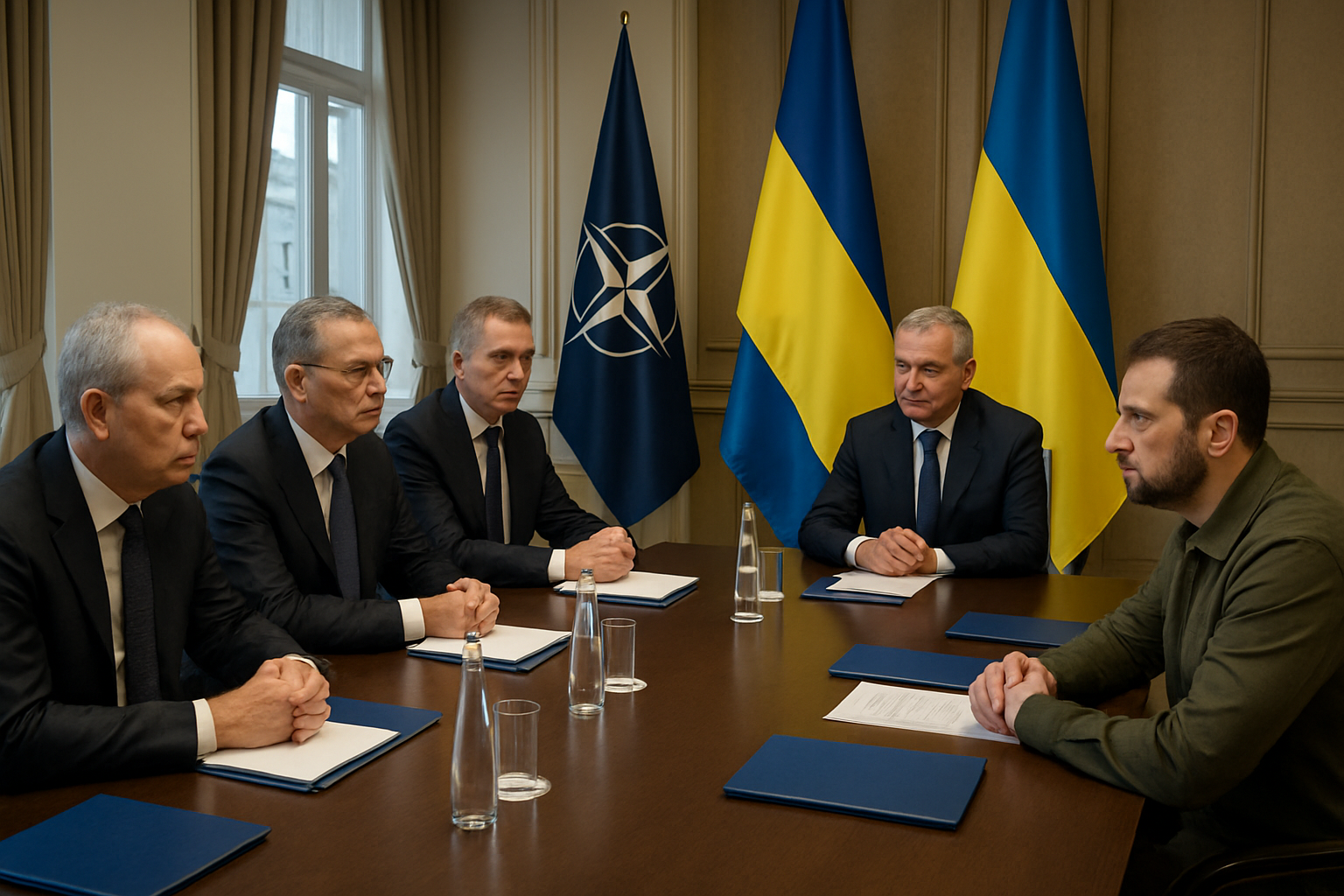
A high-level NATO delegation made its first official visit to Kyiv since Russia's February 2022 invasion, marking a historic diplomatic milestone as trilateral peace negotiations remain indefinitely suspended due to the Iran crisis.
The unprecedented visit, led by French Admiral Pierre Vandieront, focused on discussions about Ukrainian military participation in future NATO exercises and training programs, according to Pavlo Palisa, Deputy Head of the Ukrainian Presidential Office. The delegation's arrival in the Ukrainian capital represents the Alliance's most direct engagement with Ukraine on its own soil since the conflict began nearly four years ago.
Historic Diplomatic Breakthrough
The visit comes at a critical juncture as the most promising diplomatic initiatives since the invasion have been derailed by the Middle East crisis. Previously, historic breakthroughs in February 2026 included a 314-prisoner exchange between Russia and Ukraine—the first in five months—and the restoration of US-Russia military communications after a four-year suspension.
These achievements, along with Geneva peace talks that showed "significant progress" on ceasefire monitoring mechanisms, had created unprecedented momentum toward a potential settlement. However, President Zelensky announced in early March that trilateral Ukraine-Russia-US negotiations were postponed indefinitely due to the Iran situation.
"Due to situation around Iran, there are still no necessary signals for trilateral meeting until security situation and general political context allow."
— Volodymyr Zelensky, Ukrainian President
Military Cooperation Framework
The NATO delegation's discussions centered on integrating Ukrainian forces into Alliance training programs and exercises—a significant step that would mark the first formal NATO exercises involving Ukrainian personnel since the conflict began. This development represents an evolution from traditional arms supply to comprehensive military support frameworks.
The visit also builds on recently disclosed UK military infrastructure in Ukraine, with four operational maintenance, repair, and overhaul (MRO) facilities currently servicing Western-supplied equipment, with a fifth facility planned. This infrastructure enables rapid repair turnaround without the need to transport materiel out of the country for maintenance.
Escalating Military Situation
The diplomatic engagement occurs against a backdrop of intensifying military operations. Russian forces have accelerated territorial gains, capturing 481 square kilometers in January 2026 compared to 260 square kilometers in December 2025—an 85% increase representing the fastest monthly gains in recent periods.
The past week alone saw Russia launch 1,750 strike drones, 1,530 guided aerial bombs, and 39 missiles against Ukrainian targets. The systematic targeting of civilian infrastructure continues, with over 1,170 buildings in Kyiv still lacking adequate heating from previous energy attacks during sub-zero temperatures.
Ukrainian casualties continue to mount, with President Zelensky having disclosed that 55,000 soldiers have been officially killed, with a "large number" still missing. International estimates suggest actual casualties could be 2-3 times higher when including undocumented deaths and missing personnel.
Nuclear Governance Crisis
The NATO visit occurs amid an unprecedented nuclear governance crisis. The New START treaty expired on February 5, 2026, creating the first period in over 50 years without US-Russia nuclear constraints. Both superpowers control approximately 80% of global nuclear weapons, with Russia possessing 4,380 warheads and the US maintaining 3,708.
UN Secretary-General António Guterres has called this a "grave turning point" with nuclear risks at their "highest in decades." The restored military communications between Washington and Moscow remain the only formal diplomatic channel between the nuclear superpowers.
European Unity Under Pressure
The Alliance's show of support comes as European unity faces significant challenges. Hungary continues to threaten vetoes of the EU's historic €90 billion loan package for Ukraine over disputes regarding the Druzhba pipeline. Lithuania's Foreign Minister has warned that the "EU cannot become Budapest's hostage."
Despite these divisions, international support for Ukraine remains unprecedented in scope. The EU loan package represents the largest single-nation assistance ever provided, supplemented by Sweden-Denmark's €246 million air defense systems and Germany's delivery of 35 Patriot missiles.
Strategic Implications
The NATO delegation's visit signals the Alliance's determination to maintain its partnership with Ukraine regardless of battlefield dynamics or suspended peace negotiations. This direct engagement in the Ukrainian capital demonstrates strategic commitment with implications for broader European security architecture.
The visit also represents NATO's assessment of enhanced integration as a deterrent effect against Russian multi-front operations. Intelligence sources report Russian forces are "stepping up redeployment preparing new offensive operations on several fronts simultaneously."
Ukraine's Evolving Role
As peace talks remain stalled, Ukraine has pivoted to become a security provider rather than merely an aid recipient. Ukrainian military specialists are now deployed to five Middle Eastern countries—Jordan, Qatar, Kuwait, UAE, and Saudi Arabia—sharing expertise in combating Iranian Shahed drones, the same weapons that have devastated Ukrainian infrastructure.
This evolution demonstrates how Ukraine is leveraging its battlefield experience into strategic partnerships while core territorial sovereignty challenges await resolution. Defense Secretary Rustem Umerov confirmed these deployments represent a new phase in Ukraine's international cooperation.
Looking Forward
With the Trump administration's June 2026 peace deadline now uncertain due to competing Middle East priorities, the NATO delegation's visit takes on added significance. The framework achievements from earlier diplomatic breakthroughs—including prisoner exchange mechanisms and Pentagon-Moscow deconfliction protocols—remain intact and can be reactivated when conditions permit.
However, fundamental territorial disputes remain unchanged. Russia continues to demand recognition of occupied eastern Ukrainian territories and insists any Putin-Zelensky talks must occur in Moscow. Ukraine maintains its territorial integrity position while categorically rejecting any territorial concessions.
The Alliance's direct engagement in Kyiv represents both a vote of confidence in Ukraine's long-term defensive capabilities and a signal that NATO remains committed to the principles of territorial sovereignty and international law. As the conflict approaches its fifth year, this historic visit underscores that the stakes extend far beyond Ukraine to encompass the future of European security architecture and 21st-century conflict resolution.