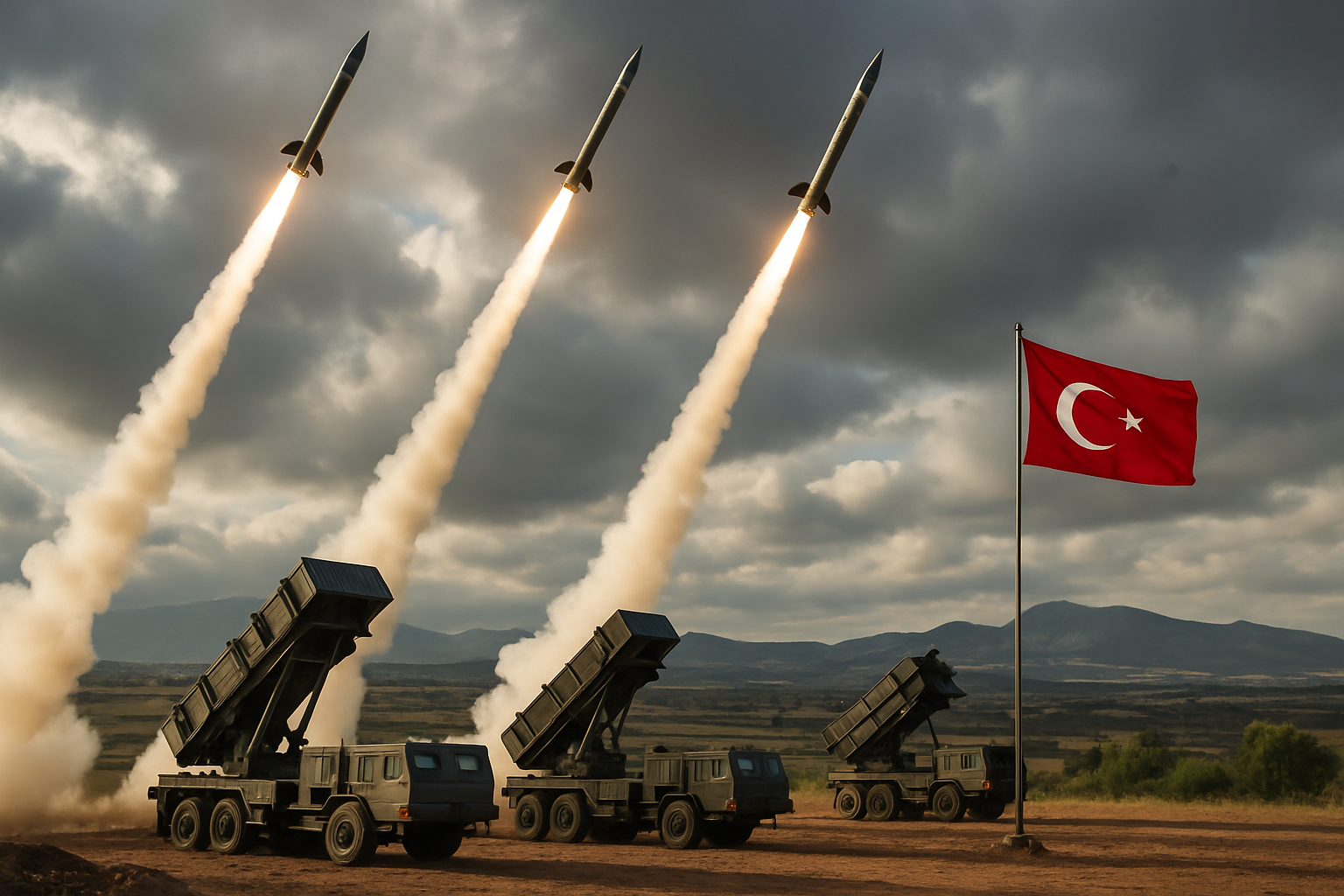
NATO air and missile defense systems successfully intercepted a fourth Iranian ballistic missile after it entered Turkish airspace on March 30, 2026, Turkey's Defense Ministry announced, marking the latest escalation in what has become the most dangerous international crisis since the end of the Cold War.
The ballistic missile, launched from Iran, was shot down by NATO defense systems deployed in the eastern Mediterranean, according to the Turkish Defense Ministry's statement on Monday. This represents the fourth such interception since the start of the Iran crisis, following three previous incidents earlier this month that had already prompted Ankara to issue strong protests and warnings to Tehran.
Unprecedented Pattern of Airspace Violations
The ministry emphasized that all necessary measures were being taken "decisively and without hesitation" against any threats directed at Turkey's territory and airspace. This latest incident underscores the dramatic expansion of Iran's "Operation True Promise 4" retaliation campaign, which has systematically targeted Western and allied assets across the region following the death of Supreme Leader Ali Khamenei on March 1, 2026.
The Iranian Revolutionary Guard's declaration that "no red lines remain" has materialized in a series of unprecedented attacks that have transformed a bilateral US-Israel conflict into a global crisis. The targeting of Turkish airspace represents a direct challenge to NATO's collective defense principles, testing the alliance's Article 5 commitments in real-world conditions for the first time in the 21st century.
Global Crisis Reaches Critical Phase
The March 30 interception occurs against the backdrop of an unparalleled global crisis that has disrupted virtually every aspect of international commerce and security. More than 18,000 flights have been cancelled worldwide—the most extensive aviation disruption since COVID-19—as eight Middle Eastern countries maintain simultaneous airspace closures.
Dubai International Airport, the world's busiest with 86 million annual passengers, remains completely shut down from missile damage sustained earlier in the month. Emirates, Air France-KLM, Wizz Air, and other major carriers have suspended operations indefinitely, stranding hundreds of thousands of passengers globally.
"The international community is facing the greatest test of multilateral cooperation in the modern era."
— UN Secretary-General António Guterres
Energy Security Crisis Deepens
The Iranian attacks have created an unprecedented energy security crisis that extends far beyond the Middle East. Oil prices have surged past $110 per barrel, with Brent crude hitting $119.50—levels not seen since the early Ukraine crisis. Iran's Revolutionary Guard has effectively closed the Strait of Hormuz through the deployment of 2,000-6,000 naval mines, blocking 40% of the world's seaborne oil transit.
More than 150 oil and LNG tankers worth billions of dollars remain stranded in the Persian Gulf as major shipping companies Maersk and MSC have suspended all operations in the region. The International Energy Agency (IEA) has responded with its largest strategic petroleum reserve release in the agency's 50-year history—400 million barrels from 32 countries—double the size of the response to the 2022 Ukraine crisis.
Natural gas prices have surged 24% in Europe and 78% in the United States, while Qatar's LNG production—representing approximately 20% of global exports—has been halted due to Iranian attacks on energy infrastructure.
NATO's Eastern Mediterranean Response
The repeated Iranian violations of Turkish airspace have triggered the most significant NATO mobilization in the Eastern Mediterranean since the 1974 Turkish invasion of Cyprus. The alliance has deployed an unprecedented multi-national naval coalition including the HMS Dragon destroyer, Spanish frigates, and Italian, French, Dutch, and Greek vessels.
This coordinated response was initially triggered by Iranian drone attacks on RAF Akrotiri in Cyprus—the first attack on European territory since World War II. The European Union activated its ESTIA evacuation plan for the first time in bloc history, evacuating thousands of civilians from areas near British sovereign bases.
France has repositioned its Charles de Gaulle aircraft carrier from the Baltic to the Mediterranean, while Greece has committed four F-16 fighter jets and two frigates in the most significant military support for Cyprus since 1974. The coordinated defense represents a template-setting example of European strategic autonomy in action.
Nuclear Diplomacy Collapse
The current crisis emerged from the complete breakdown of nuclear negotiations between the United States and Iran, despite achieving what diplomats described as "broad agreement on guiding principles"—the most significant progress since the collapse of the Joint Comprehensive Plan of Action (JCPOA) in 2018.
The insurmountable obstacle remained Iran's exclusion of ballistic missiles and regional proxies as "red lines" that would not be included in any nuclear-only agreement, while the United States insisted on comprehensive negotiations covering missiles, armed groups, and human rights issues.
Iran continues enriching uranium to 60% purity with more than 400 kilograms of weapons-grade material—sufficient for multiple nuclear weapons if weaponized. This crisis unfolds against the broader context of nuclear governance breakdown following the expiration of the New START treaty in February 2026, marking the first time in over 50 years without US-Russia nuclear constraints.
Constitutional Crisis in Iran
The death of Supreme Leader Ali Khamenei on March 1, 2026, ended his 37-year rule and triggered the first constitutional succession crisis in the Islamic Republic's 47-year history. Mojtaba Khamenei, the deceased leader's son, has emerged as the favored candidate for Supreme Leader—representing what would be the first hereditary succession in Iranian history.
CIA assessments suggest that a Revolutionary Guards member is likely to be chosen, indicating a significant shift from clerical to military governance during this critical period. This military influence is evident in the systematic and sophisticated nature of Iran's retaliatory operations, which have demonstrated unprecedented reach and coordination.
Congressional Scrutiny Intensifies
In Washington, bipartisan congressional opposition to Operation Epic Fury continues to mount. Senator Richard Blumenthal expressed being "more concerned than ever" about potential ground troop deployment, while the conflict maintains historically unprecedented unpopularity at just 25% public support.
The Pentagon has prepared operations through September 2026, far beyond the initial 4-6 week timeline suggested by the Trump administration. Operation Epic Fury has already cost $11.3 billion in its first week, with 150 US troops wounded and three confirmed killed in what represents the largest Middle Eastern operation since the 2003 Iraq invasion.
Regional Coalition Under Strain
The unprecedented consensus among Saudi Arabia, the UAE, Qatar, and Egypt that had initially supported diplomatic solutions has come under severe strain as Iranian retaliation has directly targeted their territories. Egyptian President Abdel Fattah el-Sisi condemned the attacks on "sisterly Arab countries," warning of "comprehensive chaos spreading across the region."
The UAE has suffered one civilian death in Abu Dhabi, Kuwait has experienced 32 injuries from airport strikes, and Qatar has reported eight injuries despite successfully intercepting 65 missiles and 12 drones using Patriot systems. This direct targeting of Gulf states represents a fundamental shift in Iranian strategy and threatens decades-old regional security arrangements.
Humanitarian Crisis Unfolds
The current crisis has produced what experts describe as the largest international evacuation effort since the Arab Spring of 2011. Australia has 115,000 nationals trapped in the region, while Germany faces the challenge of evacuating 30,000 stranded tourists. Multiple countries, including Sweden and Serbia, have ordered immediate evacuations from Iran due to "extremely uncertain" security conditions.
The Iranian Red Crescent reports more than 787 civilian casualties from US-Israeli strikes, including a controversial elementary school attack that killed between 53-85 students and staff. The Pentagon has confirmed US responsibility for the school strike, attributing it to "outdated targeting data"—raising serious questions about potential Geneva Conventions violations.
Global Economic Disruption
The crisis has created profound disruptions to global supply chains, with manufacturing sectors dependent on Gulf logistics networks—including automotive, electronics, and textiles—experiencing severe impacts. Financial markets have crashed worldwide, with Pakistan's KSE-100 recording its largest single-day decline in history at -8.97%.
Airlines have been forced to implement emergency fuel surcharges as jet fuel prices have soared from $85-90 per barrel to $150-200 per barrel. The fundamental vulnerability of global systems to geopolitical shocks in strategic regions has been dramatically exposed, forcing a reconsideration of supply chain dependencies.
Template-Setting Historical Significance
The March 30, 2026 interception represents far more than a tactical military success. It marks a critical test of NATO's collective defense mechanisms in the face of indirect aggression from a major regional power. The alliance's response has demonstrated both its capabilities and the challenges of maintaining unity during complex, evolving crises that don't fit traditional threat models.
UN Secretary-General António Guterres has described the current situation as "the greatest test of multilateral cooperation and crisis management in the modern era." The rapid transition from diplomatic breakthrough to military escalation demonstrates the fragility of crisis management mechanisms in an increasingly multipolar world.
The success or failure of containing this crisis will establish precedents for 21st-century conflict resolution, nuclear proliferation prevention, and the effectiveness of diplomatic versus military solutions to international disputes. The implications extend decades beyond the current events, potentially reshaping approaches to territorial sovereignty enforcement, energy security architecture, and international law enforcement.
Looking Ahead
As NATO forces maintain their defensive posture in the Eastern Mediterranean and diplomatic efforts continue through Pakistani mediation, the international community faces critical decisions that will determine whether this remains a contained regional crisis or evolves into the broader Middle Eastern war that many experts have long feared.
The fourth interception over Turkey serves as a stark reminder that geographic boundaries have failed to contain this conflict, with European territory now directly affected for the first time since World War II. The coming days and weeks will test not only military defense systems but the fundamental resilience of the international order established in the aftermath of the world's last global conflict.
With energy markets in chaos, aviation networks disrupted, and nuclear governance frameworks strained to their limits, the stakes could not be higher. The NATO intercept over Turkey on March 30 may be remembered as either a successful example of collective defense in action or as one of the final warnings before a much larger conflagration engulfed the region and beyond.