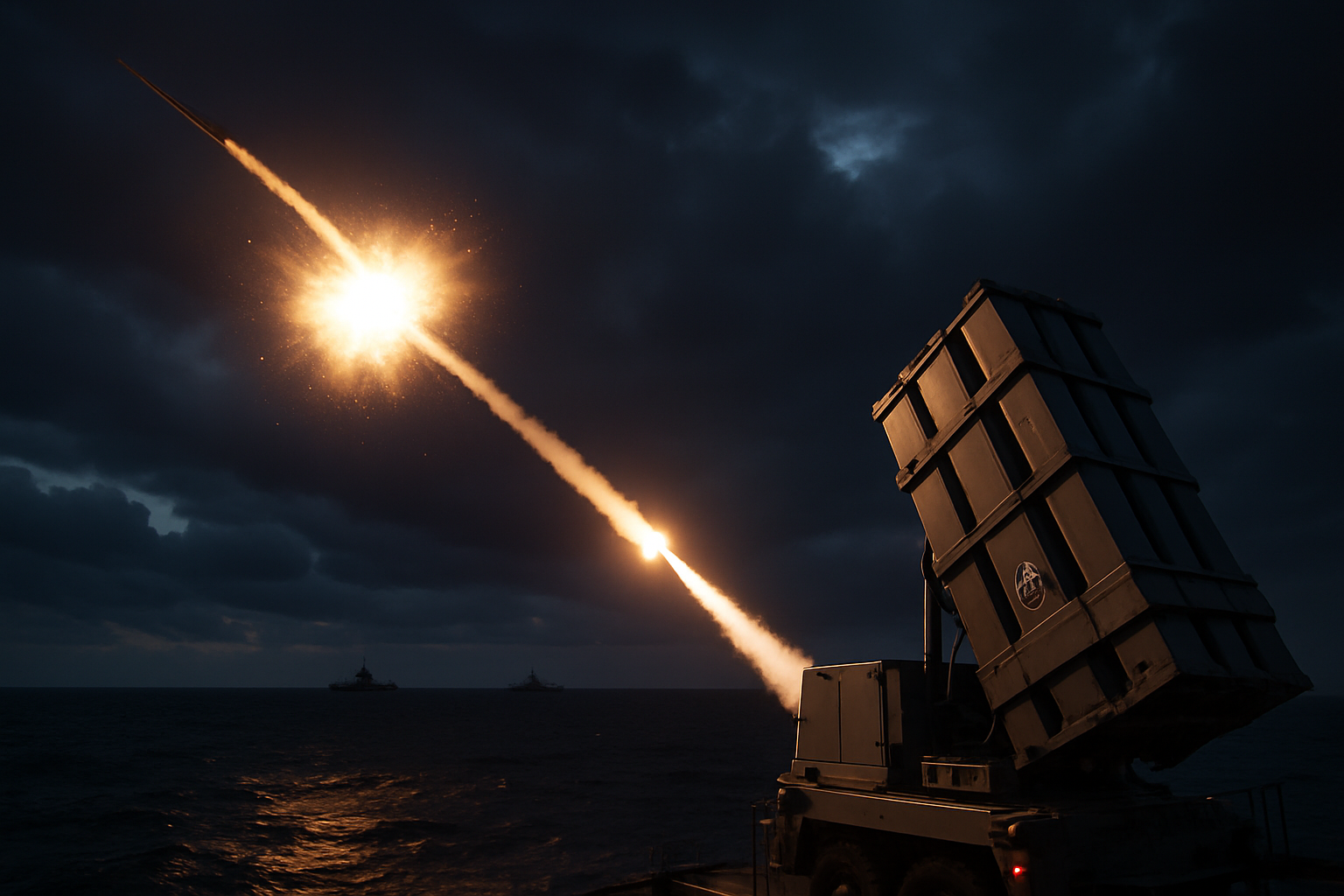
NATO air defense systems successfully intercepted and destroyed an Iranian ballistic missile targeting Turkish airspace on March 4, 2026, marking the first time the Atlantic alliance has been directly drawn into the escalating Middle East conflict.
The missile, launched as part of Iran's "Operation True Promise 4" retaliation campaign, was tracked after transiting Iraqi and Syrian airspace before being neutralized by NATO air and missile defense units operating in the Eastern Mediterranean, according to Turkey's Defense Ministry.
The interception represents a watershed moment in post-World War II European security, as it marks the first direct Middle Eastern targeting of European sovereign military installations since 1945. The incident has invoked Article 5 collective defense principles, with NATO demonstrating its commitment to protecting all member states amid unprecedented regional tensions.
Conflicting Reports on Intended Target
While initial reports suggested the missile was heading toward Turkish territory, conflicting accounts emerged throughout the day. A Turkish official later told AFP that the missile had "veered off course" and was actually heading toward Cyprus rather than Turkey, contradicting NATO's initial assessment.
The discrepancy has created confusion about the missile's intended target, with some sources suggesting the projectile was aimed at a British sovereign base in Cyprus. However, NATO maintained its position that Turkey was the intended target, strongly condemning Iran's actions.
"We condemn Iran's targeting of Turkey. NATO stands firmly with all Allies, including Turkey, as Iran continues strikes across the region."
— NATO Spokesperson
Despite the conflicting reports about the target, the alliance emphasized its unified response. "Our deterrence and defense posture remains strong across all domains, including air and missile defense," the spokesperson added.
Context of Regional Escalation
The missile intercept occurred against the backdrop of "Operation Epic Fury," the largest coordinated US-Israeli military operation since the 2003 Iraq invasion. The operation has resulted in confirmed deaths of senior Iranian leadership, including Defense Minister Aziz Nasirzadeh, IRGC Chief Mohammad Pakpour, and dozens of other officials.
Most significantly, Iranian Supreme Leader Ali Khamenei was confirmed killed on March 1, ending his 37-year rule and triggering a constitutional succession crisis that has seen his son Mojtaba appointed as the new Supreme Leader.
Iran's massive retaliation, dubbed "Operation True Promise 4," has seen the Islamic Revolutionary Guard Corps declare that "no red lines remain," with systematic targeting of US and allied facilities across the region. The Turkish missile intercept represents the first time NATO territory has been directly targeted in this conflict.
Debris Falls on Turkish Soil
Following the successful intercept, debris from both the Iranian missile and the NATO interceptor fell in Turkey's southern Hatay province, specifically in the Dortyol district. Turkish authorities confirmed that while debris was recovered from both land and water, no casualties or significant property damage occurred.
The Defense Ministry emphasized that the fragments that reached Turkish soil belonged primarily to the interceptor missile used to neutralize the threat, rather than the Iranian weapon itself.
"Our determination and capacity to ensure the security of our country and our citizens are at the highest level. While Turkey stands for regional stability and peace, it is fully capable of safeguarding the security of its territory and citizens against any threat, regardless of origin."
— Turkish Defense Ministry Statement
Collapse of Nuclear Diplomacy
The military escalation comes despite recent diplomatic breakthroughs in Geneva talks that achieved "broad agreement on guiding principles" - the most progress in Iran-US nuclear negotiations since the JCPOA collapse in 2018. However, fundamental scope disagreements proved insurmountable.
Iran maintained that ballistic missiles and regional proxies were "red lines" that would be excluded from nuclear-only talks, while the US demanded a comprehensive agreement addressing missiles, armed groups, and human rights. Iran continues to enrich uranium at 60% purity, approaching the 90% weapons-grade threshold, with sufficient material for multiple weapons according to intelligence assessments.
The diplomatic breakdown occurred in a broader context of nuclear governance crisis, as the New START treaty between the US and Russia expired on February 5, 2026 - the first time in over 50 years without bilateral nuclear constraints between the superpowers.
Global Aviation Crisis Intensifies
The regional conflict has created the most extensive aviation disruption since COVID-19, with over 18,000 flights cancelled worldwide. Eight countries - Iran, Iraq, Israel, UAE, Qatar, Syria, Kuwait, and Bahrain - have simultaneously closed their airspace, creating the most comprehensive regional closure in modern aviation history.
Dubai International Airport, the world's busiest with over 86 million passengers annually, remains completely shut down after sustaining missile damage. This has severed critical Europe-Asia hub connections, with major carriers including Emirates, Air France-KLM, Wizz Air, and Bulgaria Air suspending Middle East operations.
International Response and Evacuations
The crisis has triggered the largest coordinated international evacuation operation since the Arab Spring in 2011. Australia reports 115,000 nationals trapped in the region, Germany has 30,000 tourists stranded, and Cyprus has activated its ESTIA evacuation plan for the first time.
Multiple countries have issued urgent travel warnings and begun emergency evacuations. Sweden and Serbia ordered immediate evacuations from Iran citing "extremely uncertain" security conditions, while the United States authorized the departure of non-essential personnel from 15 Middle Eastern countries.
Energy Security Implications
The conflict has created a global energy crisis, with oil prices surging over 10% to above $80 per barrel. Iran has effectively closed the Strait of Hormuz, which handles 40% of global seaborne oil transit, declaring shipping routes "unsafe."
Major shipping companies Maersk and MSC have suspended operations, leaving over 150 tankers stranded in the Persian Gulf with billions of dollars worth of cargo. Natural gas prices have increased by 24% in Europe and 78% in the US, while Qatar has halted LNG production, affecting global energy supplies.
NATO's Collective Defense Response
The missile intercept represents the first practical test of NATO's Article 5 collective defense principle in the 21st century. The alliance's integrated missile defense system, deployed in the Eastern Mediterranean, successfully demonstrated its capability to protect member territories from ballistic missile threats.
France, Greece, and the UK have deployed additional military assets to the Eastern Mediterranean, including anti-missile systems, naval frigates, and fighter aircraft. This unprecedented European military mobilization represents the most significant Eastern Mediterranean deployment since the 1974 Turkish invasion of Cyprus.
The coordinated response demonstrates NATO unity in the face of extra-regional threats, establishing a template for how the alliance responds to attacks on member territory from Middle Eastern actors.
Regional Coalition Under Strain
The escalation has severely strained an unprecedented regional coalition that had backed diplomatic solutions. Saudi Arabia, UAE, Qatar, and Egypt had formed a remarkable consensus supporting the nuclear negotiations - the most unified Middle Eastern approach to preventing military confrontation in decades.
However, Iranian retaliation strikes have directly targeted several coalition member territories. The UAE reported one civilian killed in Abu Dhabi, Kuwait Airport was struck by drones causing employee injuries, and Qatar intercepted 65 missiles and 12 drones using Patriot systems, with 8 people injured by fragments.
"We condemn the attacks on sisterly Arab countries and warn of comprehensive chaos that could engulf the region."
— Egyptian President Abdel Fattah el-Sisi
Historical Significance and Template-Setting Precedent
Military analysts describe March 4, 2026, as a watershed moment that may rank among the most dangerous since the end of the Cold War. The rapid transition from diplomatic framework to military escalation demonstrates the fragility of crisis management mechanisms in the multipolar era.
The successful NATO intercept provides a template for alliance response to extra-regional threats, while the broader crisis tests fundamental principles of international law enforcement, territorial sovereignty, and nuclear governance credibility simultaneously.
The stakes extend far beyond the immediate region, affecting global energy security, aviation networks, supply chains, and the credibility of diplomatic solutions to international crises. Success in containing the escalation could provide a framework for future crisis resolution, while failure may accelerate military approaches to conflict resolution for decades to come.
Looking Ahead
As the crisis enters its fifth day, the international community faces critical decisions about escalation management and conflict containment. The NATO intercept, while successful, represents just one incident in a rapidly evolving situation that has already drawn multiple nations and international organizations into direct involvement.
With Iran's new Supreme Leader consolidating power under Revolutionary Guard influence, and the United States maintaining its largest Middle Eastern naval presence since 2003, the coming days will be crucial in determining whether this crisis can be contained or will expand into a broader regional war with global implications.
The precedent set by NATO's successful defense of Turkish airspace will likely influence alliance doctrine for years to come, establishing new parameters for collective defense in an era where regional conflicts can rapidly become global crises affecting millions of civilians worldwide.