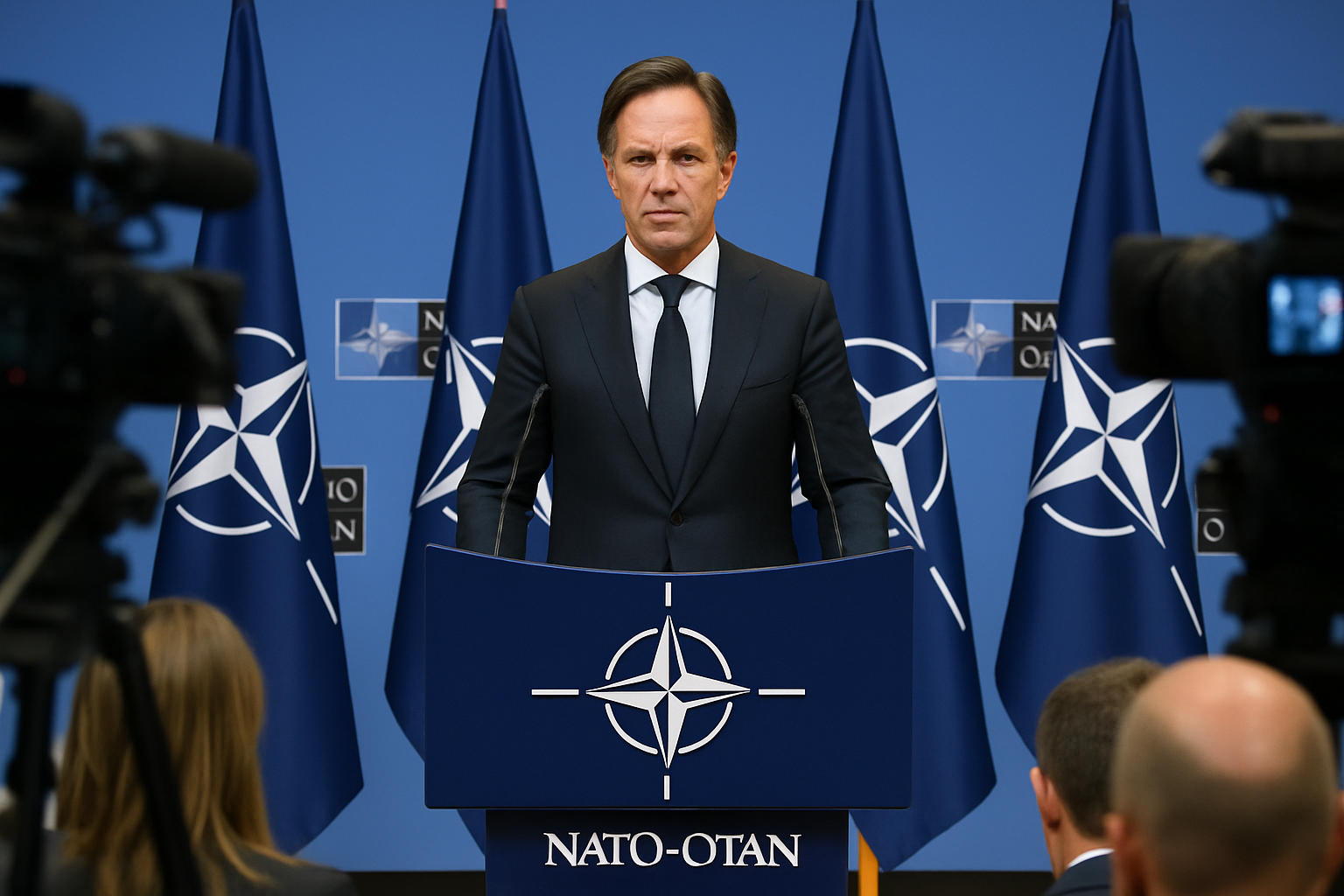
NATO Secretary-General Mark Rutte has urged allied capitals to consider rapid commitments to help secure the Strait of Hormuz, after President Donald Trump signaled he wants concrete support within days from alliance members struggling to respond to Iran's continued blockade of the strategic waterway.
Reuters reported that Rutte briefed several allied governments following a crucial meeting with Trump in Washington on Wednesday, held against the backdrop of mounting tensions within NATO over the escalating conflict with Iran. The high-stakes diplomatic consultations come as the alliance faces its most serious test since the Cold War, with fundamental disagreements emerging over military support for U.S. operations in the Persian Gulf.
NATO Unity Under Strain
Diplomatic sources indicated that frustration is growing in Washington over what Trump administration officials perceive as inadequate allied support. However, some European allies have pushed back strongly, noting they were not consulted before or after the outbreak of hostilities that have now entered their second month.
While NATO as an alliance is not expected to take a direct role in military action against Iran, there is willingness among member states to explore longer-term measures to safeguard shipping through Hormuz, particularly as diplomatic efforts with Tehran appear increasingly futile.
"The president has made it clear that he expects concrete commitments from our allies who benefit from stable energy markets and free navigation,"
— Senior NATO Official, speaking on condition of anonymity
The Iranian Blockade: A Global Crisis
Iran's Revolutionary Guard has maintained effective control of the Strait of Hormuz since early March, deploying an estimated 2,000-6,000 naval mines throughout the 21-mile waterway that handles 40% of global seaborne oil transit. The crisis has already triggered the most severe energy emergency since the 1970s oil shocks, with oil prices peaking at $119.50 per barrel for Brent crude.
The International Energy Agency has responded with its largest strategic petroleum reserve release in 50-year history—400 million barrels from 32 countries—while over 150 oil and LNG tankers remain stranded in the Persian Gulf, representing billions in cargo value. Major shipping companies including Maersk and MSC have suspended all operations in the region.
European Responses Diverge
The crisis has exposed significant divisions within NATO about the appropriate response to Iran's actions. While some allies have contributed to naval protection efforts—particularly following Iranian drone attacks on RAF Akrotiri in Cyprus, the first attack on European territory since World War II—others remain reluctant to provide direct military support.
Germany has confirmed participation in the IEA strategic reserves release, with Japan deploying 80 million barrels for the first time since the 2011 Fukushima disaster. However, several European nations have been notably absent from discussions about naval convoy operations.

Trump's Ultimatum Strategy
Trump has repeatedly criticized NATO members for what he describes as ineffective responses to the Iranian threat. The president has warned of "very bad consequences" if allies fail to assist in reopening the critical shipping route, representing unprecedented transatlantic pressure during an active military crisis.
The administration has specifically called on China, France, Japan, South Korea, and Britain to send warships to jointly secure the waterway, though several nations have declined these requests. Australia and Japan have explicitly rejected direct naval deployment requests, citing concerns about escalation.
The Diplomatic Breakdown
The current crisis stems from the complete collapse of U.S.-Iran nuclear negotiations, despite what had been described as a "broad agreement on guiding principles"—the most progress since the 2018 JCPOA withdrawal. The diplomatic breakdown occurred when Iran excluded ballistic missiles and proxy groups as "red lines" while the United States demanded comprehensive coverage of missiles, armed groups, and human rights.
This led to Operation Epic Fury, the largest U.S.-Israeli coordinated operation since 2003, which prompted massive Iranian retaliation under "Operation True Promise 4." Iranian officials declared "no red lines remain" in their systematic targeting of regional coalition territories.
Regional Coalition Under Pressure
The Iranian response has severely strained the previously unprecedented Saudi/UAE/Qatar/Egypt diplomatic consensus. Regional casualties include one civilian killed in Abu Dhabi, 32 injured in Kuwait airport strikes, and eight wounded in Qatar despite Patriot missile systems intercepting 65 missiles and 12 drones.
Egyptian President Abdel Fattah el-Sisi condemned the attacks on "sisterly countries," warning of "comprehensive chaos" if the escalation continues. This represents a fundamental challenge to decades of established Gulf security arrangements.
"We are witnessing the greatest test of multilateral cooperation in the modern era,"
— UN Secretary-General António Guterres
Global Economic Ramifications
The crisis has generated unprecedented global economic disruption. Aviation networks have been paralyzed with over 18,000 flights cancelled worldwide—the most extensive disruption since COVID-19. Eight Middle Eastern countries maintain simultaneous airspace closures, while Dubai International Airport, the world's busiest, remains shut due to missile damage.
Financial markets have crashed globally, with Pakistan's KSE-100 suffering its largest single-day decline in history (-8.97%) and South Korea's KOSPI triggering circuit breakers with a 12% drop. Consumer impacts range from fuel rationing in Bangladesh for 170 million people to emergency price controls across Europe.
Nuclear Governance Crisis
The maritime crisis occurs against the backdrop of a broader nuclear governance breakdown. The New START Treaty expired on February 5, marking the first time in over 50 years without U.S.-Russia nuclear constraints. Iran continues uranium enrichment to 60% purity with over 400kg of weapons-grade material—sufficient for multiple weapons.
This represents what UN officials describe as nuclear risks at their "highest level in decades," creating a template-setting moment for 21st-century diplomacy versus military confrontation in an increasingly multipolar world.
Energy Architecture Transformation
The crisis has exposed dangerous over-dependence on strategic chokepoints, requiring fundamental restructuring of global energy architecture. The 21-mile Strait of Hormuz represents a single-point failure in modern logistics, with no realistic alternatives capable of handling the diverted volume.
Qatar Energy Minister Saad Al Kaabi has warned that Gulf states may be forced to declare force majeure "within weeks," with oil potentially approaching $150 per barrel in a scenario that could "bring down the economies of the world."
Looking Ahead: Critical Decisions
As NATO allies grapple with Trump's demands for concrete support, the alliance faces fundamental questions about its role in energy security and crisis response. The outcome will likely determine precedents for 21st-century conflict resolution, affecting everything from energy market evolution to nuclear proliferation prevention.
The current crisis represents the most dangerous international situation since the Cold War's end, affecting regional war prevention, global energy security, nuclear governance credibility, and international law enforcement simultaneously. Success in containing the crisis could provide a framework for future nuclear crisis resolution, while failure may accelerate military solutions and encourage proliferation worldwide.
The coming days will prove critical as NATO members weigh their responses to American pressure against their own strategic calculations, with implications extending far beyond the current maritime emergency to shape the fundamental nature of transatlantic security cooperation for decades to come.