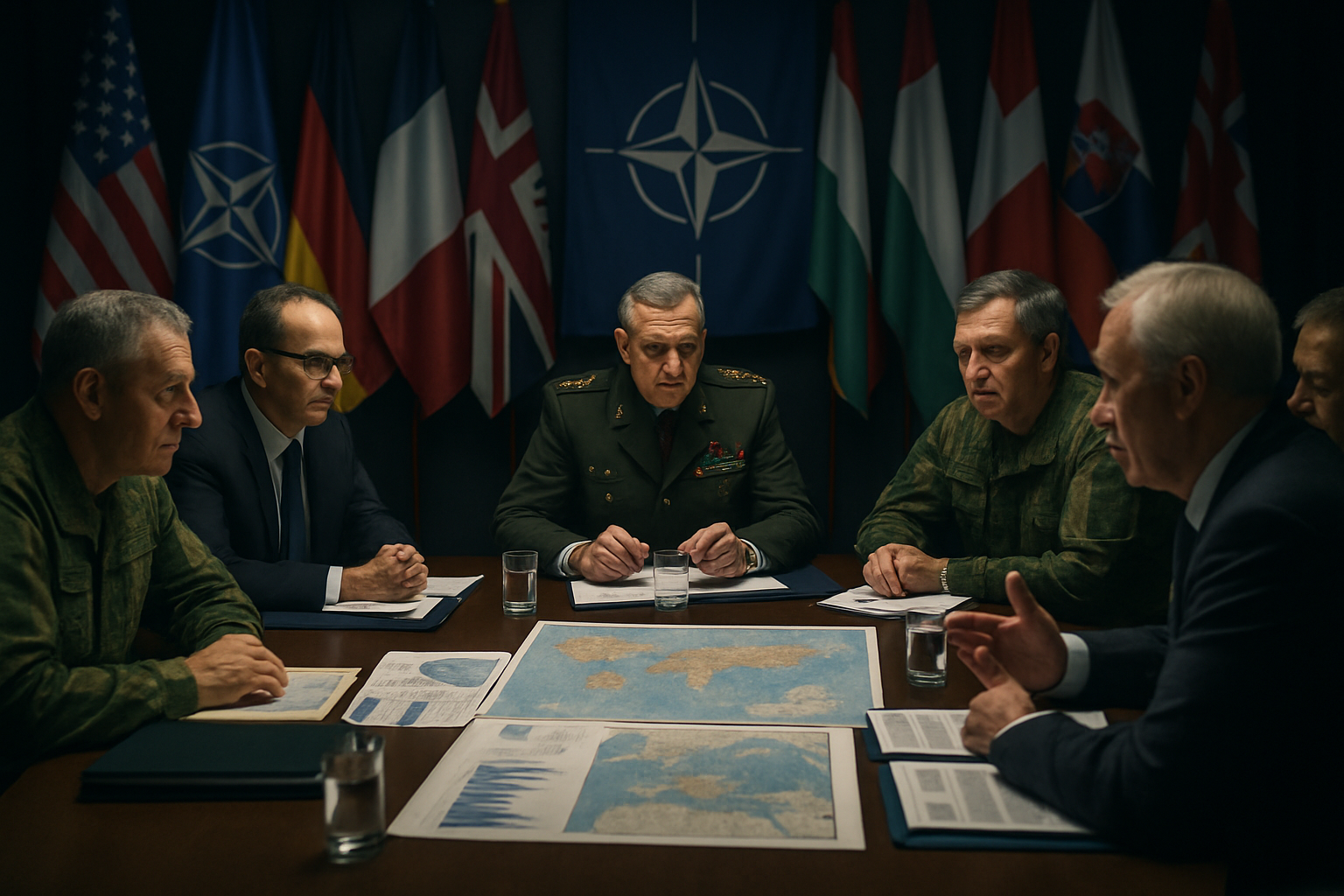
The NATO alliance faces its gravest existential crisis since its founding in 1949, as President Donald Trump escalates threats to withdraw the United States from the 75-year partnership following European allies' comprehensive rejection of military support for operations in the Strait of Hormuz.
Behind closed doors at the White House, tensions reached a breaking point when NATO Secretary-General Mark Rutte met with Trump amid what sources describe as "sharp words and threats" over European support for Operation Epic Fury. The meeting, characterized by the White House as "frank and open discussion between good friends," failed to ease mounting tensions that have fundamentally altered the transatlantic relationship.
European Allies Draw the Line
The crisis stems from European allies' unprecedented coordinated rejection of Trump's demands for naval coalition support in the Persian Gulf. German Defense Minister Boris Pistorius led the resistance with a pointed question that has become emblematic of European frustration: "What does Donald Trump expect a handful of European frigates to do that the powerful US Navy cannot?"
The rejection was comprehensive and historically significant. France explicitly declined warship deployment, Japan and Australia refused naval vessels despite their critical dependence on Middle East oil, and Sweden's Prime Minister Ulf Kristersson cited "Iraq lessons" in refusing assistance. This represents the most unified European rejection of American military leadership since the 2003 Iraq War.
"We will not be accomplices in something that is bad for the world simply out of fear of retaliation."
— Pedro Sánchez, Spanish Prime Minister
Spain escalated the confrontation beyond symbolic rejection to concrete action, with Prime Minister Pedro Sánchez denying US military base access and Defense Minister Margarita Robles closing Spanish airspace to US military aircraft involved in Iran operations. This forced American planes to bypass Spain entirely for Middle East missions, marking the first such denial since the 1950s defense agreements.
Trump's Unprecedented Response
Trump's reaction has been swift and historically unprecedented. In a Truth Social declaration that shocked diplomatic circles, he wrote: "We no longer 'need' or want assistance from NATO countries—IN FACT, WE NEVER NEEDED IT!" The president has repeatedly called NATO a "paper tiger" and confirmed through the White House that he is "seriously considering" US withdrawal from the alliance.
The administration has moved beyond rhetoric to concrete threats. Trump ordered Treasury Secretary Scott Bessent to "cut off all dealings" with Madrid and threatened to "cut off all trade" with Spain, calling it a "terrible ally." Reports suggest the administration is examining potential sanctions against NATO allies deemed insufficiently supportive during the Iran crisis.
European Strategic Autonomy in Action
The crisis has catalyzed a remarkable demonstration of European strategic autonomy. While rejecting American requests for Persian Gulf operations, European allies showed unprecedented unity in defending their own territory. When Iranian drones struck RAF Akrotiri in Cyprus—the first attack on European soil since World War II—a four-nation naval coalition led by HMS Dragon, supported by Spanish, Italian, French, Dutch, and Greek vessels, responded within hours.
This selective cooperation paradigm represents a fundamental shift in European thinking: support for defensive operations while rejecting what they view as "optional wars" or "American military adventures." The European Union activated its ESTIA crisis mechanism for the first time in history, demonstrating institutional capacity for independent action.
Nuclear Deterrence Discussions
The alliance strain has accelerated unprecedented discussions about European nuclear deterrence. German Chancellor Friedrich Merz confirmed direct negotiations with French President Emmanuel Macron about expanding France's nuclear deterrent beyond national scope—the first such serious talks since the Cold War ended.
Nordic countries have abandoned long-standing nuclear-free policies, with Finland lifting its comprehensive nuclear weapons ban and Sweden expressing willingness to host nuclear weapons during wartime. These discussions reflect deep European concerns about American security guarantee reliability under Trump's leadership.
Congressional Pushback and Domestic Opposition
Despite Trump's threats, bipartisan support for NATO remains strong in Congress. Senators from both parties have issued statements supporting continued alliance membership, providing European allies some reassurance about long-term American commitment. However, this institutional support contrasts sharply with executive branch hostility toward the alliance.
The Iran operation that sparked the NATO crisis faces unprecedented domestic opposition, with only 25% of Americans supporting the military action—historically low for early-stage operations. Operation Epic Fury has exceeded $27 billion in costs during its first month, running at approximately $1 billion daily with operations now extended through September 2026, far beyond the initial 4-6 week timeline.
Historical Significance and Global Stakes
UN Secretary-General António Guterres has characterized the current moment as "the greatest test of multilateral cooperation in the modern era." The crisis occurs amid multiple simultaneous challenges: the February 2026 expiration of the New START nuclear treaty (creating the first nuclear arms control void between the US and Russia in over 50 years), ongoing conflicts in Ukraine, and fundamental questions about the post-World War II international order.
Polish Prime Minister Donald Tusk captured European fears when he warned that NATO's breakup would be "Putin's dream plan." Estonian researchers note that while Trump cannot unilaterally withdraw from NATO, he can effectively "paralyze alliance activities and reduce US military presence in Europe."
Energy Security and Economic Warfare
The NATO crisis unfolds against a backdrop of global energy disruption. Iran's mining of the Strait of Hormuz has effectively closed 40% of global oil transit, sending oil prices above $100 per barrel and forcing the International Energy Agency to authorize its largest strategic petroleum reserve release in 50 years—400 million barrels from 32 countries.
The economic warfare dimension extends beyond energy to direct threats against allies. Trump's threat to impose unilateral trade embargos would violate WTO rules and existing EU-US agreements, but the precedent of weaponizing economic relationships against alliance partners marks a dangerous departure from post-war cooperation principles.
The Path Forward
As NATO approaches its crossroads, the stakes extend far beyond institutional survival. The alliance's adaptation—or failure to adapt—will establish precedents for 21st-century international cooperation, burden-sharing models, and the balance between national sovereignty and collective security obligations.
European strategic autonomy has evolved from aspiration to operational reality. The question now is whether this development strengthens or fragments Western security architecture. Success in managing the current crisis could create frameworks for institutional innovation and adaptation. Failure could accelerate Western fragmentation at a critical moment for international stability.
The coming weeks will test whether seven and a half decades of transatlantic partnership can survive its most severe challenge, or whether April 2026 will mark the beginning of a fundamental realignment in global security architecture. For European allies, the choice between strategic autonomy and traditional American deference has already been made—the question now is whether the alliance can evolve to accommodate this new reality while preserving collective defense principles that have underpinned Western security since 1949.