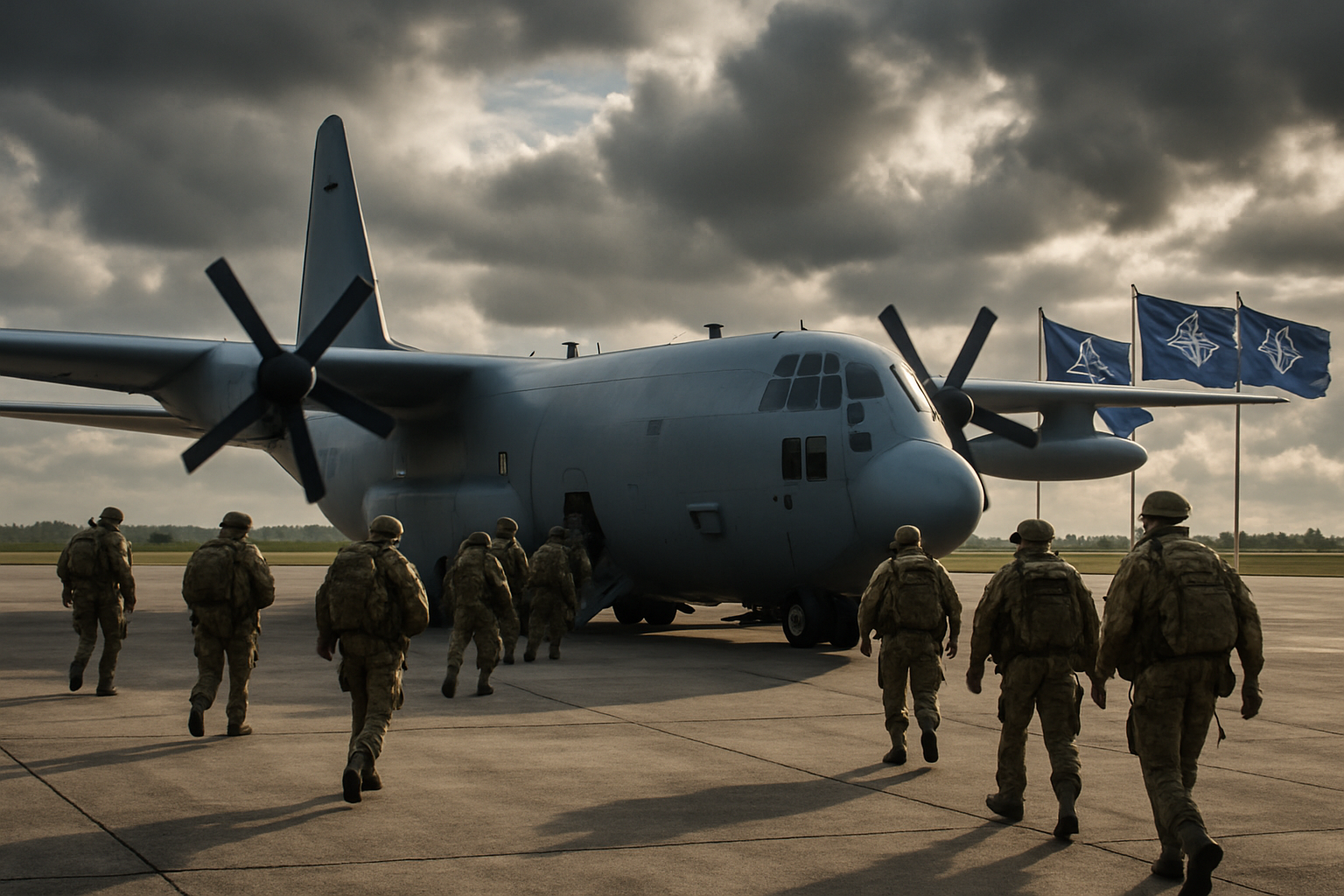
NATO forces including Italian and Canadian troops have begun evacuating Iraq following devastating Iranian missile strikes on military installations, marking the most significant Alliance withdrawal from the Middle East since the chaotic Afghanistan exit in 2021.
The Alliance confirmed Friday evening that personnel from its Iraq mission are being temporarily relocated to Europe as part of what officials describe as a "reconfiguration deployment" due to deteriorating security conditions. The move comes after Iran's Revolutionary Guard declared "no red lines remain" in systematic attacks targeting Western military assets across the region.
Italian Forces Under Direct Attack
Italian military installations have faced repeated Iranian drone targeting as part of Tehran's "Operation True Promise 4" escalation campaign. The Ali Al Salem airbase in Kuwait, which houses the Italian Task Force Air, has been struck multiple times over two weeks, with one drone destroying a shelter housing Italian aircraft.
General Luciano Portolano confirmed the drone hit but emphasized that "there have been no repercussions on the security of our military personnel." Defense Minister Guido Crosetto is monitoring developments "with maximum attention" as Italy maintains 2,000 troops deployed across regional bases alongside 30,000 Italian citizens in Gulf countries.

The Italian Task Force Air has operated continuously for 12 years since the ISIS period, making these assets among the closest NATO military positions to Iran and therefore primary targets in the current crisis. Despite asset losses, Italian forces are maintaining essential mission activities under enhanced security protocols.
Canadian Military Evacuation Confirmed
Canadian Defense Minister David McGuinty confirmed Friday that "Canadian military personnel left Iraq with NATO allies," though he declined to provide specific details about the evacuation timeline or force numbers. The withdrawal represents Canada's first major military evacuation from Iraq since the country's involvement in anti-ISIS operations began.
The evacuation comes as the U.S.-Israeli war against Iran enters its most dangerous phase, with Trump administration officials describing the conflict as requiring operations "through September 2026" - far beyond the initial 4-6 week timeline. Congressional sources report growing bipartisan concern about potential ground troop deployment.
Regional Security Collapse
The NATO withdrawal occurs amid the most dangerous international crisis since the Cold War, with Iranian forces systematically targeting Western military installations across Europe and the Middle East. For the first time since World War II, Iranian drones struck European territory when they attacked RAF Akrotiri in Cyprus, prompting an unprecedented naval coalition response involving British, Spanish, Italian, French, Dutch, and Greek vessels.
The crisis stems from the complete collapse of U.S.-Iran nuclear diplomacy despite achieving "broad agreement on guiding principles" in February 2026 - the most progress since the JCPOA framework collapsed in 2018. Iran's exclusion of ballistic missiles and regional proxies as "red lines" proved incompatible with U.S. demands for comprehensive agreements covering missiles, armed groups, and human rights.
Energy Crisis and Global Impact
Iran's mining of the Strait of Hormuz with an estimated 2,000-6,000 naval mines has effectively closed the waterway responsible for 40% of global oil transit. Oil prices have surged past $100 per barrel for the first time since 2022, heading toward warnings of $200 per barrel as the International Energy Agency authorized its largest strategic reserve release in 50 years - 400 million barrels from 32 countries.
"What does Donald Trump expect a handful of European frigates to do that the powerful US Navy cannot?"
— Boris Pistorius, German Defense Minister
European allies have delivered a crushing rejection of Trump's demands for an international naval coalition to reopen the Strait of Hormuz, with Germany, France, Japan, and Australia explicitly declining to send warships despite their critical dependence on Middle Eastern energy supplies.
Aviation Crisis Reaches COVID Scales
The conflict has triggered the most severe global aviation crisis since the COVID-19 pandemic, with over 18,000 flights cancelled worldwide. Eight Middle Eastern countries have simultaneously closed their airspace, completely severing Europe-Asia flight corridors. Dubai International Airport, the world's busiest with 86 million annual passengers, remains shuttered due to missile damage.
Major carriers including Emirates, Air France-KLM, and Wizz Air have suspended operations indefinitely, stranding hundreds of thousands of passengers globally and exposing the vulnerability of modern aviation networks to regional conflicts.
Humanitarian and Nuclear Concerns
The Pentagon has confirmed U.S. responsibility for an elementary school strike in Minab, Iran, that killed an estimated 165-185 students due to "outdated targeting data." The tragic incident has prompted 46 Senate Democrats to demand a comprehensive investigation and represents one of the war's most controversial moments.
Iran continues uranium enrichment at 60% purity with over 400 kilograms of material approaching weapons-grade levels - sufficient for multiple nuclear weapons if weaponized. The crisis occurs in the context of broader nuclear governance breakdown, with the New START treaty having expired in February 2026, marking the first 50-year period without U.S.-Russia nuclear constraints.
Alliance Fractures Emerge
The NATO withdrawal from Iraq reflects deeper fractures within the Western alliance, as European leaders increasingly distinguish between territorial defense obligations and what they view as optional American military adventures. Despite refusing to join Gulf operations, Europeans demonstrated unprecedented unity in defending their own territory after Iranian attacks on Cyprus.
This selective cooperation highlights growing European strategic autonomy, with the continent willing to coordinate defensive measures while rejecting what German officials describe as American "optional war" rather than collective security necessity.
Regional Coalition Under Strain
The unprecedented diplomatic coalition of Saudi Arabia, UAE, Qatar, and Egypt that had backed nuclear diplomacy is now severely strained as Iranian retaliation targets their territories directly. Egypt's President Abdel Fattah el-Sisi condemned attacks on "sisterly countries," warning of "comprehensive chaos spreading across the region."
Gulf states find themselves caught between U.S. alliance obligations and Iranian pressure, with the UAE suffering one civilian death in Abu Dhabi, Kuwait reporting 32 injured from airport strikes, and Qatar forced to intercept 65 missiles and 12 drones despite diplomatic efforts.
Template-Setting Crisis
UN Secretary-General António Guterres has described the current crisis as "the greatest test of multilateral cooperation in the modern era." The rapid transition from diplomatic breakthrough to military escalation demonstrates the fragility of crisis management in the multipolar era, with implications extending far beyond the immediate conflict.
The stakes include regional war prevention, global energy security, nuclear governance credibility, and international law enforcement of post-World War II order principles. Success in containing the escalation could provide a framework for future nuclear crisis resolution, while failure may accelerate military solutions and reshape Middle Eastern geopolitics for decades.
Looking Forward
As NATO forces continue their withdrawal from Iraq, the Alliance faces its most severe test since formation. The coming phase will determine whether the crisis remains a contained regional confrontation or escalates into broader Middle Eastern warfare with global consequences affecting energy markets, supply chains, and diplomatic precedents.
The withdrawal marks a watershed moment in international relations, potentially establishing new precedents for 21st-century conflict resolution approaches and alliance obligations in an increasingly complex multipolar world. For European allies, the challenge lies in balancing territorial defense cooperation with resistance to what they view as discretionary American military interventions.
With Trump administration officials preparing for operations through September 2026 and Iranian forces maintaining their "no red lines" posture, the NATO withdrawal from Iraq may represent only the beginning of a broader reconfiguration of Western military presence in the volatile Middle East.