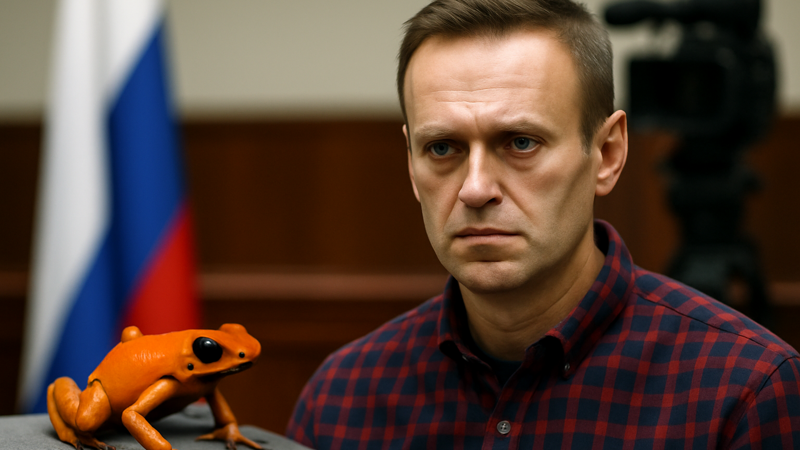
On the second anniversary of Alexei Navalny's death, five European nations presented conclusive scientific evidence that Russia assassinated the opposition leader using epibatidine toxin from South American poison dart frogs—the first documented use of such exotic poison in a state-sponsored killing.
The United Kingdom, Germany, France, Sweden, and the Netherlands announced Saturday their joint investigation had definitively proven Navalny was murdered using a rare neurotoxin naturally produced by Ecuadorian poison dart frogs. The toxin, not naturally found in Russia, required sophisticated state-level synthesis and deployment capabilities that investigators said only the Russian government possessed.
Breakthrough Scientific Investigation
The unprecedented multi-laboratory analysis used advanced mass spectrometry to detect epibatidine presence in biological samples two years after Navalny's death—a remarkable technical achievement given the toxin's rapid biological breakdown. The investigation required extraordinary European coordination and secrecy for transporting biological samples across borders.
"Only the Russian government had the means, motive, and opportunity to deploy this lethal toxin against Navalny out of fear of his opposition activities."
— UK Foreign Office Joint Statement
Swedish Foreign Minister Maria Malmer Stenergard emphasized the findings' certainty, stating: "It can only be Russia since he was in Russian custody." The investigation represents the most comprehensive international forensic cooperation in a suspected state assassination case in modern history.
Mother's Reaction at Moscow Grave
Speaking near her son's grave in Moscow on the second anniversary, Lyudmila Navalnaya said the European assessment confirmed what the family knew from the beginning. "This confirms what we knew from the start. We knew our son didn't simply die in prison—he was murdered," she told gathered supporters and journalists.
The widow, Yulia Navalnaya, declared the murder a "scientifically proven fact" and demanded that "murderer Putin must be held accountable." Supporters gathered at Navalny's Moscow grave despite risks, with Russian authorities arresting 14 people across the country during memorial events.
Pattern of Exotic Russian Assassinations
The epibatidine assassination represents a dangerous evolution in Russia's documented pattern of exotic poison attacks. Previous cases include Navalny's 2020 survival of Novichok poisoning, the 2018 Skripal attack using the same nerve agent, and Alexander Litvinenko's 2006 polonium poisoning in London.
Epibatidine, extracted from the skin of South American poison dart frogs, is 200 times more potent than morphine and affects pain and movement receptors, causing death through respiratory paralysis. The neurotoxin's use demonstrates Russia's deliberate shift toward increasingly exotic and untraceable substances requiring exceptional detection capabilities.
International Legal Action Initiated
The five European nations formally reported Russia to the Organisation for the Prohibition of Chemical Weapons (OPCW) for violating the Chemical Weapons Convention. This marks the first documented epibatidine use in a suspected state assassination, triggering formal international legal proceedings.
The OPCW referral could result in sanctions, asset freezes, and travel bans against Russian intelligence services. The UK is considering fresh sanctions targeting those responsible for the assassination program.
Germany characterized the measures as "an additional step toward de facto annexation," while Britain demanded Israel reverse moves warning of "unilateral attempts to alter the geographic and demographic makeup of Palestine."
Kremlin Denial and Russian Response
The Kremlin "strongly rejected" the European assessment, with spokesperson Maria Zakharova dismissing the findings as "Western propaganda deception" and "absurd desperation." Russian officials demanded concrete proof while following their familiar denial pattern despite mounting scientific evidence.
Russia's ambassador to Germany, Sergey Nechayev, claimed the poisoning story disrupts West-Russia dialogue, saying there are too many in the West who are "all-in on conflict with Russia."
Strategic Timing and Context
The announcement coincided with renewed international efforts to address Russian state-sponsored violence. Multiple European sources report that 15 nations issued a joint statement demanding the release of Russian political prisoners, describing Navalny's "legacy as alive."
The timing also occurred amid ongoing Ukraine peace negotiations, with the assassination evidence adding pressure for accountability measures against Russian leadership. The scientific certainty removes reasonable doubt compared to previous intelligence-based assessments.
Impact on Opposition Movement
Navalny's assassination effectively decapitated Russia's organized opposition movement. While his Anti-Corruption Foundation continues operating from abroad, it lacks his charismatic leadership that once mobilized millions of Russians against President Vladimir Putin's rule.
The sophisticated assassination sends a chilling message to Russian dissidents worldwide about the regime's technical capabilities and determination to eliminate opposition figures regardless of international consequences.
Forensic and Technical Breakthrough
The successful detection of epibatidine two years post-mortem represents a breakthrough in forensic science, given the toxin's rapid biological breakdown. The multi-laboratory confirmation methodology establishes new standards for evidence collection and international cooperation in forensic investigations.
The investigation required specialized equipment typically reserved for military applications and unprecedented intelligence sharing among NATO allies and EU members. This demonstrates the international community's commitment to holding state actors accountable for transnational crimes.
Broader Implications for International Law
The case establishes dangerous precedents for 21st-century authoritarian assassination programs that test international law enforcement boundaries. The coordinated European response represents the most comprehensive opposition to suspected Russian state crimes since the Cold War.
Legal experts cite potential violations of UN Security Council resolutions and Geneva Conventions on occupied territories. The systematic extension of Russian state violence beyond its borders meets international legal definitions of terrorism regardless of diplomatic immunity claims.
Looking Forward
The success or failure of achieving meaningful consequences for Russia's assassination program will influence other authoritarian regimes' calculations about the costs and risks of eliminating opposition figures abroad. The case affects precedents for territorial sovereignty, international justice cooperation, and conflict resolution mechanisms globally.
As the international community watches, the Navalny case has become a test of whether 21st-century global governance mechanisms can effectively respond to sophisticated state-sponsored crimes or demonstrate structural limitations when UN Security Council permanent members violate international law.
The scientific certainty achieved through this unprecedented international investigation provides an unassailable foundation for international action, potentially serving as a template for investigating other suspicious opposition deaths worldwide.