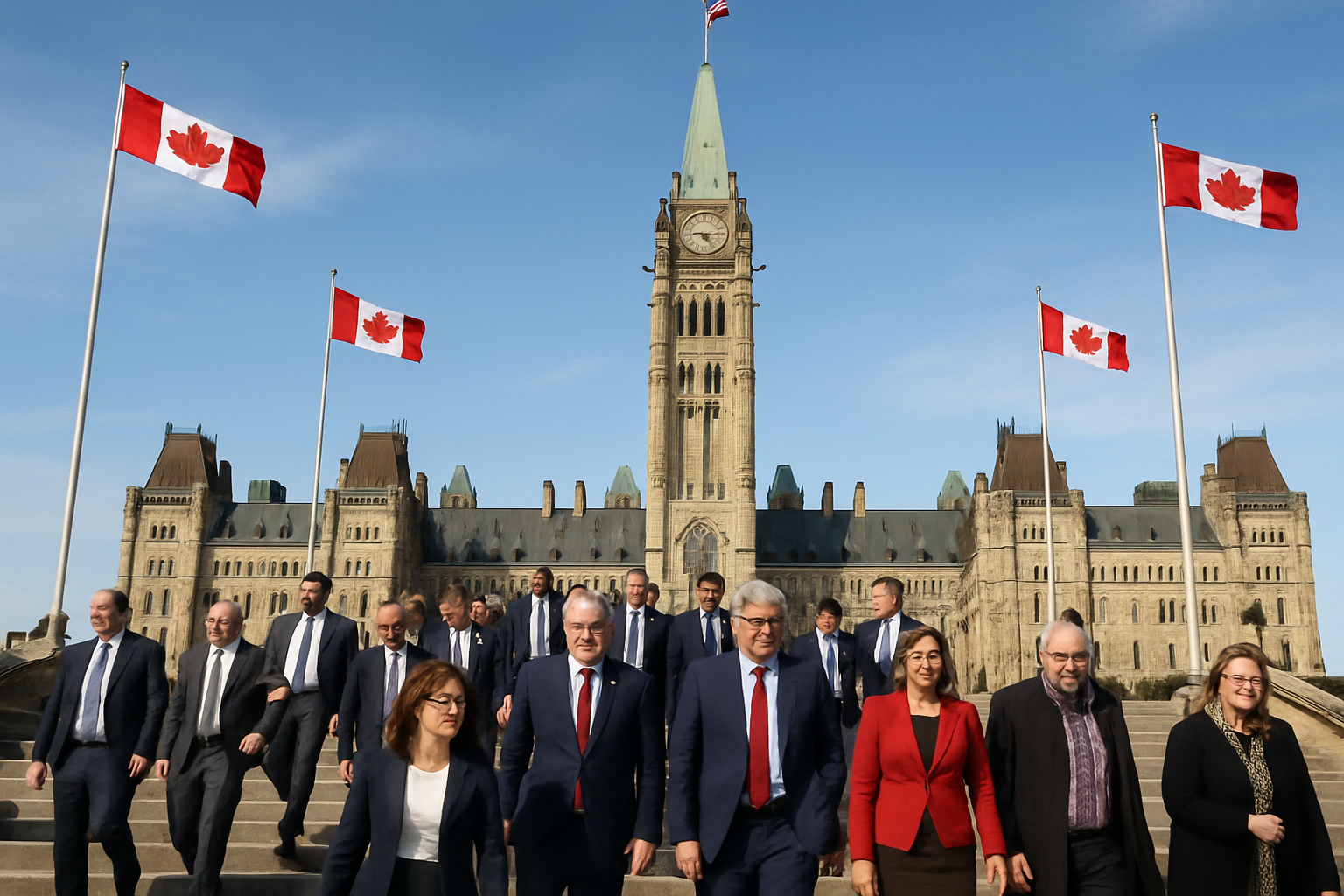
NDP MP Lori Idlout announced her decision to cross the floor to the Liberal Party on Tuesday, bringing Prime Minister Mark Carney's government one step closer to achieving a majority in Parliament while US-Canada relations face new strains over trade policy and sovereignty.
The Nunavut MP's defection represents a significant political development for Carney's Liberal government, which has been operating with a thin minority since taking power. Idlout's move reduces the NDP caucus while strengthening the Prime Minister's position in Parliament, providing greater stability for his legislative agenda during a period of heightened international pressure.
Strategic Timing Amid Trade Tensions
Idlout's floor-crossing comes at a crucial moment as Canada navigates increasingly complex trade relationships with the United States. US Ambassador to Canada Pete Hoekstra recently held what he described as a "very friendly" meeting with British Columbia Premier David Eby, despite numerous trade irritants between the two nations.
The ambassador declined to provide specific details about ongoing trade discussions, stating that any significant progress would be announced by the respective countries' leaders. However, the meeting underscores the continuous diplomatic efforts required to maintain the world's longest undefended border and one of the most integrated economic partnerships globally.
Trump's Provocative Commentary
Adding to the diplomatic complexity, President Donald Trump recently referred to Prime Minister Mark Carney as the "future governor of Canada" in a Truth Social post, making the controversial comment while discussing efforts to combat Asian carp in Lake Michigan, which straddles the US-Canada border.
The reference to Carney as a "governor" rather than Prime Minister appears to be another instance of Trump's pattern of making provocative statements about Canadian sovereignty, reminiscent of his previous comments about Canada becoming the "51st state." Such rhetoric continues to complicate bilateral relations despite ongoing diplomatic engagement.
"These comments demonstrate a fundamental misunderstanding of Canada's status as a sovereign nation and our constitutional democracy."
— Senior Canadian official, speaking on condition of anonymity
Parliamentary Mathematics and Governance
Idlout's defection alters the parliamentary arithmetic in Ottawa, providing Carney with additional votes for key legislation and budget measures. The move suggests confidence in the Liberal government's direction and policies, particularly regarding Northern and Indigenous issues that are central to the Nunavut MP's constituency concerns.
Political analysts note that floor-crossings often reflect deeper dissatisfaction with party leadership or policy direction. Idlout's move may signal broader tensions within the NDP caucus or attraction to the Liberal government's approach to issues affecting her constituents.
Historical Context of US-Canada Relations
The current tensions occur against the backdrop of Canada's long history of managing complex relationships with American administrations. From the memory available, Prime Minister Carney has already demonstrated significant international leadership, including his historic address to the Australian Parliament in March 2026 - only the second Canadian leader ever to receive such an honor.
Carney has positioned Canada as a "middle power" seeking to strengthen relationships with like-minded democracies during a period when traditional great power structures face unprecedented challenges. His government's approach emphasizes "pragmatic engagement" with global partners while maintaining democratic principles.
Economic Implications and Trade Policy
The ongoing US-Canada trade discussions come as both nations face pressure to maintain economic integration while addressing domestic political concerns. Previous tensions over tariffs have demonstrated the vulnerability of the bilateral relationship to political volatility, making diplomatic engagement essential for economic stability.
Canada's economy remains heavily integrated with the United States, with bilateral trade exceeding $700 billion annually across energy, automotive, agricultural, and technology sectors. Any disruption to this relationship would have significant consequences for both economies.
Looking Forward
Idlout's floor-crossing strengthens Carney's parliamentary position at a time when steady leadership is crucial for navigating international challenges. The move provides the Prime Minister with additional political capital to advance his government's agenda while responding to external pressures.
The effectiveness of Canada's diplomatic approach will be tested in the coming months as the government balances maintaining strong bilateral relationships with defending Canadian sovereignty and democratic institutions. Success will depend on the government's ability to engage constructively while firmly defending national interests.
As these political developments unfold, they reflect broader themes of democratic resilience, international cooperation, and the ongoing challenge of managing relationships between sovereign nations in an increasingly interconnected but politically volatile world.