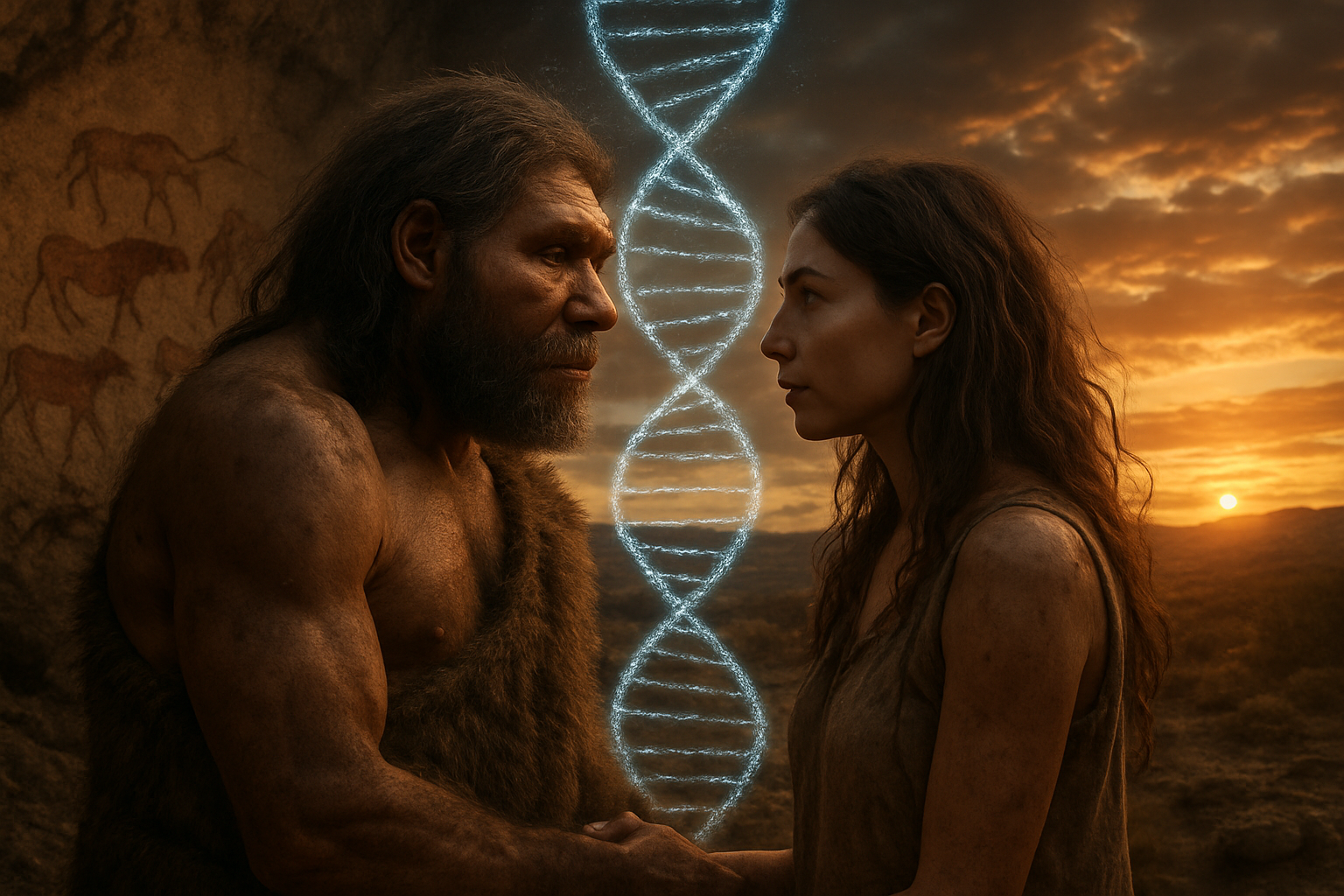
Groundbreaking genetic research has revealed remarkable insights into prehistoric human mating patterns, showing that Neanderthal males primarily engaged in relationships with modern human females approximately 45,000 years ago, fundamentally reshaping our understanding of early human evolution and interbreeding dynamics.
The discovery, emerging from analysis of X-chromosome DNA patterns in modern humans, represents one of the most significant breakthroughs in prehistoric anthropology in recent years. Researchers examining the conspicuous absence of Neanderthal genes on modern humans' X-chromosomes found compelling evidence pointing to specific directional mating preferences that have profound implications for how we understand our evolutionary past.
Revolutionary Genetic Evidence
According to research published across multiple European scientific institutions, the absence of Neanderthal genetic material on the X-chromosome of modern humans can be most simply explained by particular sexual preferences of our prehistoric ancestors. This finding challenges decades of assumptions about random interbreeding between Neanderthal and Homo sapiens populations.
Swedish research led by Professor Lars Werdelin suggests that Neanderthal males may have been more attractive partners to modern human females than previously imagined. "It may very well have been that they were both more pleasant and more generous than we ourselves were," Werdelin noted, proposing that Neanderthal males possessed social qualities that made them desirable partners to Homo sapiens women.
The genetic evidence is particularly compelling because X-chromosomes are inherited differently than other chromosomes. Women carry two X-chromosomes (one from each parent), while men carry one X-chromosome (from mother) and one Y-chromosome (from father). This inheritance pattern creates unique genetic signatures that researchers can trace back tens of thousands of years.
Challenging Traditional Evolution Models
This discovery occurs within a broader context of archaeological and genetic findings that are revolutionizing our understanding of early human capabilities and behaviors. The February 2026 research builds upon recent discoveries showing that early humans possessed far more sophisticated social, technological, and cognitive abilities than traditional evolutionary models suggested.
The evidence suggests that rather than simple random encounters between populations, there were complex social dynamics at play during the period of Neanderthal-Homo sapiens coexistence in Europe and western Asia between approximately 45,000 and 28,000 years ago.
Austrian scientific sources describe this pattern as arising from "particular sexual preferences of our ancestors," indicating that mate selection during this crucial period of human evolution involved deliberate choices rather than mere opportunity. This suggests sophisticated social cognition and cultural practices among both Neanderthal and modern human populations.
Advanced Research Methodologies
The research employed cutting-edge genetic analysis techniques that allow scientists to trace inheritance patterns across millennia. By examining the distribution of Neanderthal DNA across different chromosomes in modern human populations, researchers can reconstruct mating patterns from prehistoric times with remarkable precision.
The methodology represents a convergence of traditional archaeological approaches with advanced genetic sequencing, environmental reconstruction, and population modeling. This interdisciplinary approach has become characteristic of what experts are calling the "2026 Archaeological Renaissance," where sophisticated analytical techniques are revealing previously hidden complexities in human evolutionary history.
International cooperation has been essential for this research, with teams spanning Austria, Sweden, and Singapore collaborating to analyze genetic data from diverse modern human populations across continents. This global approach ensures that findings reflect broad patterns rather than regional anomalies.
Social and Cultural Implications
The discovery suggests that Neanderthal-Homo sapiens relationships involved complex social dynamics that went beyond simple survival needs. The evidence of directional mating preferences indicates sophisticated cultural practices, potentially including courtship behaviors, social negotiations, and community acceptance of inter-group relationships.
Professor Werdelin's observation that Neanderthals may have been "more pleasant and generous" challenges longstanding stereotypes of Neanderthals as primitive or brutish. Instead, the evidence suggests they possessed social qualities that made them attractive partners, potentially including advanced communication skills, resource sharing, and emotional intelligence.
This research also provides insights into the integration of different human populations during a crucial period of migration and cultural exchange. Rather than violent competition or displacement, the evidence suggests complex social relationships that facilitated genetic and likely cultural exchange between groups.
Broader Scientific Context
This breakthrough occurs within a remarkable period of scientific discovery that is reshaping our understanding of human evolution and prehistoric capabilities. Recent months have seen discoveries of fire control 350,000 years earlier than expected, sophisticated astronomical systems dating back 8,000 years, and evidence of complex surgical procedures in ancient civilizations.
The Neanderthal mating pattern discovery contributes to a growing body of evidence suggesting that early human societies were far more sophisticated than traditional models assumed. This includes evidence of advanced planning capabilities, complex social organization, and technological innovation much earlier in human history than previously believed.
Climate change research has added urgency to archaeological and genetic studies, as environmental pressures threaten sites worldwide and create opportunities for accelerated research and preservation efforts. The current findings benefit from this intensified research environment, where international cooperation and advanced analytical techniques are producing remarkable results.
Future Research Directions
The discovery opens numerous avenues for future investigation. Researchers plan to expand genetic analysis to larger and more diverse modern human populations to confirm the patterns observed. Additionally, scientists are investigating whether similar directional mating preferences occurred in other regions where Neanderthals and modern humans coexisted.
Archaeological teams are also searching for material culture evidence that might support the genetic findings, including artifacts that could indicate social or cultural exchange between groups. Cave art, tool technologies, and settlement patterns may provide additional insights into the nature of Neanderthal-Homo sapiens relationships.
The research methodology developed for this study may also be applicable to investigating other aspects of prehistoric human behavior and social organization. The techniques for tracing inheritance patterns could reveal additional insights into ancient migration patterns, population dynamics, and cultural practices.
Implications for Modern Understanding
Beyond its scientific significance, this research has broader implications for how we understand human nature, social relationships, and cultural development. The evidence of sophisticated mate selection and cross-group relationships 45,000 years ago suggests that complex social cognition and cultural practices have deep evolutionary roots.
The findings also challenge simplistic narratives about human evolution and prehistoric life. Rather than portraying early humans as driven purely by survival instincts, the evidence suggests rich social and emotional lives involving choice, preference, and complex interpersonal relationships.
As Professor Werdelin noted, the research suggests that our Neanderthal cousins may have possessed admirable qualities that attracted modern human partners. This perspective encourages a more nuanced and respectful understanding of all branches of the human family tree and the complex interactions that shaped our evolutionary history.
The discovery represents a fundamental shift in our understanding of prehistoric human relationships and challenges us to reconsider assumptions about the development of human social behavior, mate selection, and cultural exchange during one of the most crucial periods in our evolutionary past.