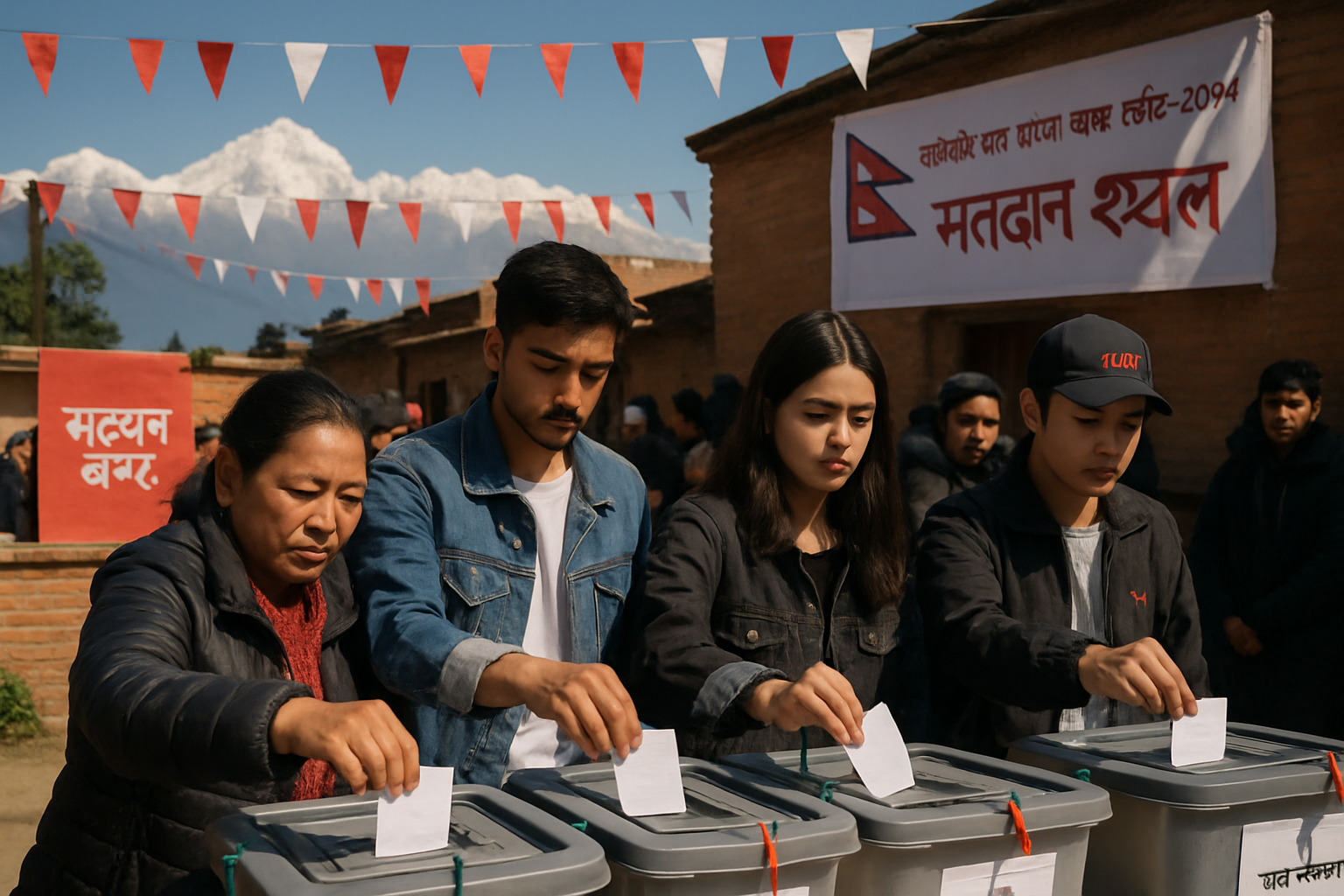
Nepal votes Thursday in a high-stakes parliamentary election that represents the first democratic test since Generation Z-led protests toppled the government six months ago, with a 35-year-old former rapper emerging as the unlikely face of political transformation in the Himalayan nation.
The election pits entrenched traditional parties against a powerful youth movement that successfully ended decades of political stagnation through deadly street protests in September 2025. At the center of this generational upheaval stands Balendra Shah, known as "Balen," a former hip-hop artist turned Kathmandu mayor who now seeks to become Nepal's youngest prime minister.
Millions of Nepali voters began casting ballots Thursday morning across 23,000 polling stations to elect 275 lawmakers, in what observers describe as the most consequential election in the nation's recent democratic history. The interim administration, led by former Chief Justice Sushila Karki since the violent uprising that left 77 dead and over 2,000 injured, declared a three-day public holiday to facilitate voting in the country of 30 million people.
From Hip-Hop to Political Hope
Shah's transformation from underground rapper to political phenomenon embodies the broader generational shift sweeping Nepal. His rise reflects widespread frustration among young Nepalis with traditional parties that have dominated politics since the country's transition to democracy, cycling through governments without delivering meaningful change on unemployment, corruption, or basic services.
"Nepalis have been waiting for change for so long, from one system to another," said Nilanta Shakya, a 60-year-old retired engineer who voted early at a college in Kathmandu. "I hope there is a meaningful change this time."
The election comes six months after the so-called "Gen Z protests" erupted across Nepal, initially triggered by government restrictions on social media but quickly evolving into broader demonstrations against corruption, unemployment, and economic inequality. The protests ultimately forced the resignation of Prime Minister K.P. Sharma Oli's government in September 2025.
A New Political Landscape
The contest features a complex multi-party race between traditional powerhouses and emerging youth-led movements. The main established parties include the Marxist former prime minister seeking a return to office and the newly elected leader of the powerful Nepali Congress party. However, it is Shah's independent youth movement that has captured national attention and international media coverage.
Shah, who served as Kathmandu's mayor before entering national politics, represents a broader phenomenon across South Asia where young leaders are challenging established political dynasties. His campaign emphasizes transparency, digital governance, and systematic anti-corruption measures—issues that resonate strongly with Nepal's large youth population.
The election takes place against the backdrop of Bangladesh's recent democratic transformation, where a similar youth-led uprising successfully ousted an authoritarian government and established new democratic institutions through peaceful electoral processes. International observers are closely watching whether Nepal can achieve a similar peaceful transition through institutional means rather than continued street demonstrations.
International Stakes and Regional Implications
The election carries significant implications for Nepal's relationships with its giant neighbors, India and China, both of whom maintain substantial influence in the landlocked nation's politics and economy. Nepal's strategic location between these two powers makes its political stability crucial for regional security and economic cooperation.
The interim government has enhanced security measures, deploying thousands of police and military personnel to ensure peaceful polling. Remote mountainous areas require helicopter access to transport election materials and officials to polling stations, highlighting the logistical challenges of conducting democratic exercises in Nepal's difficult terrain.
International election observers have arrived to monitor the proceedings, with particular attention to whether the election can meet international standards for free and fair democratic processes. The credibility of these elections will determine Nepal's standing in the international community and its access to development assistance and investment.
Economic Challenges and Youth Unemployment
The new government will inherit significant economic challenges, including high unemployment rates that particularly affect young people, infrastructure deficits, and recovery needs from recent natural disasters. Millions of Nepalis work abroad, sending remittances that constitute a major portion of the national economy, highlighting the lack of domestic employment opportunities.
The youth-led movement that brought about these elections has demanded not just political change but concrete improvements in economic opportunities, education, and governance transparency. Shah and other young candidates have promised to address corruption systematically and implement modern governance practices using technology and citizen participation.
"This election is critical in determining our future. Young people have shown they can change governments through peaceful means, and now they want to show they can govern effectively too."
— Political analyst in Kathmandu
Democratic Consolidation Test
Nepal's election represents a crucial test of whether popular uprisings can successfully transition into stable democratic governance. The country has experienced political instability for decades, with frequent changes of government and weak institutions that have struggled to deliver basic services to citizens.
The success of this electoral process could establish Nepal as a model for democratic consolidation in South Asia, demonstrating how mass movements can achieve sustainable political change through institutional processes. Failure, however, could lead to renewed instability and undermine confidence in democratic solutions to governance challenges.
Results are expected within days of voting, with the formation of a new government likely to take weeks or months depending on coalition negotiations. The election uses a mixed proportional representation system that typically requires coalition governments, meaning successful parties must demonstrate their ability to compromise and work together.
Looking Forward
Whatever the outcome, Thursday's election marks a watershed moment in Nepali politics. The emergence of figures like Balendra Shah—from rapper to mayor to potential prime minister—illustrates how dramatically the political landscape has shifted in favor of younger, outsider candidates promising systemic change.
The election also tests whether Nepal's democratic institutions can channel popular demands for change into effective governance. Success would reinforce the power of peaceful democratic processes to achieve political transformation, while failure could embolden those who prefer extra-constitutional means to bring about change.
For Nepal's neighbors and the international community, the stakes are equally high. A stable, democratic Nepal governed by legitimate leaders chosen through free and fair elections would contribute to regional stability and provide a positive example for democratic governance in South Asia.
As voters across Nepal make their choices Thursday, they are not just selecting representatives but determining whether their country can successfully navigate from protest to governance, from upheaval to institutional stability, and from youth movement to mature democracy.