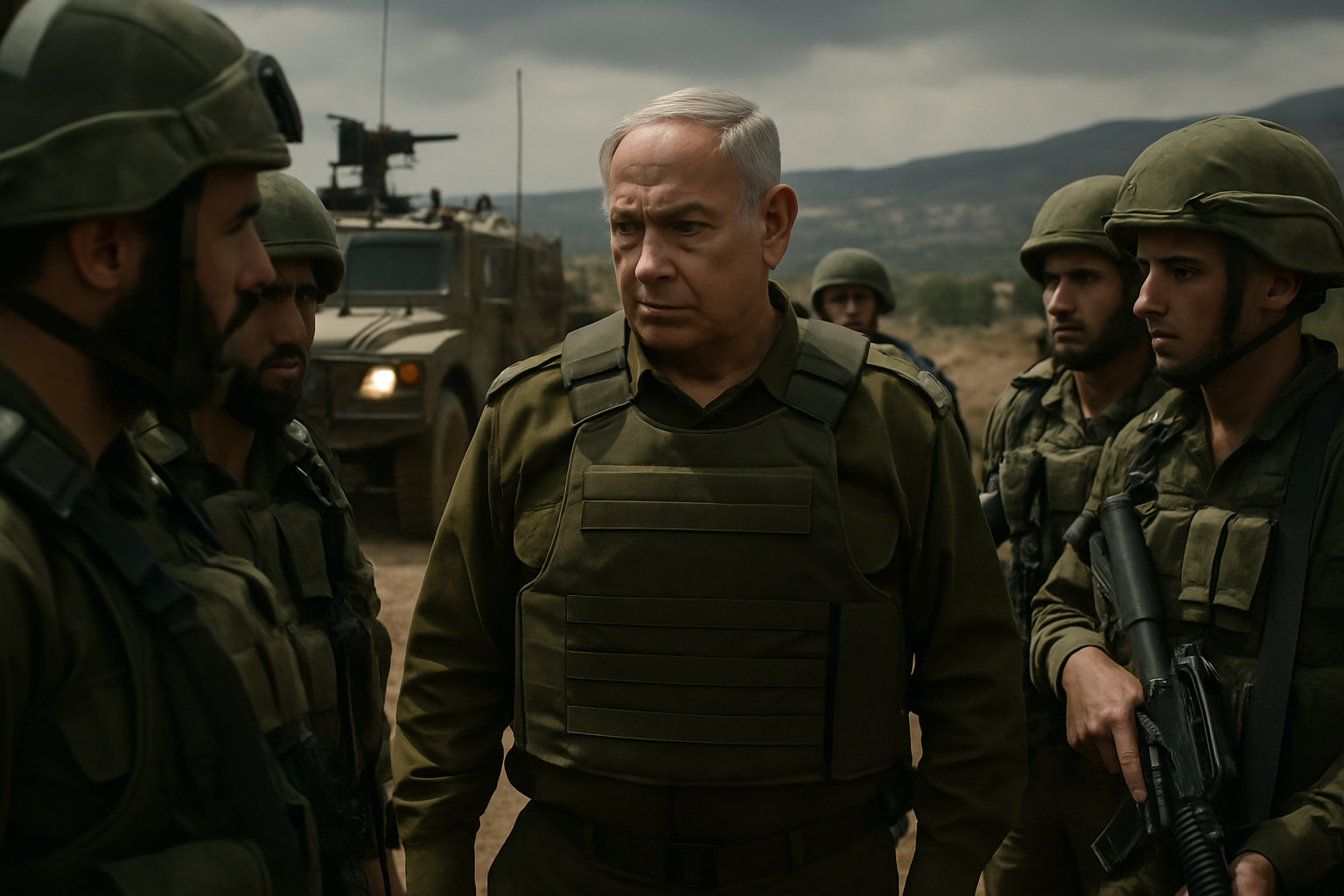
Israeli Prime Minister Benjamin Netanyahu made a high-profile visit to Israeli forces stationed in southern Lebanon on Sunday, declaring that the threat of a Hezbollah invasion has been "eliminated" through military operations, even as the region continues to grapple with escalating tensions and ongoing violence.
Netanyahu's appearance in the contested border region comes just two days before scheduled direct talks between Lebanese, Israeli, and American officials in Washington - the first formal diplomatic engagement since the complete collapse of the November 2024 ceasefire agreement in March 2026. His visit to troops wearing a flak jacket and surrounded by masked soldiers was captured in a video released by his office, emphasizing the continued military nature of Israel's presence in the area.
Netanyahu's Declaration and Military Assessment
"The war continues, including within the security zone in Lebanon," Netanyahu stated during his visit, according to multiple international media reports. The Israeli Prime Minister asserted that previous strikes on Hezbollah have "thwarted the threat of an invasion from Lebanon," while indicating that military operations would persist until all objectives are achieved.
This declaration comes amid what Israeli Defense Forces Chief Eyal Zamir has described as operations that are "just beginning" with "several weeks" of continued ground operations planned. The scope of Israeli military activity has expanded significantly beyond the positions held under the November 2024 ceasefire arrangement, with forces now controlling an estimated 10% of Lebanese territory between the border and the Litani River.
Humanitarian Crisis Deepens
The human cost of the ongoing conflict has reached catastrophic proportions. According to Lebanese health authorities, over 1.2 million Lebanese civilians - representing 25% of the country's population - have been displaced since the escalation began in March 2026. The death toll has exceeded 1,200 civilians, with emergency shelters overwhelmed to the point where thousands are sleeping on Beirut's streets.
"The humanitarian situation has reached unprecedented levels. Emergency shelters simply cannot accommodate the massive displacement we're witnessing."
— Lebanese Health Ministry Official
Particularly concerning is the systematic targeting of medical personnel, with 26 paramedics killed and 51 wounded since March 2026, according to documented reports. The deadliest single incident occurred at the Burj Qalaouiyah healthcare center in the Bint Jbeil district, where 12 medical workers - including doctors, nurses, and paramedics - were killed in what international observers have characterized as potential Geneva Conventions violations.
The Collapse of Diplomatic Frameworks
The current crisis stems from the complete breakdown of the November 2024 US-French brokered ceasefire that had held for over a year. This agreement had required both Israeli forces and Hezbollah to withdraw from southern Lebanon, creating a buffer zone monitored by Lebanese army units and UN peacekeepers.
The ceasefire collapsed in March 2026 when Hezbollah faced what sources describe as an "impossible choice" between maintaining the ceasefire arrangements and responding to Iranian pressure for retaliation following the death of Supreme Leader Ali Khamenei on March 1. The organization ultimately chose what it termed "Iranian solidarity over Lebanese sovereignty," declaring that "resistance was the only option."
This decision has pulled Lebanon into the broader Iran-Israel regional confrontation, fundamentally altering the strategic landscape and creating new complications for international mediators.
Military Operations and Tactical Developments
Israeli military operations have expanded significantly in scope and geographic reach. Recent strikes have targeted what Israel describes as Hezbollah infrastructure across multiple Lebanese regions, including weapons depots in the Bekaa Valley, command centers in southern Lebanon, and positions in Beirut's southern suburbs.
The targeting has also extended to civilian infrastructure, with Israeli forces destroying the strategic Qasmiyeh bridge over the Litani River and issuing demolition orders for homes near the border. This shift from purely military to civilian infrastructure targets has drawn international condemnation and accusations of collective punishment.
Hezbollah, for its part, maintains an estimated 20,000 fighters and has conducted over 40 operations targeting northern Israeli sites, with some attacks reaching as far as Haifa. The organization has declared "direct confrontations" with Israeli forces in southern Lebanon, marking a significant escalation from its previous restraint strategy.
International Diplomatic Efforts
Despite the military escalation, diplomatic initiatives continue. French President Emmanuel Macron has offered to host direct Israel-Lebanon talks in Paris - the first such negotiations since the ceasefire collapse. The scheduled Washington talks on Tuesday, April 15, 2026, represent the most significant diplomatic engagement between the parties in months.
However, a critical complication has emerged in what observers term the "Lebanon loophole." Netanyahu has explicitly excluded Lebanon from the broader US-Iran "Islamabad Accord" ceasefire framework that was mediated by Pakistan. This exclusion has created what Iranian officials describe as a "legitimate misunderstanding," with Iran threatening to withdraw from broader regional talks unless comprehensive ceasefire enforcement includes all fronts.
Regional and Global Implications
The Lebanon crisis has had far-reaching effects beyond the immediate region. The conflict has contributed to a global aviation crisis with over 18,000 flights cancelled worldwide, oil prices surging past $100 per barrel, and significant disruptions to international shipping through the Strait of Hormuz, which handles 40% of global oil transit.
The regional coalition of Arab states - including Saudi Arabia, UAE, Qatar, and Egypt - has maintained unified condemnation of the ongoing violence, with Egyptian President Abdel Fattah el-Sisi warning of "comprehensive chaos" spreading throughout the region if the crisis is not contained.
Template-Setting Crisis Management
UN Secretary-General António Guterres has characterized the current situation as the "greatest test of multilateral cooperation in the modern era." The crisis represents a template-setting moment for 21st-century conflict resolution, testing whether diplomatic intervention can prevent broader regional warfare or whether military escalation will become the dominant paradigm.
The success or failure of current containment efforts will likely establish precedents for international approaches to territorial disputes, humanitarian law enforcement, and conflict prevention mechanisms for decades to come.
Looking Ahead: Critical Juncture
As Netanyahu's visit to southern Lebanon underscores the military dimension of the crisis, the scheduled Washington talks represent perhaps the last immediate opportunity for diplomatic intervention. The negotiations will need to address not only immediate ceasefire arrangements but also longer-term security guarantees, the status of Hezbollah's military capabilities, and mechanisms to prevent external pressure from undermining future agreements.
The coming days and weeks are crucial in determining whether diplomatic solutions can gain traction or whether the region will continue on a trajectory toward expanded military confrontation affecting millions more civilians across the Middle East.
The stakes extend far beyond the immediate Israel-Lebanon dynamic, encompassing broader questions of regional stability, international law enforcement, and the viability of negotiated peace agreements in an era of complex proxy relationships and great power competition.