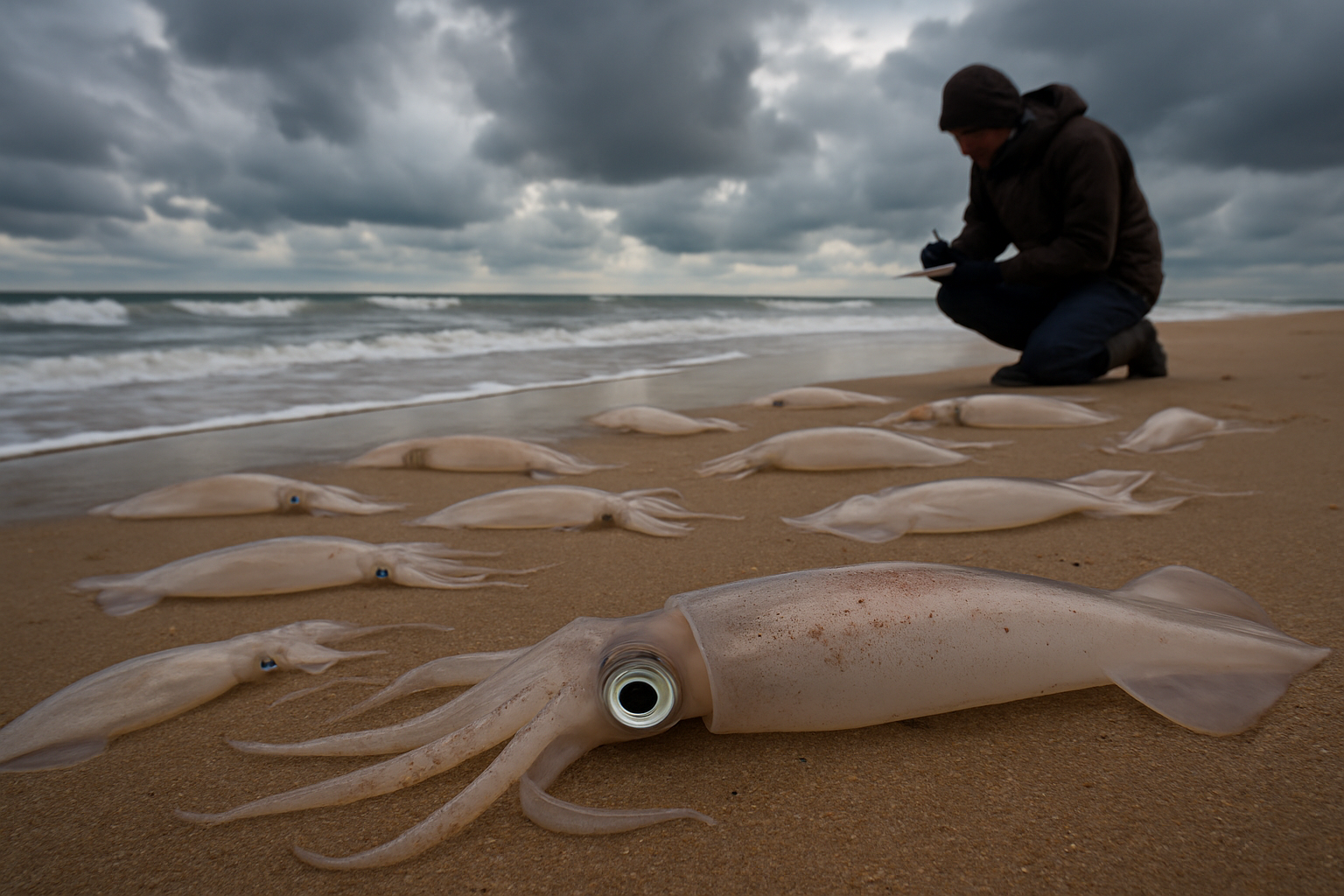
A remarkably large number of European flying squid have washed ashore on Dutch beaches in February and March 2026, marking an unprecedented marine phenomenon that signals concerning environmental changes in North Sea ecosystems during the 20th consecutive month of global temperatures exceeding 1.5°C above pre-industrial levels.
The mass stranding event, first reported by NL Times on March 16, 2026, represents an unusual disruption to normal marine life patterns along the Dutch coast. European flying squid (Todarodes sagittatus), typically found in deeper offshore waters, rarely appear in such numbers on beaches, making this event particularly significant for marine biologists and environmental scientists.
Understanding the European Flying Squid
European flying squids are dynamic oceanic cephalopods known for their remarkable swimming abilities and complex life cycles. These marine creatures typically inhabit the deeper waters of the North Atlantic and North Sea, using their powerful tentacles and streamlined bodies to navigate ocean currents in search of fish and smaller squid prey.
The species plays a crucial role in North Sea food webs, serving both as predators of smaller marine organisms and as essential prey for larger fish, seabirds, and marine mammals. Their presence in coastal waters typically follows specific seasonal patterns linked to feeding migrations and reproductive cycles.
Climate Context and Marine Ecosystem Stress
This mass stranding occurs against the backdrop of unprecedented global climate conditions. January 2026 marked the hottest recorded month in human history, extending a streak of 20 consecutive months where global temperatures exceeded the critical 1.5°C threshold above pre-industrial levels. This sustained warming has fundamentally altered atmospheric and oceanic systems worldwide.
Recent marine research has documented alarming impacts on ocean ecosystems. Studies published in 2026 reveal that every 0.1°C of ocean warming per decade reduces fish populations by 7.2%, with compound effects threatening food security for billions of people dependent on marine protein sources. The analysis of 33,990 fish populations across the Mediterranean, North Atlantic, and Northeast Pacific between 1993-2021 shows catastrophic trends that extend beyond individual species to entire marine ecosystems.
"These strandings are likely symptomatic of broader disruptions to North Sea marine systems. When deep-water species like flying squid appear en masse on beaches, it signals significant changes in ocean currents, temperature gradients, or food web dynamics."
— Dr. Sarah van der Berg, Dutch Antarctic Program
Historical Context of Netherlands Marine Conservation
The Netherlands has established sophisticated marine conservation infrastructure over decades, including the renowned Wadden Sea UNESCO World Heritage site and advanced marine rescue operations. Dutch marine biologists have consistently employed cutting-edge technology including environmental DNA sampling, satellite tracking, and real-time monitoring systems to understand complex marine ecosystem changes.
Previous marine incidents in Dutch waters have included harbor porpoise rescues from Wadden Sea mudflats and investigations into declining common seal populations. The Dutch commitment to marine conservation includes rejecting seabed mining proposals to protect essential ecosystem services.
However, the scale and timing of the flying squid strandings represent something qualitatively different from typical marine rescue scenarios, suggesting systemic environmental pressures rather than isolated incidents.
Potential Environmental Triggers
Marine biologists are investigating several potential causes for the unprecedented squid strandings:
- Ocean Temperature Disruption: Rapid warming of North Sea waters may have displaced normal thermal layers that flying squid rely on for navigation and feeding
- Current Pattern Changes: Climate change is altering major ocean circulation patterns, potentially disrupting the Gulf Stream and related systems that influence North Sea conditions
- Food Web Disruption: Changes in plankton populations and fish distributions may have forced squid closer to shore in search of prey
- Chemical Ocean Changes: Increased acidification and altered oxygen levels could be making deeper waters less hospitable
- Storm Activity: Intensified storm systems linked to climate change may be physically displacing marine organisms from their normal habitats
Broader Marine Crisis Indicators
The Dutch squid strandings align with a pattern of marine distress signals observed globally throughout 2026. European waters have experienced mass puffin die-offs, with tens of thousands of seabirds washing ashore dead across Portugal, France, Spain, and the UK since January. Tagged Icelandic puffins found in Portugal demonstrate the international scope of marine ecosystem disruption.
Research published in Nature Ecology & Evolution confirms that ocean warming is driving unprecedented reductions in marine life across entire ocean basins. The study examined marine populations across the northern hemisphere and found unambiguous evidence that accelerating seabed warming is decimating fish populations through compound effects.
These findings suggest that the flying squid strandings in the Netherlands may be part of a broader collapse of North Atlantic marine ecosystems struggling to adapt to rapidly changing environmental conditions.
Economic and Social Implications
The Netherlands' substantial marine economy depends on healthy ocean ecosystems. The country's fishing industry, marine tourism, and coastal infrastructure represent billions of euros in economic activity annually. Marine ecosystem disruption threatens not only environmental integrity but also economic stability for coastal communities.
Dutch eco-tourism, including whale watching and marine wildlife experiences, attracts millions of visitors annually. The health of marine ecosystems directly supports this industry while contributing to the Netherlands' reputation as a global leader in environmental stewardship and sustainable development.
International Cooperation and Response
Addressing marine ecosystem disruption requires unprecedented international cooperation, as ocean currents, atmospheric systems, and species migrations cross political boundaries. The Netherlands participates in various European marine conservation initiatives, including the EU Civil Protection Mechanism and collaborative research programs with institutions across the region.
Dutch marine expertise contributes to global climate research and adaptation strategies. The country's experience with advanced monitoring systems, environmental DNA analysis, and marine rescue operations provides valuable knowledge for other nations facing similar challenges.
The European Union's commitment to 90% greenhouse gas emissions reduction by 2040 represents the most ambitious climate legislation in European history, but implementation faces challenges including supply chain vulnerabilities and the need for enhanced international coordination.
Technology and Traditional Knowledge Integration
Effective marine conservation increasingly requires sophisticated integration of cutting-edge technology with traditional ecological knowledge and community-based management approaches. Dutch marine research combines advanced scientific capabilities with centuries of maritime expertise and coastal stewardship practices.
Modern monitoring systems include satellite imagery, autonomous underwater vehicles, environmental DNA sampling, and AI-powered analysis tools. However, these technological capabilities must be combined with traditional fishing knowledge, coastal community observations, and historical ecological understanding to develop comprehensive responses to marine environmental changes.
Looking Forward: Adaptive Management Strategies
The flying squid strandings represent a critical test of the Netherlands' adaptive capacity to respond to unprecedented marine environmental changes. Traditional conservation approaches designed for stable environmental conditions require fundamental evolution to address rapidly changing baseline conditions while maintaining long-term sustainability.
Success factors for marine conservation include community ownership and engagement, transparent governance frameworks, economic incentives that make protection financially viable, and integration of traditional ecological knowledge with modern conservation science. However, funding sustainability remains a critical concern, particularly as climate change disrupts project timelines and requires adaptive management approaches.
The Netherlands' response to this marine crisis will likely influence regional environmental policy approaches and demonstrate whether comprehensive marine protection can keep pace with accelerating environmental change during this critical climate action decade.
Global Implications and Urgency
The mass stranding of European flying squid in Dutch waters serves as a stark reminder that environmental action windows are rapidly narrowing as ecological systems approach critical thresholds that could trigger irreversible changes. The tools, knowledge, and cooperation frameworks exist for comprehensive marine protection, but success depends on unprecedented speed of coordination and implementation.
As the world experiences its most environmentally challenging period in recorded history, the Netherlands flying squid phenomenon highlights both the urgency of environmental challenges and the potential for coordinated human response. The outcome will help determine whether marine conservation efforts can maintain planetary habitability during this decisive period for global environmental protection.
International scientific collaboration, enhanced monitoring systems, and adaptive management strategies will be essential for understanding and responding to such unprecedented marine environmental changes. The lessons learned from this Dutch coastal crisis may prove vital for marine ecosystems worldwide as climate change continues to accelerate and compound environmental stresses.