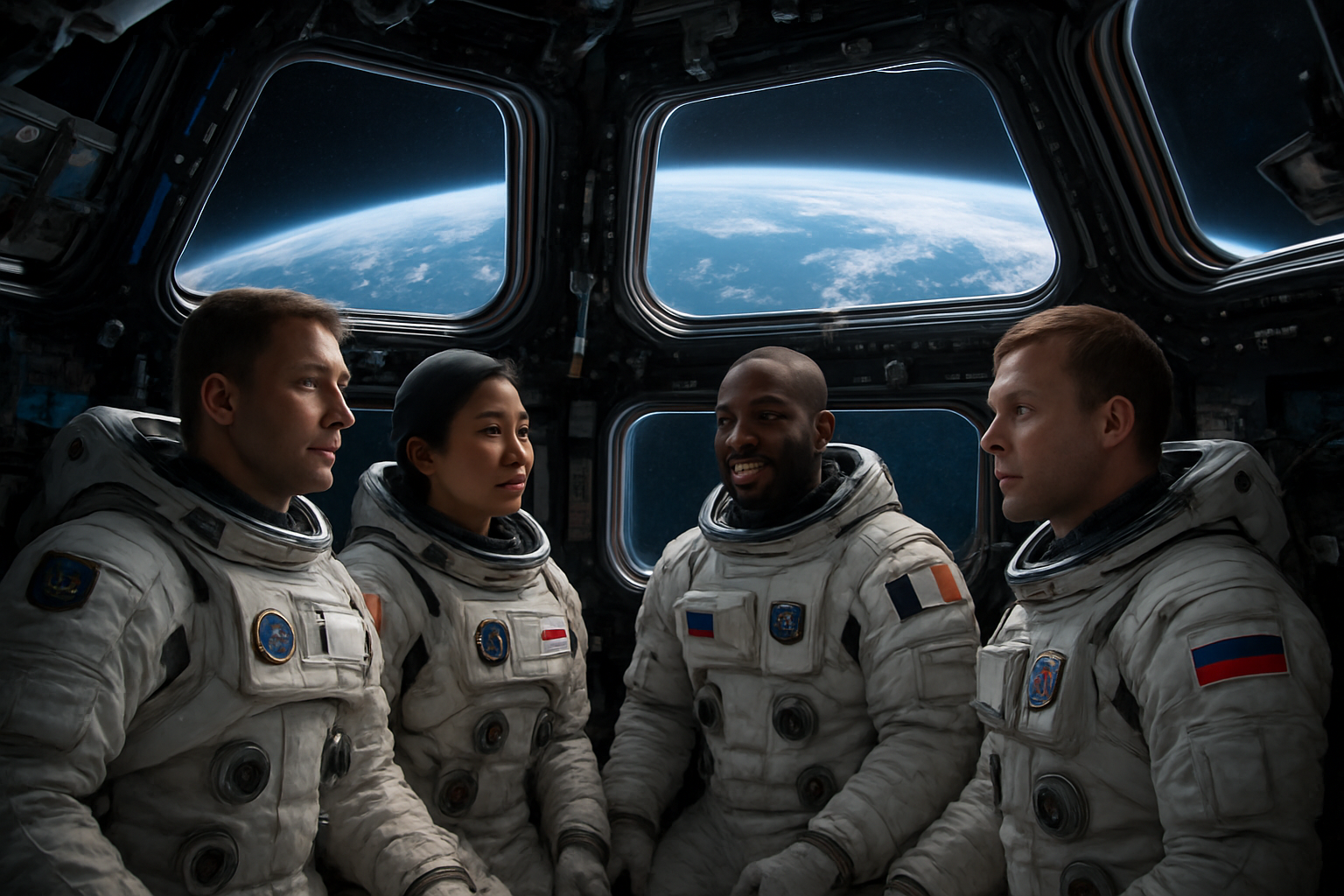
Four astronauts representing an unprecedented international collaboration have successfully arrived at the International Space Station, marking a critical milestone in restoring the orbital laboratory to full operational capacity following the first medical evacuation in ISS history.
The crew, traveling aboard a SpaceX Dragon capsule as part of the Crew-12 mission, includes NASA Commander Jessica Meir, a Swedish-American marine biologist; NASA pilot Jack Hathaway; French ESA Mission Specialist Sophie Adenot, who becomes the first French woman to reach the ISS in 25 years; and Russian cosmonaut Andrei Fedyaev. The successful docking occurred at 21:15 Paris time while the station orbited over South Africa, approximately 34 hours after their launch from Cape Canaveral.
Restoring Critical Operations
The arrival represents a crucial crew rotation that restores the ISS to its full seven-person complement. Since January, only three astronauts remained aboard the station following an unprecedented medical evacuation that removed the previous crew ahead of schedule. This skeleton crew maintained essential operations but limited the station's scientific research capabilities.
"This mission brings us back to full operational status," said a NASA spokesperson. "The expanded crew will enable us to resume our complete scientific research program, including critical experiments that require multiple team members."
Groundbreaking Scientific Mission
The eight-month mission duration represents a record for European astronauts and will focus on advanced scientific research crucial for future deep space exploration. Key experiments include:
- Lung tissue cultivation research: Understanding how microgravity affects human biology, essential for future lunar settlements and Mars exploration
- Space-Associated Neuro-Ocular Syndrome (SANS) studies: Addressing vision problems that affect astronauts during extended missions, a critical challenge for deep space travel
- Advanced materials research: Developing technologies for sustainable space habitation
"These experiments will directly inform the medical and operational protocols we need for lunar bases and eventual Mars missions."
— Dr. Sarah Mitchell, NASA Space Medicine Division
International Cooperation in Action
The mission exemplifies continued international cooperation in space despite global tensions. Sophie Adenot's participation marks a historic return for French human spaceflight, as she becomes only the second French woman to reach space, following Claudie Haigneré's mission 25 years ago.
The crew's diverse expertise reflects the ISS's role as a truly international laboratory. Commander Meir brings extensive experience in marine biology and previous ISS missions, while pilot Hathaway contributes advanced aerospace engineering skills. Adenot, a former helicopter pilot and engineer, represents the European Space Agency's growing human spaceflight capabilities, and Fedyaev continues Russia's long-standing partnership in the ISS program.
Technical Achievement and Safety
The Dragon capsule traveled at speeds exceeding 27,000 kilometers per hour to achieve the precise orbital rendezvous required for docking. The crew underwent extensive quarantine procedures at Kennedy Space Center before launch, demonstrating the safety-first approach that has become standard for ISS missions.
This successful mission occurs during what experts describe as the transition from the "AI revolution to the space economy golden age," with commercial space companies increasingly taking on roles previously handled solely by government agencies.
Broader Space Industry Context
The arrival comes amid significant developments in the global space industry. SpaceX is preparing for a potential June 2026 IPO that could value the company at over $1 trillion, while NASA's Artemis II lunar flyby mission continues preparations for March 2026, representing humanity's return to lunar exploration.
Other nations are also advancing their space capabilities. Pakistan has selected astronaut candidates for a mission to China's Tiangong space station later this year, while European companies are expanding rocket manufacturing capabilities to reduce dependence on foreign launch services.
Future Implications
The success of this crew rotation demonstrates the maturity of current space transportation systems and international cooperation frameworks. The research conducted during this eight-month mission will contribute directly to planning for sustained human presence beyond Earth orbit.
As space activities transition from experimental ventures to essential infrastructure, missions like Crew-12 establish the operational precedents and scientific foundations necessary for humanity's next steps into the solar system. The crew's work will inform everything from life support systems for lunar bases to medical protocols for Mars expeditions.
With the ISS now restored to full capacity, the international space community can continue building toward a future where human presence in space becomes routine rather than extraordinary, marking another step in humanity's gradual expansion beyond Earth.