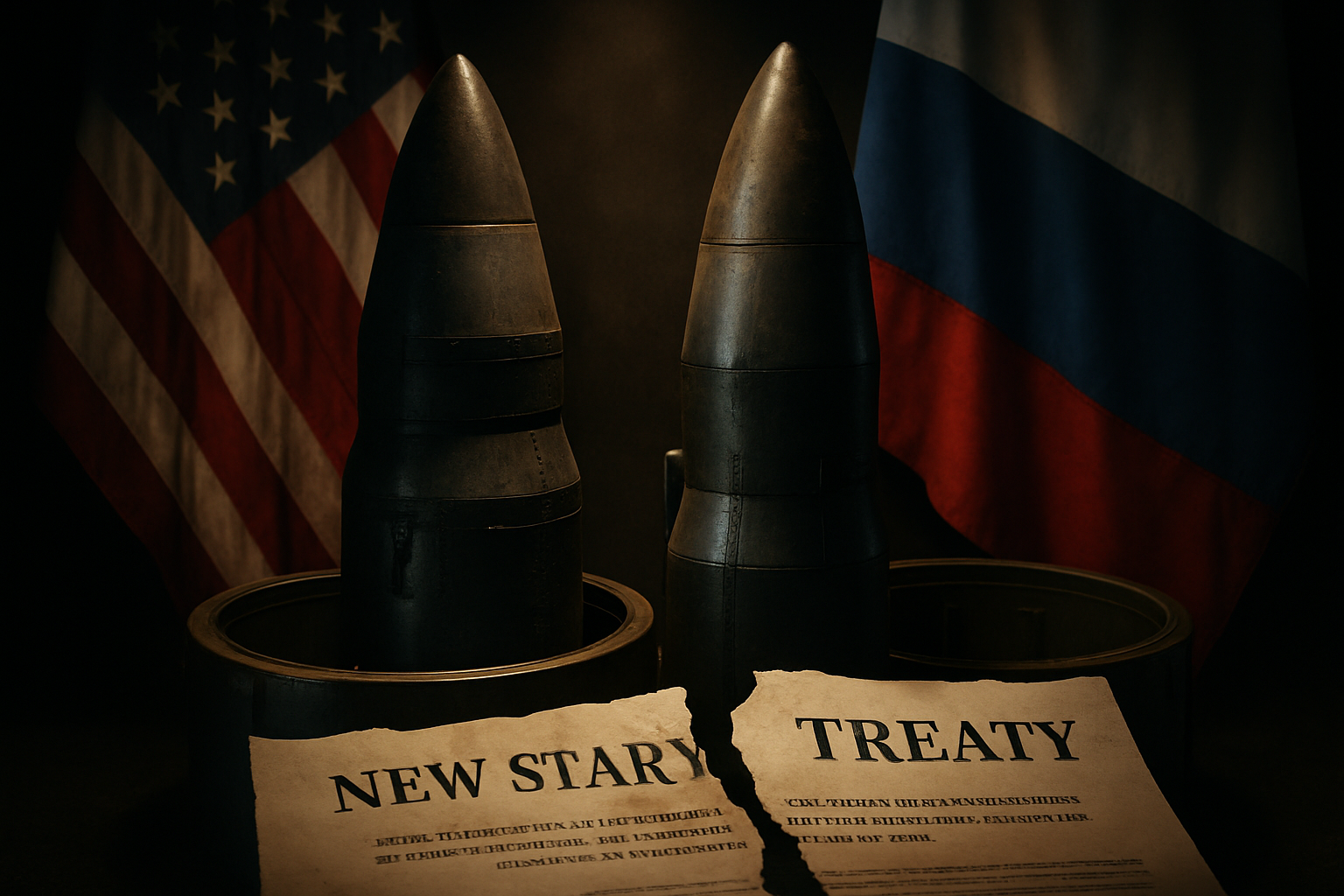
The New Strategic Arms Reduction Treaty (New START) between the United States and Russia officially expired at midnight GMT on February 5, 2026, ending the last bilateral nuclear arms control agreement between the world's two largest nuclear powers and marking the first time in over 50 years that no binding limits exist on their strategic nuclear arsenals.
Russian Security Council Deputy Chairman Dmitry Medvedev confirmed the historic milestone, stating that "for the first time in 54 years, Moscow and the United States are left with no treaty on nuclear arms control." The expiration eliminates all restrictions on deployed strategic warheads, delivery systems, and crucial verification mechanisms that have prevented nuclear miscalculation since the Cold War era.
Treaty Provisions Lost
The expired treaty had imposed limits of 1,550 deployed strategic warheads for each nation, along with restrictions on 800 strategic delivery systems. More critically, the agreement included biannual data exchanges, on-site inspections, advance notification requirements for intercontinental ballistic missile (ICBM) launches, and comprehensive verification protocols that provided transparency between the nuclear superpowers.
The loss of these verification mechanisms creates what experts describe as an information void that could lead to worst-case planning scenarios and increased risks of miscalculation. Without regular inspections and data sharing, both nations will operate with limited visibility into each other's nuclear capabilities and intentions.
Diplomatic Breakdown
The treaty's expiration follows a complete breakdown in diplomatic efforts to extend the agreement. Russia confirmed that the United States never responded to President Vladimir Putin's proposal for a 12-month extension of the treaty's main provisions, offered as tensions escalated over the Ukraine conflict.
The New START treaty was originally signed in 2010 under Presidents Barack Obama and Dmitry Medvedev, then extended for five years in 2021 under President Joe Biden. However, deteriorating US-Russia relations over Ukraine prevented further cooperation under the Trump administration's return to power.
A critical factor in the treaty's demise was President Trump's insistence that any future nuclear framework must include China's rapidly expanding nuclear arsenal. China has consistently rejected trilateral participation, demanding that the US and Russia first reduce their arsenals significantly before Beijing would consider joining multilateral negotiations.
International Alarm
The treaty's expiration has triggered widespread international concern about the potential for an unrestricted nuclear arms race. UN Secretary-General António Guterres called the development a "grave turning point" for global security, warning that the risk of nuclear weapon use is now "higher than at any time in decades."
"This represents a fundamental shift in global nuclear security architecture after five decades of bilateral arms control."
— UN Secretary-General António Guterres
NATO Secretary-General Mark Rutte described the timing as the "worst possible" given current global tensions, while Pope Leo XIV warned of a potential "new arms race" that could define international security for generations.
Japanese atomic bomb survivors, who have long advocated for nuclear disarmament, expressed particular fear about the implications. The timing coincides with ongoing Ukraine-Russia-US peace talks in Abu Dhabi, adding another layer of complexity to already fraught international negotiations.
Current Nuclear Arsenals
Russia currently possesses approximately 4,380 nuclear warheads with 1,710 deployed, while the United States maintains around 3,708 warheads with 1,670 deployed. Together, these nations control more than 80% of the world's nuclear weapons, making their bilateral relationship crucial for global nuclear stability.
Both countries are now technically free to expand their nuclear arsenals without bilateral constraints, though such expansion would require massive financial investments. Experts estimate that unrestricted nuclear modernization could cost each nation over $100 billion annually.
China's Growing Role
China's nuclear expansion has increasingly shaped US thinking on arms control, with concerns over Beijing's rapid buildup becoming a central issue in treaty negotiations. China has rejected calls to enter nuclear talks, maintaining that it will only participate after the US and Russia make substantial reductions to their arsenals.
This three-way dynamic has complicated traditional bilateral arms control approaches, as any future agreement will likely need to address the reality of multiple nuclear powers rather than just the US-Russia relationship that dominated Cold War-era treaties.
Strategic Implications
The treaty's expiration has profound implications for global security architecture. Regional security arrangements are under review by NATO allies and Russia's neighbors, while the loss of verification mechanisms creates challenges for other nonproliferation efforts worldwide.
The development undermines the credibility of the Nuclear Non-Proliferation Treaty (NPT) and broader international nuclear governance structures. Countries that have refrained from developing nuclear weapons may question the commitment of nuclear powers to disarmament obligations.
Economic Consequences
Without treaty limits, both nations may feel compelled to engage in costly nuclear modernization programs to maintain strategic parity. The economic burden could exceed $100 billion annually for comprehensive nuclear force modernization, diverting resources from other national priorities.
The uncertainty also affects allied nations, which may need to reassess their defense spending and nuclear security guarantees in light of the changed strategic environment.
Future Prospects
While diplomatic channels remain open, significant obstacles persist to establishing any new nuclear arms control framework. Rebuilding verification mechanisms and confidence-building measures would require years of sustained cooperation between nations currently engaged in proxy conflicts.
The complexity of modern nuclear arsenals, including hypersonic delivery systems and tactical weapons, presents additional challenges that future agreements will need to address. Any new treaty framework would also need to consider the multilateral nature of contemporary nuclear competition.
Regional Security Concerns
The treaty's expiration occurs against the backdrop of multiple global crises, including the ongoing Ukraine conflict, tensions in the Taiwan Strait, and escalating concerns about Iran's nuclear program. This convergence of security challenges creates a particularly dangerous environment for unrestricted nuclear competition.
Regional allies of both superpowers are reassessing their security arrangements and considering their own defense capabilities in light of the changed nuclear landscape. The absence of US-Russia nuclear constraints may encourage other nations to develop or expand their own nuclear capabilities.
Path Forward
Experts emphasize that while the treaty's expiration represents a significant setback for nuclear arms control, it does not automatically lead to an arms race. Both nations have domestic economic constraints and competing national priorities that may limit massive nuclear expansion.
However, the international community faces the challenge of preventing unrestricted nuclear competition while maintaining deterrence stability. Success in establishing new arms control frameworks will require unprecedented compromise and sustained political will from all major nuclear powers.
The expiration of New START marks the end of an era in nuclear arms control and the beginning of a new, more complex chapter in international security relations. The choices made by world leaders in the coming months and years will determine whether this represents a temporary setback or a fundamental shift toward renewed nuclear competition.