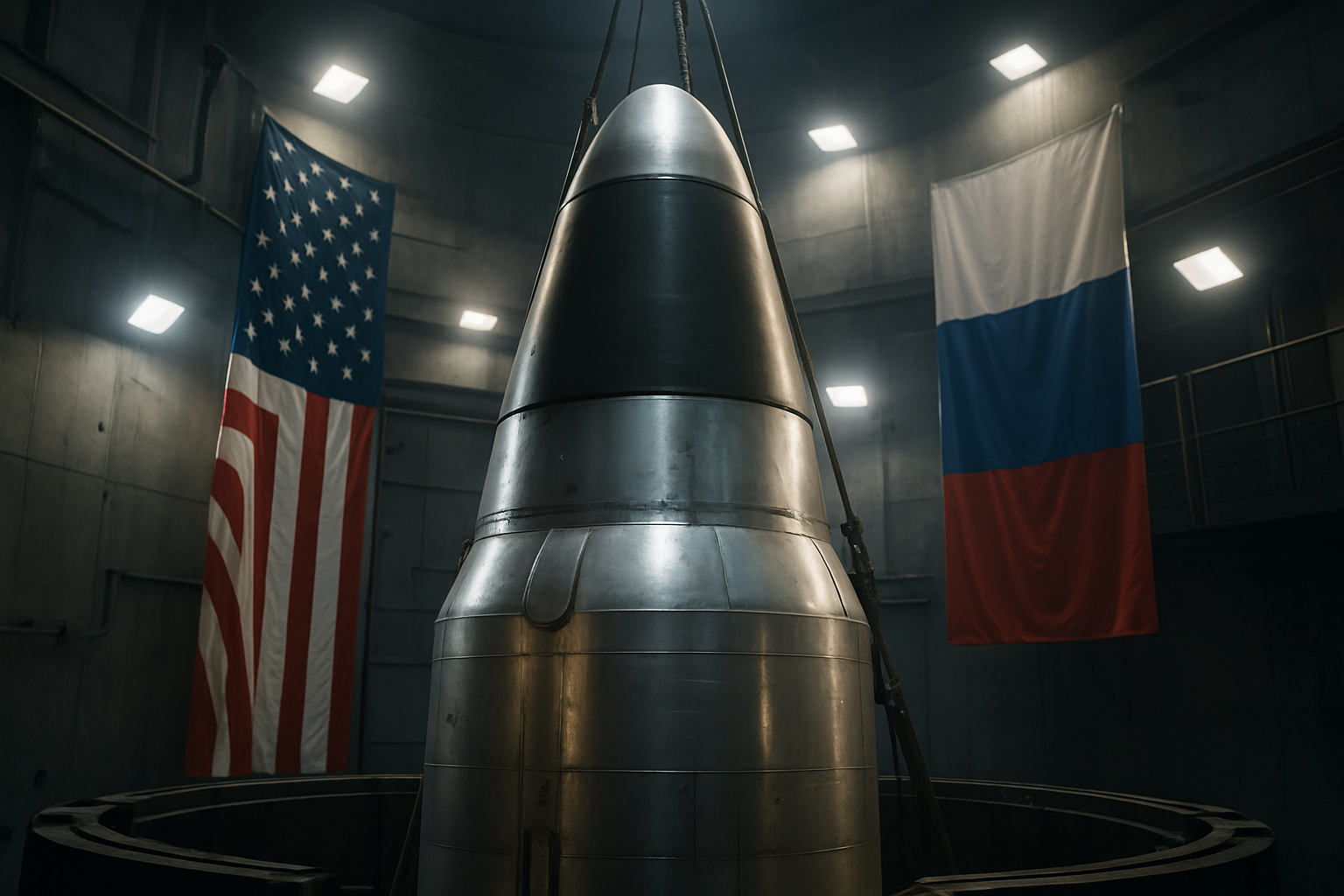
The New Strategic Arms Reduction Treaty (New START) between the United States and Russia officially expired on Thursday, February 5, 2026, marking the first time in over 50 years that no binding nuclear arms control agreement exists between the world's two largest nuclear powers.
President Donald Trump announced on his Truth Social platform that instead of extending the expired treaty, the United States should pursue "a new, improved, and modernized treaty" with Russia. The president dismissed the previous agreement as "badly negotiated" and claimed it was being "flagrantly violated."
"Rather than extend 'NEW START,' we should have our Nuclear Experts work on a new, improved, and modernized Treaty that can last long into the future," Trump wrote Thursday evening.
Global Security Implications
The treaty's expiration eliminates all limits on the deployment of strategic nuclear warheads and delivery systems between the two nations that control approximately 80% of the world's nuclear weapons. Under New START, both countries were limited to 1,550 deployed strategic warheads and 800 strategic delivery systems.
UN Secretary-General António Guterres called the expiration a "grave moment" for international peace and security, emphasizing the elevated risk of nuclear weapon use. "This represents a grave turning point for global security," Guterres stated, noting that nuclear weapon use risk is "higher than at any time in decades."
NATO Secretary-General Mark Rutte described the timing as the "worst possible," given current global tensions. The expiration coincides with ongoing conflicts in Ukraine and heightened tensions across multiple theaters, from the Middle East to the South China Sea.
Last-Minute Diplomatic Efforts Fall Short
According to reports from Axios, negotiations had been taking place over the past 24 hours in Abu Dhabi between US and Russian officials, attempting to preserve key provisions of the treaty. However, these efforts ultimately failed to produce an agreement.
"Russia regrets the expiry of its last remaining nuclear arms treaty with the United States but was still ready to talk, raising the possibility of a last-minute deal to preserve limits on deployment of the world's deadliest weapons."
— Kremlin spokesman Dmitry Peskov
Russian President Vladimir Putin had proposed a 12-month extension of the main provisions, but the Trump administration never formally responded to this proposal. The White House confirmed that, to their knowledge, no agreement had been reached to maintain treaty provisions during future negotiations.
Treaty Provisions Lost
The expiration eliminates crucial verification mechanisms that have prevented nuclear miscalculation since the Cold War era. Lost provisions include:
- Biannual data exchanges between the two nuclear powers
- On-site inspections of nuclear facilities
- Advance notification protocols for ICBM launches
- All verification mechanisms for strategic nuclear arsenals
- Information sharing that has prevented worst-case planning scenarios
The treaty originally signed in 2010 under Presidents Obama and Medvedev was extended in 2021 under President Biden, but deteriorating relations over Ukraine prevented further cooperation under the Trump administration.
Current Nuclear Arsenals
According to current assessments, Russia maintains approximately 4,380 nuclear warheads with 1,710 deployed, while the United States possesses about 3,708 warheads with 1,670 deployed. Combined, these two nations control more than 80% of the world's nuclear weapons.
Without treaty constraints, both nations are now technically free to expand their nuclear arsenals without bilateral limitations. Defense analysts warn that unrestricted nuclear modernization could exceed $100 billion annually for both countries combined.
China Factor Complicates Future Agreements
A significant challenge in developing any future nuclear agreement lies in President Trump's insistence that China must be included in any new framework. Trump has consistently argued that China's expanding nuclear arsenal, which has grown from approximately 350 warheads in 2020 to over 500 currently, cannot be ignored in future agreements.
However, China has repeatedly rejected participation in trilateral nuclear negotiations, demanding that the US and Russia first reduce their arsenals significantly before Beijing would consider joining any nuclear limitation framework.
International Response and Concerns
The expiration has triggered widespread international concern about the potential for an unrestricted nuclear arms race. Multiple international organizations have warned about the implications for global security:
The International Campaign to Abolish Nuclear Weapons (ICAN) criticized the US silence on Russia's extension proposal, stating it makes "every crisis more dangerous." Regional allies across Europe, Asia, and elsewhere have expressed concern about the security implications of eliminating nuclear arms control between superpowers.
Pope Leo XIV warned of a "new arms race," while Japanese atomic bomb survivors expressed fears about potential conflict escalation without nuclear limitations.
Technical and Strategic Challenges Ahead
Creating a new nuclear arms control framework faces significant technical and political challenges. Any future agreement would need to address:
- Modern nuclear delivery systems not covered by the original treaty
- Hypersonic weapons and emerging military technologies
- China's inclusion as a nuclear power
- Verification mechanisms for a trilateral agreement
- Regional nuclear programs in other countries
White House Press Secretary Karoline Leavitt noted that a modernized treaty could "last long into the future," suggesting the administration envisions a more comprehensive and durable agreement than previous frameworks.
Economic and Military Implications
The loss of nuclear arms limitations creates both economic and strategic implications. Without constraints, both nations may accelerate expensive nuclear modernization programs, diverting resources from other priorities.
Military planners on both sides now face uncertainty about opposing nuclear capabilities, potentially leading to worst-case scenario planning and an escalatory cycle of nuclear buildup.
Diplomatic Opportunities Remain
Despite the treaty's expiration, diplomatic channels remain open. The timing coincides with ongoing Ukraine-Russia-US trilateral peace talks in Abu Dhabi and upcoming Iran-US nuclear negotiations scheduled for February 7 in Oman.
Both Russia and the United States have indicated continued willingness to engage in nuclear discussions. The challenge lies in developing a framework that addresses 21st-century nuclear realities while maintaining strategic stability.
The path forward requires unprecedented diplomatic innovation to prevent the first unrestricted nuclear arms race between superpowers since the early Cold War era. Success or failure in developing new nuclear agreements will likely define global security architecture for decades to come.