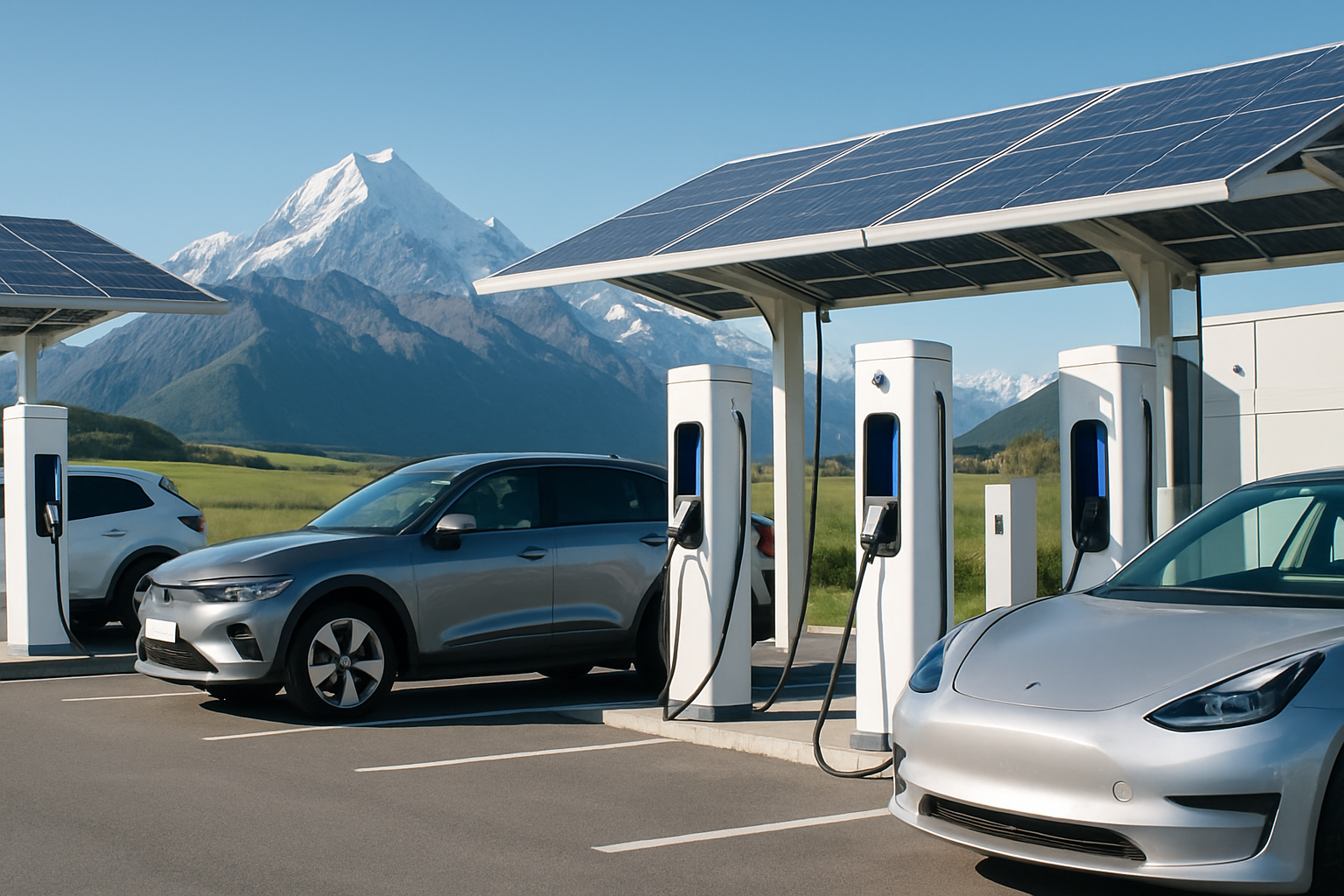
New Zealand has announced a landmark $50 million government investment to double the country's public electric vehicle charging infrastructure, deploying 2,574 new charging points nationwide in a major push to accelerate transportation electrification.
The initiative, revealed through zero-interest loans to ChargeNet and Meridian Energy, represents the most significant expansion of EV infrastructure in New Zealand's history. The funding will support nationwide rollout of public charging stations, addressing one of the primary barriers to electric vehicle adoption across the country.
Strategic Investment in Clean Transportation
The government's decision to provide zero-interest loans rather than direct subsidies demonstrates confidence in the commercial viability of New Zealand's EV charging network expansion. ChargeNet and Meridian Energy, two key players in the country's energy sector, will lead the deployment of the 2,574 new charging points across urban and rural locations.
This investment comes at a critical time for New Zealand's transportation sector, as the country seeks to meet ambitious climate targets while supporting growing consumer interest in electric vehicles. The doubling of public charging infrastructure addresses range anxiety and charging accessibility concerns that have historically slowed EV adoption rates.
Global Context of EV Infrastructure Development
New Zealand's $50 million commitment aligns with a worldwide surge in electric vehicle infrastructure investment. Austria recently doubled its EV charging capacity with 1,000 additional stations, while Estonia maintains European leadership with 88% renewable electricity and continental Europe's largest battery storage facility serving 90,000 households.
The global context includes ongoing supply chain challenges, with China maintaining 60% of critical materials production and 90% of refining capacity for lithium, cobalt, and rare earth elements essential to EV batteries. Memory chip shortages have caused sixfold price increases affecting vehicle control systems, expected to continue until new fabrication facilities come online in 2027.
"The funding will support the rollout of 2,574 new public charge points, representing a fundamental shift in New Zealand's approach to sustainable transportation infrastructure."
— Government Infrastructure Development Program
Technology and Market Developments
The infrastructure expansion occurs amid revolutionary advances in EV battery technology. BYD's recent Megawatt Flash Charging breakthrough enables 400km range in just 5 minutes, while Blade Battery 2.0 technology functions effectively in temperatures down to -30°C, addressing cold climate concerns relevant to New Zealand's South Island.
Battery longevity studies have exceeded early predictions, with Tesla Model S vehicles from 2012-2014 retaining 85-92% capacity after 200,000+ miles, and Nissan Leaf models from 2011-2013 maintaining 75-85% retention after a decade of operation. These findings suggest practical EV battery lifespans of 15-20 years, significantly longer than initial manufacturer warranties.
Addressing Urban-Rural Disparities
New Zealand's charging network expansion specifically addresses urban-rural adoption disparities observed globally. While homeowners and rural residents typically enjoy advantages through home charging capabilities, urban apartment dwellers face infrastructure barriers that public charging networks can help resolve.
The strategic placement of charging stations will focus on bridging gaps in coverage across New Zealand's diverse geography, from dense urban centers to remote rural communities. This approach mirrors successful international models where comprehensive charging networks have accelerated EV adoption rates.
Economic and Environmental Benefits
The zero-interest loan structure provides economic advantages for both the government and private sector partners. ChargeNet and Meridian Energy can expand operations without traditional financing costs, while the government maintains oversight and ensures public benefit from the infrastructure development.
Vehicle-to-grid technology advancement enables EVs to function as distributed energy storage, charging during off-peak renewable generation periods and discharging during high demand. This capability aligns with New Zealand's commitment to renewable energy and grid stability optimization.
Climate Urgency and Policy Response
The infrastructure investment occurs during unprecedented climate urgency, with January 2026 marking the 18th consecutive month of global temperatures exceeding 1.5°C above pre-industrial levels. Transportation electrification has become essential for meeting international climate commitments during what experts call the "decisive climate action decade."
New Zealand's approach demonstrates coordinated policy response addressing infrastructure development, supply chain security, and environmental responsibility. The country's commitment to doubling public charging infrastructure positions it as a regional leader in sustainable transportation transformation.
Implementation Timeline and Expected Impact
The rollout of 2,574 new charging points will proceed systematically across the country, with priority given to high-traffic corridors and underserved regions. The infrastructure expansion supports New Zealand's broader strategy to achieve transport sector decarbonization while maintaining economic competitiveness.
Industry experts anticipate the doubled charging network will significantly reduce range anxiety among potential EV buyers, potentially accelerating adoption rates beyond current projections. The investment also creates employment opportunities in installation, maintenance, and operation of charging infrastructure.
International Cooperation and Supply Chain Considerations
The project occurs within broader international efforts to diversify EV supply chains and reduce dependencies on single-source suppliers. The US-EU-Japan Critical Minerals Partnership, involving 55 countries and seven African suppliers, seeks alternatives to current supply chain concentrations.
New Zealand's infrastructure development demonstrates how nations can advance transportation electrification while navigating global supply chain challenges. The country's approach balances rapid deployment with sustainable development principles and long-term economic viability.
Future Implications
The $50 million investment represents more than infrastructure expansion—it signals New Zealand's commitment to leadership in sustainable transportation during the most significant automotive industry transformation in over a century. Success of this initiative could provide templates for other nations pursuing similar EV infrastructure development.
The doubled charging network will support New Zealand's transition toward a fully electrified transport sector, contributing to climate targets while demonstrating that comprehensive infrastructure investment can accelerate clean technology adoption. The project's impact extends beyond transportation, supporting renewable energy integration and positioning New Zealand as a model for sustainable development in the Asia-Pacific region.