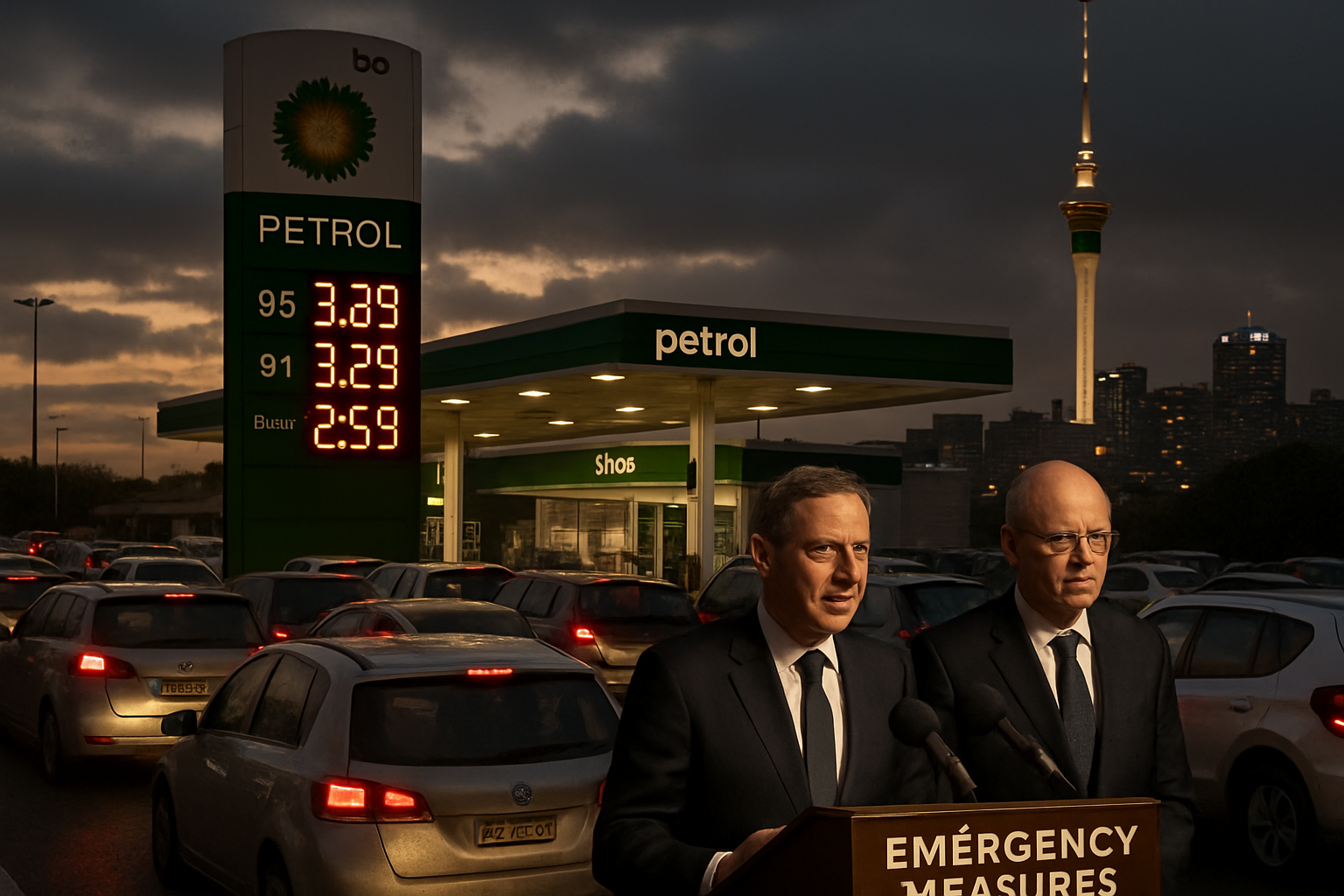
New Zealand's government has unveiled comprehensive fuel rationing plans and detailed crisis response protocols as the nation confronts its most severe energy emergency since the 1970s oil shocks, with petrol prices reaching historic highs and widespread supply disruptions threatening essential services.
Finance Minister Nicola Willis outlined the emergency framework at a press conference on Thursday, explaining the trigger mechanisms that would activate fuel restrictions and the priority hierarchy for allocation should supplies become critically low. The announcement comes as fuel prices surpass NZ$3.32 per liter in many regions, with economists warning of potential NZ$4 per liter costs if the global crisis continues.
Emergency Rationing Framework Revealed
The government's rationing plan establishes a three-tier priority system designed to maintain essential services during severe fuel shortages. According to Willis, the highest priority category includes emergency services, hospitals, food distribution networks, and critical infrastructure operations. The second tier covers public transport systems, freight networks serving rural communities, and agricultural operations vital to food security.
"We are implementing these measures as a precautionary response to unprecedented global supply disruptions," Willis explained. "The rationing system will only activate if our fuel reserves drop to critically low levels, but we must be prepared for all scenarios."
The trigger mechanism for rationing implementation requires a combination of factors: national fuel reserves below 15 days of normal consumption, persistent supply chain disruptions lasting more than seven consecutive days, or international emergency declarations affecting New Zealand's primary fuel suppliers.
Global Crisis Origins
New Zealand's fuel emergency stems from Iran's Revolutionary Guard declaring the Strait of Hormuz "unsafe for shipping," effectively blocking 40% of global seaborne oil transit. This unprecedented closure has created the most severe energy crisis since the 1970s oil shocks, with oil prices breaching $100 per barrel for the first time since 2022.
The International Energy Agency (IEA) has responded with the largest strategic petroleum reserve release in its 50-year history, deploying 400 million barrels from 32 member countries. Japan is releasing 80 million barrels - its first strategic deployment since the 2011 Fukushima disaster - reflecting the severity of the crisis for energy-import dependent nations.
"This is the most severe energy security crisis in decades, exposing single-chokepoint vulnerabilities in the global supply system."
— Samuel Ciszuk, Energy Security Analyst
New Zealand's Vulnerability Exposed
The crisis has highlighted New Zealand's extreme vulnerability to global supply disruptions, with the nation importing virtually all its refined petroleum products. Unlike countries with domestic refining capacity or strategic petroleum reserves, New Zealand relies heavily on international supply chains that have been severely disrupted by the Middle East conflict.
Prime Minister Christopher Luxon has warned that the government is preparing for a "prolonged Iran conflict" scenario, acknowledging that traditional market mechanisms may prove insufficient to address the crisis. Officials are considering emergency measures not implemented since the "Muldoon era" of the 1970s, including potential car-free days and direct government intervention in fuel allocation.
The government is also examining temporary pauses to scheduled fuel tax increases, though officials remain concerned that reducing taxes could inadvertently subsidize increased demand during a supply shortage, potentially worsening the crisis.
Aviation and Transport Disruption
The crisis extends beyond road transport, with Air New Zealand cutting more than 1,000 flights affecting 44,000 passengers as jet fuel costs have surged 122% from $85-90 per barrel to $150-200 per barrel. The airline has suspended its 2026 financial outlook due to the "abrupt spike" in fuel costs, highlighting the broader economic implications of the crisis.
Public transport systems across New Zealand are experiencing their highest usage in seven years as consumers seek alternatives to private vehicle use. The government is prioritizing fuel allocations to maintain public transport services, recognizing their critical role in reducing overall fuel demand.
International Supply Chain Collapse
The global scope of the crisis has created unprecedented supply chain disruptions affecting New Zealand's fuel imports. Major shipping companies Maersk and MSC have completely suspended operations in the Persian Gulf, stranding over 150 oil and LNG tankers worth billions in cargo value.
Qatar's LNG production halt at the Ras Laffan and Mesaid facilities - representing approximately 20% of global LNG exports - has compounded the crisis. Qatar's Energy Minister Saad Al Kaabi has warned that Gulf states may be forced to declare force majeure "within weeks" if oil prices continue climbing toward $150 per barrel.
Financial Market Impact
The energy crisis has triggered widespread financial market volatility, with the Pakistani stock exchange recording its largest single-day decline in history and South Korea's KOSPI index falling 12% before circuit breakers activated. Central banks including the European Central Bank and Bank of Japan are coordinating emergency liquidity measures to prevent financial contagion.
Consumer and Economic Consequences
New Zealand consumers are experiencing the most dramatic fuel price increases in the nation's modern history. Waitomo Group CEO Simon Parham reports a 15-20% surge in fuel demand, with panic-buying behavior reminiscent of the early stages of COVID-19.
The crisis is particularly acute in rural areas, where alternative transportation options are limited and fuel costs represent a higher proportion of household expenses. Stewart Island, dependent on diesel generators for electricity generation, faces the prospect of power shortages if fuel supplies are disrupted further.
Economic analysts warn that sustained high fuel prices could trigger broader inflationary pressures, potentially forcing the Reserve Bank to consider interest rate adjustments to manage cost-of-living pressures on already stretched household budgets.
Regional Coordination and Future Planning
New Zealand is coordinating its crisis response with Pacific partners, including Tonga and Fiji, to maintain regional fuel supply stability. Prime Minister of Tonga Lord Fakafanua has received assurances about fuel supply security through Singapore-Fiji shipping routes, demonstrating the interconnected nature of Pacific energy security.
The government is also accelerating discussions about long-term energy security, including enhanced strategic reserves, supply diversification, and renewable energy transitions. While these structural changes require years or decades to implement, officials acknowledge that the current crisis has dramatically accelerated the urgency of energy independence initiatives.
Looking Ahead
The duration of New Zealand's fuel crisis remains uncertain, dependent on diplomatic or military resolution of the Middle East conflict. Unlike weather-related disruptions with predictable recovery timelines, geopolitical crises can persist indefinitely, making traditional crisis management approaches less effective.
Willis emphasized that the rationing plans represent "responsible preparation for worst-case scenarios" rather than an immediate implementation. However, she acknowledged that if the international crisis continues to escalate, New Zealand may have little choice but to implement emergency measures not seen since the turbulent energy crises of the 1970s.
"We are facing the greatest test of our energy security in modern history. The measures we are preparing today may determine how well New Zealand weathers this unprecedented global crisis."
— Nicola Willis, Finance Minister
The crisis represents a watershed moment for New Zealand's energy policy, potentially reshaping approaches to energy security, import dependence, and emergency preparedness for decades to come. As global energy markets remain volatile and geopolitical tensions continue to escalate, New Zealand's response to this crisis may establish new paradigms for small, import-dependent economies navigating an increasingly unstable international environment.