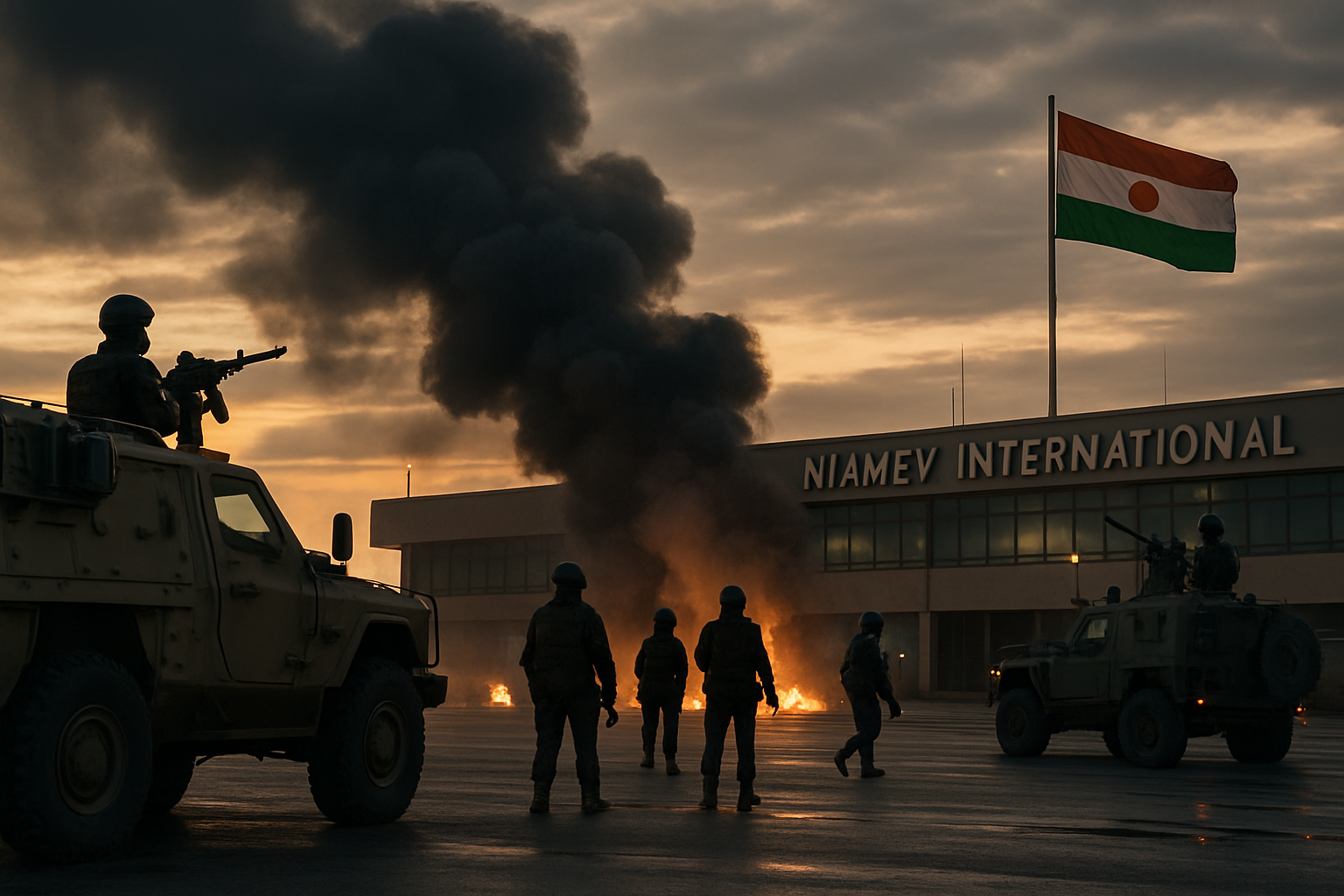
Niger's military ruler General Abdourahamane Tiani has accused France, Benin, and Côte d'Ivoire of sponsoring a coordinated attack on Niamey's international airport, as the Alliance of Sahel States (AES) condemned what it called a "premeditated and blind" assault on strategic infrastructure.
The attack on Diori Hamani International Airport occurred in the early hours of January 29, 2026, at approximately 00:20 local time. According to Niger's Ministry of Defense, a group of what they described as "remote-controlled mercenaries" launched an assault targeting both strategic infrastructure and civilian installations.
Casualties and Response
Niger's defense ministry reported that 20 mercenaries were neutralized and 11 others apprehended during the attack. The assault put innocent populations and civilian assets at serious risk, according to official statements from Niamey.
Despite the severity of the attack, Niger's Civil Aviation Authority (ANAC) confirmed that flight operations continued normally at the airport, with several airlines maintaining their scheduled services. However, an Air Côte d'Ivoire aircraft was reportedly hit by gunfire during the incident, though details about casualties or damage to the aircraft remain limited.
Serious Diplomatic Accusations
In an unprecedented diplomatic escalation, General Tiani directly named French President Emmanuel Macron, Ivorian President Alassane Ouattara, and Beninese President Patrice Talon as sponsors of the attack. Speaking via state radio, Tiani warned that Niger had grown tired of their threats and that they should prepare to hear Niger's response.
"Niger has exhausted its patience with what we describe as foreign threats and conspiracies. Those responsible for financing, arming, providing intelligence, or offering political support to these mercenaries will answer for their actions."
— General Abdourahamane Tiani, Niger's Military Leader
The accusations represent a significant deterioration in relations between Niger and these nations, particularly France, which has seen its influence in the Sahel region dramatically reduced since a series of military coups in recent years.
AES Alliance Shows Solidarity
The Alliance of Sahel States, led by current rotating president Captain Ibrahim Traoré of Burkina Faso, issued a strong condemnation of the airport attack. In a communiqué, the AES described the assault as "clearly a premeditated, coordinated and blind attack" that targeted both strategic infrastructure and civilian installations.
The alliance emphasized its solidarity with Niger and warned that perpetrators and their supporters would be held accountable for their actions. The AES, formed by Niger, Mali, and Burkina Faso after their respective military coups, has positioned itself as an alternative to traditional Western partnerships in the region.
Public Support and Mobilization
Following the attack, the population of Niamey organized a public rally to show support for the National Council for the Safeguard of the Homeland (CNSP) and the Defense and Security Forces. The demonstration reflected popular backing for the military government's response to what many citizens view as external interference.
The mobilization came as Niger has increasingly isolated itself from Western partners, expelling French troops and reducing cooperation with international organizations. The government has also recently suspended NGO activities at refugee sites, except for health-related interventions, citing the need to renew contracts for field agents of the National Commission for Refugee Status Eligibility.
Regional and International Implications
The attack and subsequent accusations have broader implications for West African security and diplomacy. The African Union has condemned what it termed "heinous attacks" in Niger and reaffirmed its support for the country amid ongoing security threats.
The incident occurs against a backdrop of deteriorating relations between the AES member states and their former colonial powers, particularly France. The three nations have systematically expelled French military forces and distanced themselves from Western-backed regional organizations like ECOWAS.
Media Restrictions Intensify
The security situation has been accompanied by increased restrictions on media freedom. On January 23, 2026, authorities arrested a Deutsche Welle correspondent in Niamey following the publication of a report about Nigerian refugees and migrants taking shelter in cemeteries and abandoned buildings. The charges against the journalist have not been disclosed.
Security Implications
The airport attack represents a significant escalation in the security challenges facing Niger and the broader Sahel region. The targeting of critical infrastructure like the international airport suggests a level of coordination and planning that authorities attribute to foreign backing.
Niger's strategic location and its role as a transit point for migration and trade make it a crucial player in regional stability. The country has been battling various armed groups and dealing with spillover effects from conflicts in neighboring Mali and Burkina Faso.
The accusations against France, Benin, and Côte d'Ivoire, if proven or widely believed, could further destabilize an already fragile regional security environment and potentially lead to broader diplomatic and security consequences across West Africa.
As tensions continue to escalate, the international community watches closely to see how this diplomatic crisis unfolds and whether it will lead to further deterioration in relations between the Sahel nations and their traditional partners.