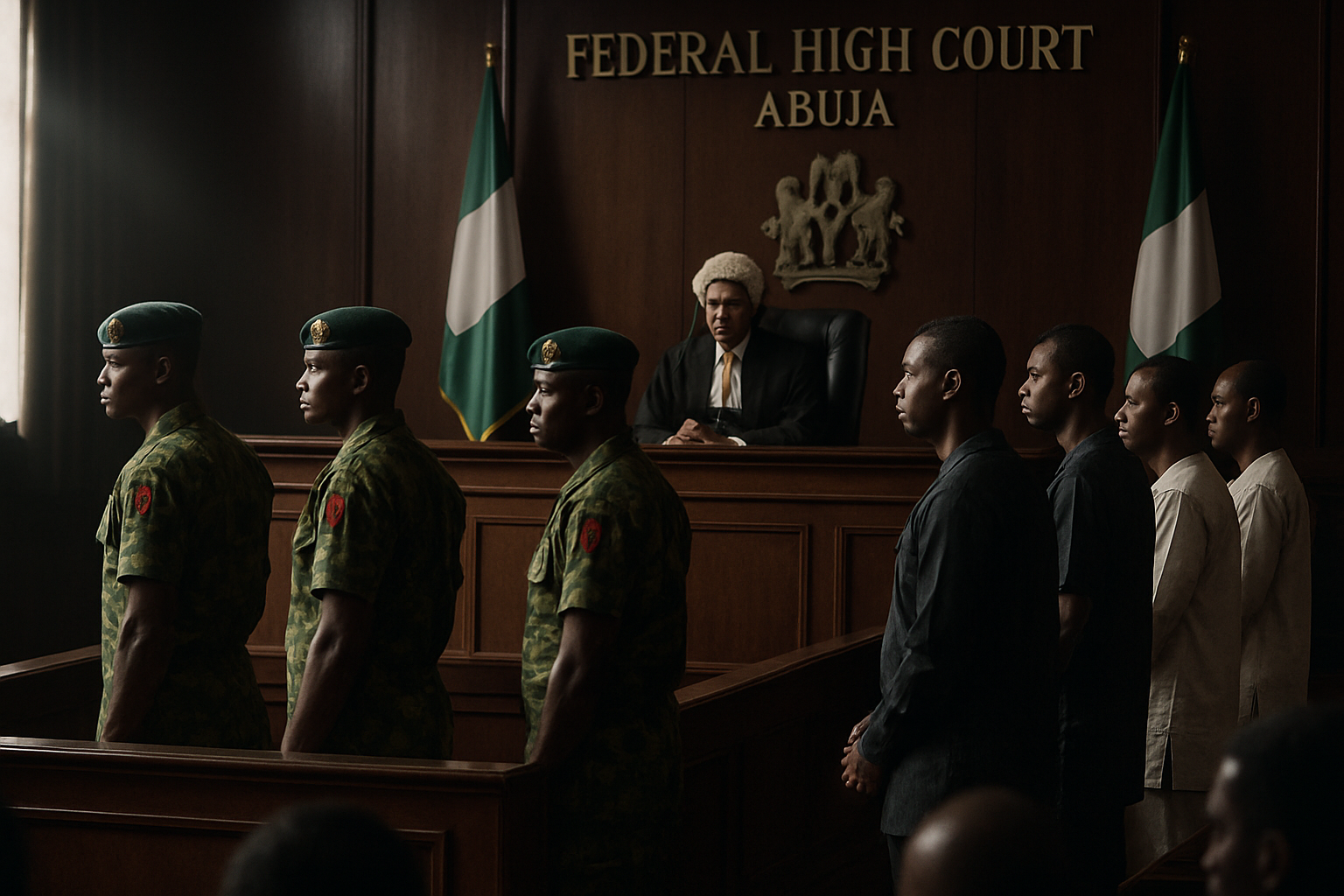
Nigerian federal prosecutors have formally arraigned six men, including a retired major general, on charges of attempting to plan a military coup against President Bola Ahmed Tinubu's administration, marking a significant test of democratic institutions amid the country's expanding security crisis.
The suspects appeared before Justice Joyce Abdulmalik of the Federal High Court in Abuja on Wednesday, April 22, 2026, following months of detention that began with what authorities initially characterized as routine disciplinary issues before evolving into allegations of a broader conspiracy to overthrow the democratically elected government.
Charges and Legal Proceedings
According to court documents, prosecutors have filed a comprehensive 13-count charge including terrorism, coup plotting, and treasonable felony against the six defendants. The charges allege the suspects attempted to plan a coup in October 2025, during a period of heightened political tensions and security challenges across Nigeria.
The arraignment represents the culmination of investigations that began when military authorities announced the arrest of 16 officers for what were initially described as "discipline issues." However, the scope expanded significantly as investigators claimed to have uncovered evidence of a coordinated plot against the Tinubu administration.
Legal sources familiar with the case indicate that the charges carry severe penalties under Nigerian law, with terrorism-related offenses potentially carrying life sentences. The Federal High Court's jurisdiction over such matters reflects the gravity with which authorities view threats to democratic governance.
Context of Nigeria's Security Crisis
The alleged coup plot emerges against the backdrop of Nigeria's most severe security crisis in decades, with multiple threats challenging state authority across the country's diverse regions. Since taking office, President Tinubu has confronted an expanding array of security challenges that have tested his administration's capacity to maintain order and protect civilian populations.
Recent intelligence assessments document a concerning pattern of security deterioration. In February 2026, terrorist attacks in Kwara State killed 162 people in coordinated village massacres, while March saw deadly suicide bombings in Maiduguri that killed 23 people and wounded over 100 others during Ramadan. Military installations have also come under attack, with coordinated assaults in March killing Lt. Col. Umar Farouq and demonstrating sophisticated terrorist capabilities.
The geographic expansion of violence from traditional northeastern strongholds to previously stable regions has strained military resources and challenged conventional counter-terrorism approaches. Intelligence failures have been documented repeatedly, with communities providing advance warnings about terrorist presence that authorities often ignore until attacks occur.
Military Leadership Changes
The alleged coup plot prompted President Tinubu to conduct what sources describe as a major reshuffle of the military high command, reflecting concerns about institutional loyalty and operational effectiveness. The reshuffling affected key positions across the armed forces and was seen as an attempt to reassert civilian control over military leadership.
Defense analysts note that such extensive leadership changes during active security operations carry both benefits and risks. While removing potentially disloyal elements strengthens civilian control, disrupting command structures during complex counter-terrorism operations can temporarily reduce operational effectiveness.
The military's role in Nigerian politics remains a sensitive issue given the country's history of successful coups between 1966 and 1993. Democratic institutions established since 1999 have generally maintained civilian supremacy, but ongoing security challenges have increased military visibility in governance and raised questions about civil-military relations.
"The charges come months after the suspects were detained, initially over alleged disciplinary issues before authorities claimed to have uncovered a broader plan to overthrow the government."
— Court Source, Federal High Court Abuja
Democratic Governance Under Pressure
Nigeria's handling of the alleged coup plot occurs during a critical period for African democratic governance. The country's status as Africa's most populous nation and largest economy makes its democratic stability crucial for regional and continental political development.
The legal proceedings test institutional capacity to address threats to constitutional order through judicial rather than extrajudicial means. International observers view the case as indicative of whether African democratic institutions can effectively manage internal security threats while maintaining rule of law principles.
Opposition parties and civil society organizations have called for transparency in the judicial process, emphasizing the importance of due process rights even for those accused of serious crimes against the state. The balance between national security and individual rights remains a central challenge for emerging democracies facing complex security environments.
Regional and International Implications
The alleged coup plot has drawn attention from regional and international partners concerned about Nigeria's democratic stability. West African regional organizations, including ECOWAS, have historically taken strong positions against unconstitutional changes of government, making Nigeria's effective handling of the situation crucial for regional precedent-setting.
International partners providing counter-terrorism support, including the United States, United Kingdom, and France, are closely monitoring developments. Nigeria's ability to address internal threats through legal institutions rather than military solutions affects broader international cooperation frameworks and support programs.
The case also occurs amid concerning trends in global democratic governance, with military interventions affecting multiple African countries in recent years. Nigeria's successful prosecution of alleged coup plotters through civilian courts would demonstrate institutional resilience and provide a positive example for democratic governance under pressure.
Investigative Process and Evidence
Details about the evidence supporting the coup plot allegations remain largely confidential due to the sensitive nature of national security proceedings. However, sources indicate that investigators have compiled communications, planning documents, and witness testimony allegedly demonstrating coordination among the defendants.
The investigation reportedly involved multiple security agencies, including military intelligence, civilian intelligence services, and federal law enforcement. The complexity of gathering evidence in national security cases while preserving due process rights represents a significant challenge for prosecutors.
Defense attorneys are expected to challenge both the evidence and the legal framework under which charges were filed. The case will likely test Nigerian courts' capacity to manage high-profile national security prosecutions while maintaining fair trial standards.
Ongoing Security Challenges
The coup plot allegations unfold as Nigeria continues confronting multiple simultaneous security threats across different regions. Beyond terrorism in the northeast and northwest, the country faces increasing challenges from criminal gangs, ethnic conflicts, and resource competition exacerbated by climate change effects.
Recent military operations have eliminated hundreds of militants, but attacks continue demonstrating the limitations of purely military approaches to complex security challenges. The need for comprehensive strategies addressing root causes including poverty, unemployment, and governance deficits has become increasingly apparent.
President Tinubu's administration has deployed military units and forest guards to affected regions while seeking to strengthen intelligence capabilities and inter-agency coordination. However, the persistence of security challenges despite significant resource allocation highlights the complexity of Nigeria's contemporary threat environment.
Implications for Democratic Institutions
The legal proceedings against the alleged coup plotters represent a crucial test of Nigeria's democratic institutions' capacity to address existential threats through constitutional means. Success in prosecuting the case fairly and transparently would strengthen public confidence in civilian governance and rule of law principles.
The case also tests judicial independence and capacity to manage politically sensitive prosecutions without compromising legal standards. International legal experts view the proceedings as potentially precedent-setting for how democratic African states address internal security threats to constitutional order.
Civil society organizations emphasize the importance of maintaining transparency throughout the judicial process while protecting legitimate national security interests. The balance between public accountability and security considerations remains a central challenge for the proceedings.
As Nigeria confronts its most complex security environment since the return to civilian rule, the successful prosecution of alleged coup plotters through legal institutions rather than extrajudicial means would demonstrate democratic resilience and provide a template for addressing similar challenges across the continent. The outcome will significantly influence both domestic confidence in democratic governance and international perceptions of Nigeria's institutional capacity during crisis periods.