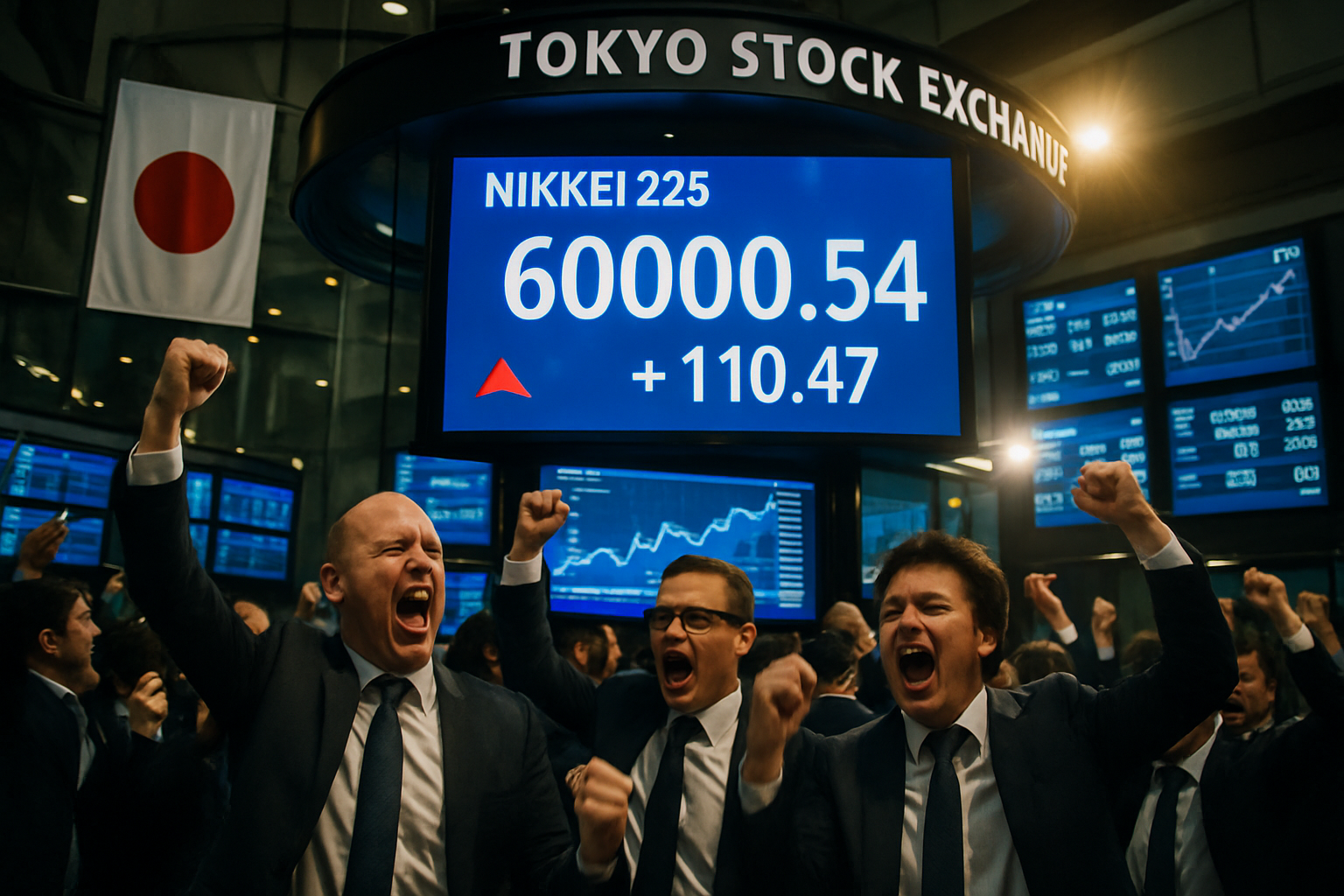
Japan's Nikkei 225 index shattered the historic 60,000 barrier for the first time on April 23, 2026, capping a remarkable recovery from the devastating market crash of March 2026 and signaling renewed confidence in Asian markets amid hopes for Middle East peace.
The benchmark index achieved the unprecedented milestone during morning trading in Tokyo, marking a dramatic turnaround from the dark days of March when the Nikkei plummeted over 2,800 points in a single session during the Iran crisis. The surge follows an extension of the Middle East ceasefire and overnight records in U.S. markets, demonstrating the interconnected nature of global financial systems.
Historic Achievement Amid Global Recovery
The 60,000 threshold represents more than just a numerical milestone—it symbolizes Japan's resilience and the broader Asian market recovery following one of the most severe financial crises since the 2008 global recession. The achievement comes as Asian markets have demonstrated remarkable leadership in the global recovery, with Tokyo posting consecutive daily gains and attracting significant international investment flows.
Japanese Prime Minister Sanae Takaichi's administration, which secured a commanding electoral mandate in February 2026, has maintained investor confidence through stable economic policies and strong international partnerships. The historic supermajority achieved by the Liberal Democratic Party has provided policy certainty that markets have rewarded with sustained confidence.
"This milestone reflects not just numerical achievement but the fundamental strength of Japan's institutional framework and its position as Asia's democratic anchor,"
— Market analyst commenting on the historic breakthrough
Recovery From March 2026 Crisis
The road to 60,000 was marked by extraordinary volatility. In March 2026, Japan's markets suffered their third-largest point drop in history when Iranian forces declared the Strait of Hormuz "unsafe for shipping," blocking 40% of global oil transit and triggering a worldwide energy crisis. Oil prices surged to $119.50 per barrel for Brent crude, while natural gas prices exploded by 78% in the United States.
The crisis exposed critical vulnerabilities in global supply chains and demonstrated how quickly geopolitical events could destabilize financial markets. Over 18,000 flights were cancelled worldwide, making it the most comprehensive aviation disruption since COVID-19. Major shipping companies suspended Persian Gulf operations, stranding billions of dollars worth of cargo.
Central banks, including the Bank of Japan and European Central Bank, coordinated emergency liquidity provisions to prevent broader financial contagion. The International Energy Agency deployed its largest strategic petroleum reserve release in 50-year history—400 million barrels from 32 countries—to stabilize energy markets.
Diplomatic Progress Fuels Optimism
The current rally has been significantly boosted by diplomatic progress in the Middle East. The extension of the ceasefire and what sources describe as "productive conversations" between key regional players has alleviated concerns about energy security that dominated market sentiment during the March crisis.
The gradual reopening of the Strait of Hormuz has allowed oil prices to retreat from crisis peaks, providing relief to energy-dependent economies worldwide. This has been particularly beneficial for Asian markets, where energy import costs had surged dramatically during the crisis, hampering corporate operations and investment planning.
Technology and Innovation Drive Growth
Beyond geopolitical factors, Japan's market surge reflects strong fundamentals in technology and innovation sectors. Despite global memory chip shortages that have driven semiconductor prices up sixfold, Japanese companies have demonstrated operational excellence and strategic flexibility.
The technology sector's resilience has been particularly notable given ongoing supply chain challenges. Companies focusing on artificial intelligence, robotics, and sustainable technologies have attracted significant investment as global markets recognize Japan's leadership in these critical areas.
The Japanese government's strategic investments in digital infrastructure and AI development have positioned the country as a beneficiary of the global technological transformation, with implications extending far beyond current market valuations.
Regional Leadership in Asian Recovery
Japan's achievement comes as part of a broader Asian market rally that has seen the region take global leadership in financial recovery. For three consecutive days, Asian markets have posted gains, with institutional investors repositioning portfolios toward Asian assets as energy markets stabilize.
This regional strength reflects sophisticated crisis management by Asian central banks and governments. Countries with strong governance frameworks have consistently outperformed during periods of global uncertainty, demonstrating that institutional quality has become a primary determinant of capital flows.
The success has particularly benefited from what analysts describe as a fundamental shift from broad regional investment themes toward country-specific fundamental analysis. Investors are increasingly focusing on local conditions, institutional quality, and policy effectiveness rather than traditional geographic categorizations.
Economic Implications and Future Outlook
The 60,000 milestone has significant implications for Japan's economic trajectory. The strong market performance provides companies with enhanced access to capital for expansion and innovation, while higher valuations support consumer wealth and domestic demand.
For global investors, Japan's achievement validates the strategy of focusing on economies with proven institutional frameworks and effective crisis management capabilities. The contrast with markets that struggled during the March crisis has reinforced the importance of governance quality in investment decisions.
Looking ahead, analysts note that recovery timelines remain somewhat uncertain, dependent on continued geopolitical stability rather than traditional economic fundamentals. However, the current trajectory suggests that well-managed economies with sound institutional foundations can navigate 21st-century volatility while maintaining prosperity and social stability.
Global Financial Architecture Evolution
The Nikkei's historic achievement occurs within a broader transformation of global financial architecture. The March 2026 crisis exposed vulnerabilities in traditional international coordination mechanisms while demonstrating the effectiveness of sophisticated country-specific approaches.
Central banks worldwide have moved away from the post-2008 synchronized monetary policy approach, instead pursuing strategies tailored to domestic conditions. This divergence has created new opportunities for countries with strong fundamentals while challenging those dependent on external coordination.
The success of Asian markets in leading global recovery suggests a potential long-term shift in financial gravity toward the Pacific region, with implications for investment flows, currency dynamics, and international economic cooperation frameworks.
"We are witnessing not just a numerical milestone but a fundamental validation of institutional quality and strategic positioning in an increasingly complex global environment,"
— Tokyo-based portfolio manager
As Japan's Nikkei 225 celebrates this historic achievement, the broader implications extend far beyond Tokyo's trading floors. The milestone represents successful navigation of unprecedented global challenges while maintaining the institutional strength and policy effectiveness that have made Japan a cornerstone of international financial stability.
The achievement also provides a template for other economies seeking to balance international integration with domestic sovereignty, demonstrating that sophisticated, well-governed nations can thrive even during periods of global uncertainty. As geopolitical tensions continue to reshape the international landscape, Japan's success offers valuable lessons for maintaining economic resilience while contributing to global stability.