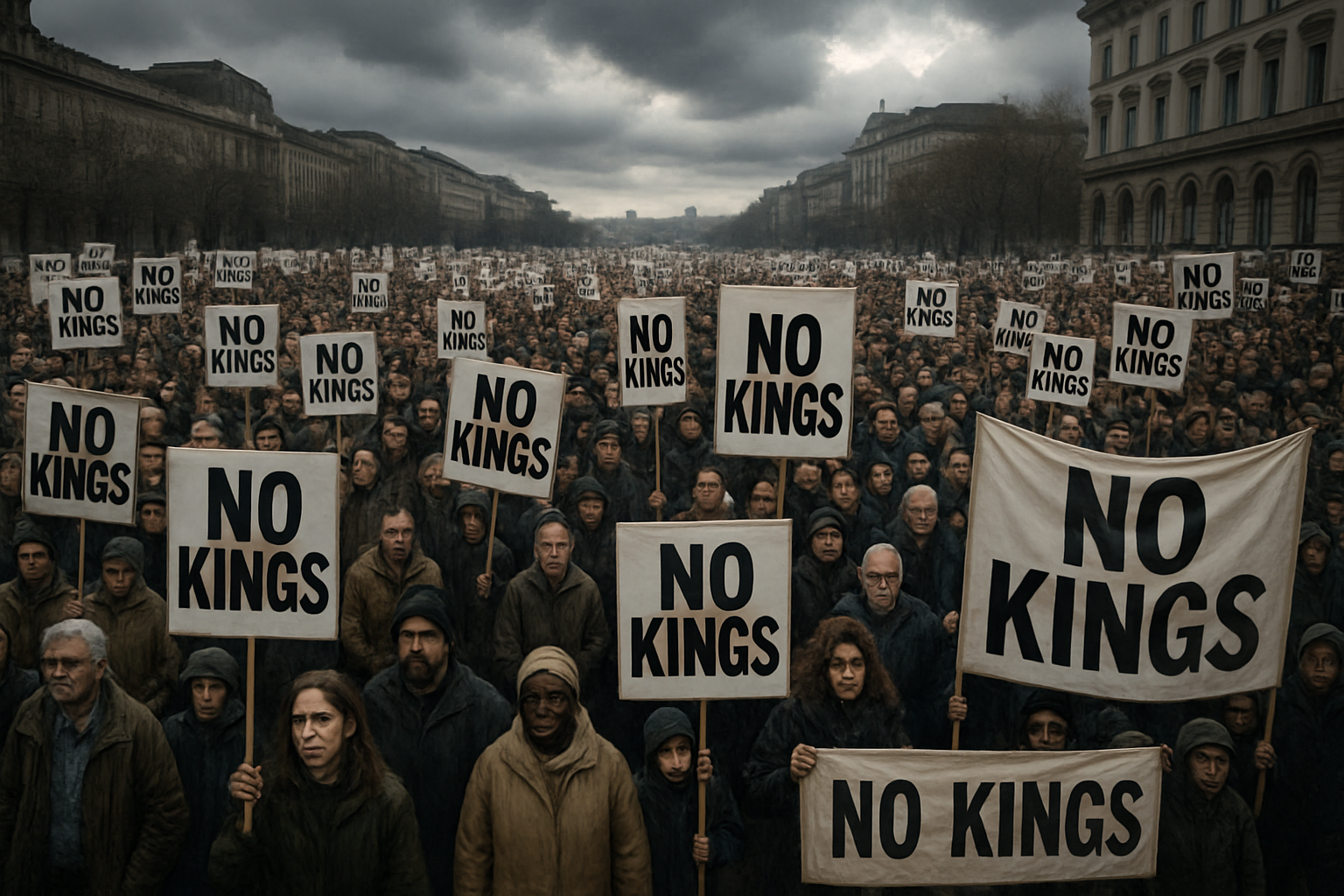
Eight million Americans participated in 'No Kings' protests across more than 3,200 cities on March 28, 2026, marking what organizers claim as the largest single-day demonstration in United States history and the third major wave of resistance since President Donald Trump's return to office.
The massive mobilization, extending from major metropolitan centers to rural communities previously untouched by anti-Trump organizing, represented an unprecedented geographic expansion of resistance movements while drawing significant international solidarity demonstrations across Europe and beyond.
Record-Breaking Scale and Geographic Reach
According to multiple international sources, the 'No Kings' demonstrations surpassed all previous protest movements in American history, eclipsing the Women's March and earlier anti-Trump mobilizations. Latvian media reported that approximately eight million people participated nationwide, while Swedish outlets confirmed millions gathered across the country.
The protests demonstrated remarkable geographic diversity, with nearly 40 percent of events occurring outside major metropolitan areas. For the first time since Trump's January 2025 return to power, demonstrations reached what organizers described as "deep-red Republican heartlands," including small towns in West Virginia and rural communities across all 50 states.
This expansion marked a significant evolution from June 2025 protests (several million participants) through October 2025 (seven million estimated) to the March 2026 peak mobilization, demonstrating sustained organizational infrastructure and growing political engagement across diverse geographic and demographic communities.
Opposition to Iran Military Engagement
The protests were significantly driven by opposition to Trump's Iran military engagement, dubbed "Operation Epic Fury," which has cost $11.3 billion in its first week alone. The operation has resulted in over 150 US wounded soldiers, three confirmed deaths, and operations extended through September—far beyond the initial 4-6 week projection.
Public opposition to the Iran strikes remains overwhelming, with only 25 percent of Americans supporting military action. Remarkably, 56 percent of Americans believe Trump is too willing to use military force, including a quarter of his Republican base—representing an unprecedented erosion of support for presidential military authority within his own party.
Palestinian news sources reported that the protests specifically condemned "the war being led by Washington alongside Israel against Iran," highlighting international concerns about American foreign policy under Trump's leadership.
International Solidarity and European Concerns
The domestic demonstrations sparked solidarity protests across multiple European cities, with reports of significant gatherings in Amsterdam, Madrid, and Rome, where approximately 20,000 marchers demonstrated their concern about American policies and their global implications.
European allies have notably rejected Trump's requests for naval coalition support in the Strait of Hormuz, with German Defense Minister questioning what "a handful of European frigates" could accomplish. In response, Trump declared the United States "no longer needs NATO assistance," creating significant transatlantic tensions that provided additional context for international solidarity demonstrations.
The rejection of traditional alliance structures has concerned European policymakers who view Trump's unilateral approach as destabilizing to international cooperation frameworks established since World War II.
Celebrity Participation and Cultural Impact
The demonstrations featured significant celebrity participation, most notably Bruce Springsteen performing "Streets of Minneapolis" at the Saint Paul rally—a song referencing deadly January 2026 immigration enforcement shootings. Actor Robert De Niro made multiple appearances, calling Trump an "existential threat to democracy."
Democratic leaders participated despite security concerns, and the protests maintained their largely peaceful character throughout the day. Swedish media noted that tens of thousands of New Yorkers protested against "king Trump," though the city's socialist mayor Zohran Mamdani was notably absent, with supporters suggesting it was "smart to keep a low profile and let Donald Trump think they are friends."
Constitutional Messaging and Democratic Resistance
The "No Kings" branding proved strategically sophisticated, referencing the founding fathers' rejection of monarchy and positioning protests within a historical narrative of democratic resistance. This constitutional framework appealed beyond traditional partisan divisions, enabling organizers to mobilize diverse communities around principles of democratic governance rather than purely partisan opposition.
Austrian media emphasized that the demonstrations carried strong signals against the US president while maintaining hope for solutions, suggesting that the protests served both as political opposition and as organizing tools for the November 2026 midterm elections.
Movement leaders emphasized constitutional principles and institutional norms they claim are under threat, rather than focusing solely on partisan disagreements. This messaging strategy has proven effective in expanding support beyond traditional Democratic constituencies.
Strategic Evolution and Tactical Innovation
The movement demonstrated sophisticated strategic evolution, adopting what organizers call "without mobilization" strategy in some regions—focusing on economic pressure through strikes and work stoppages rather than traditional street demonstrations. This approach reflects organizational maturity and adaptation to local conditions while maintaining coordinated national messaging.
Coordination across all 50 states demonstrated unprecedented organizational capacity and sustained political engagement infrastructure. The ability to maintain peaceful demonstrations while addressing both domestic concerns (immigration enforcement) and international issues (Iran war) showed strategic sophistication that transcends reactive protest models.
Immigration Enforcement Opposition Continues
Beyond foreign policy concerns, protests continued to address Trump's aggressive immigration enforcement policies. ICE deportations have quadrupled under Trump's second term, with approximately two-thirds of Americans believing immigration enforcement has "gone too far."
The Minneapolis shootings of Alex Pretti and Renee Nicole Good during immigration enforcement operations in January 2026 sparked tactical adjustments, including ICE agent withdrawals from Minnesota and mandatory body camera requirements. However, the overall enforcement strategy remains unchanged despite mounting judicial opposition requiring ICE warrants and civil rights lawsuits challenging the policies.
Federal Court Resistance and Legal Challenges
The protests occur amid mounting federal court resistance to Trump administration policies. Immigration enforcement faces growing judicial opposition, with courts increasingly requiring proper warrants and due process protections. The University of California has confirmed that deportations quadrupled during Trump's first nine months in office during his second term.
Civil rights organizations have filed numerous lawsuits challenging immigration policies, while federal courts have imposed tactical limitations on enforcement operations. These legal victories provide momentum for continued resistance while demonstrating the effectiveness of multi-front opposition strategies.
Midterm Elections Context and Political Implications
With November 2026 midterm elections approaching, the protests serve dual functions as both political opposition demonstrations and organizing tools for electoral engagement. The success in mobilizing diverse geographic and demographic communities indicates significant potential for sustained political pressure on the Trump administration.
The constitutional governance messaging extends beyond partisan frameworks while building sustained political engagement infrastructure. Organizers view the protests as critical preparation for electoral challenges, combining immediate resistance with long-term political organizing across traditional partisan divisions.
Historical Significance and Global Context
March 28, 2026, represents a critical juncture in American politics amid ongoing foreign conflicts, economic pressures, and fundamental questions about democratic institutions and presidential authority. The protests mark a significant moment in the ongoing struggle between executive power and popular resistance, with implications extending well beyond the current Trump administration.
International observers view the demonstrations as a test of American democratic capacity to channel political opposition constructively while maintaining institutional stability. The movement's ability to sustain mobilization, expand geographically, and maintain peaceful approaches while addressing complex domestic and international concerns demonstrates continued vitality of civic engagement in American democracy.
Looking Forward: Sustained Resistance or Moment of Peak Opposition?
The unprecedented scale of March 28 protests raises critical questions about the sustainability of such massive mobilization and its potential impact on American political trajectory. Whether the movement can translate street energy into sustained electoral engagement will largely determine its long-term political significance.
The combination of foreign policy opposition, domestic policy resistance, and constitutional concerns creates a comprehensive challenge to Trump administration policies that transcends traditional single-issue organizing. This breadth may provide resilience against typical protest fatigue while creating multiple pressure points for political change.
The template established by March 28 for sustained democratic resistance through peaceful mobilization, constitutional messaging, and strategic coordination may influence the trajectory of political confrontation, democratic institutions, and international relations for years ahead. Whether viewed as legitimate democratic dissent or as a challenge to elected authority, the protests demonstrate the continued vitality of civic engagement in American democracy and its potential influence on domestic and international policy-making.