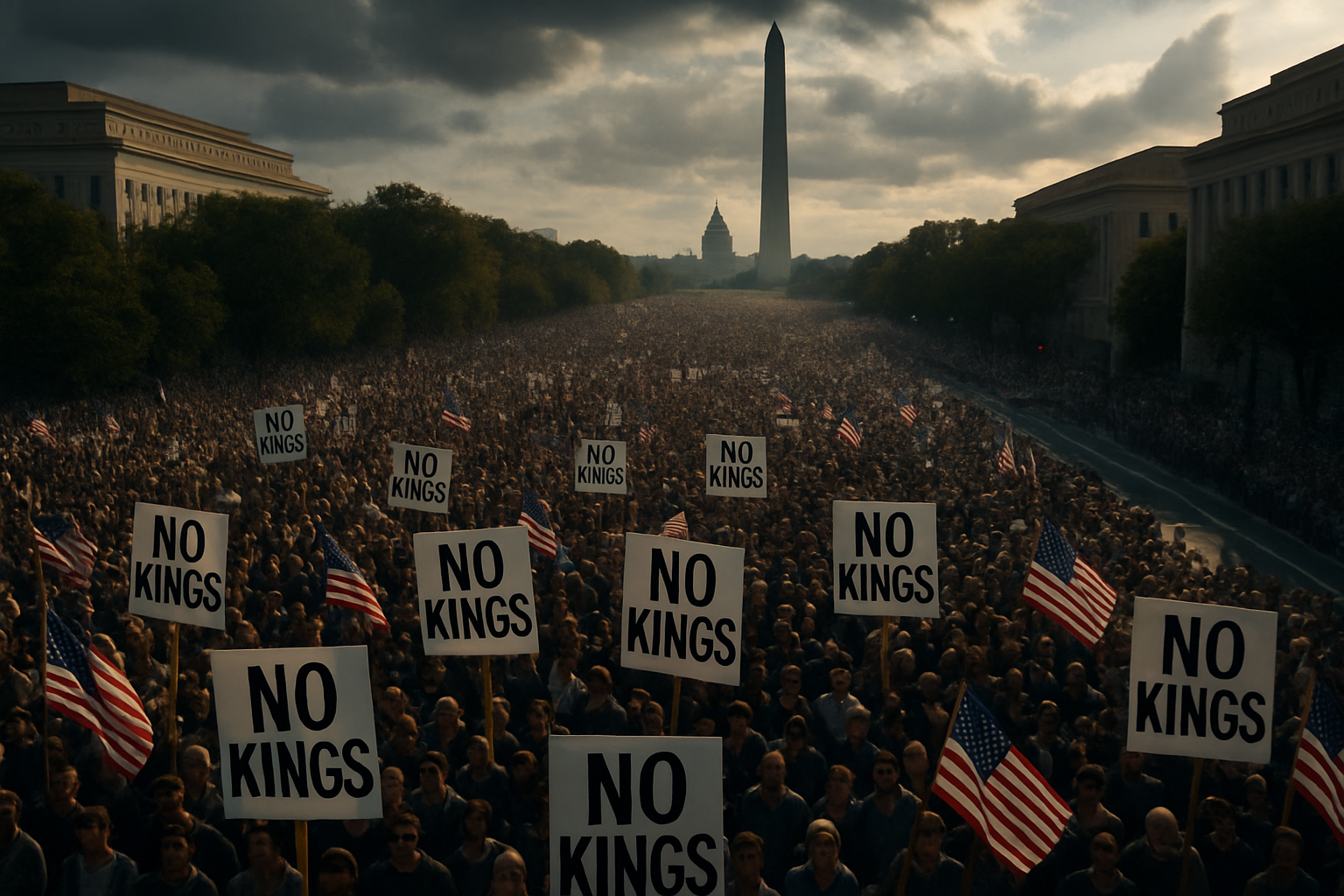
An estimated eight million Americans participated in anti-Trump "No Kings" protests across thousands of cities Saturday, marking what organizers claim is the largest single-day demonstration in United States history as opposition to President Trump's Iran military operations and aggressive immigration enforcement reached a boiling point.
More than 3,200 events were organized in all 50 states, according to protest organizers, representing a dramatic expansion from previous nationwide mobilizations. The demonstrations marked the third major wave of "No Kings" protests since Trump's return to office, building from several million participants in June 2025 and an estimated seven million in October 2025.
Large rallies took place in major cities including New York, Dallas, Philadelphia, and Washington, but organizers reported that two-thirds of the events occurred outside major urban centers—representing a nearly 40% increase in smaller community participation since the movement's first mobilization last June.
Iran War Opposition Drives Mobilization
The protests were significantly driven by growing opposition to Trump's military engagement with Iran, dubbed "Operation Epic Fury," which has cost $11.3 billion in its first week alone and resulted in more than 150 US service members wounded and three confirmed deaths. Pentagon operations have been extended through September, far beyond the initial 4-6 week projection.
Public opinion polling shows only 25% of Americans support the Iran strikes, with 56% believing Trump is too willing to use military force—including a quarter of his Republican base. The military deployment includes dual-carrier strike groups with the USS Gerald R. Ford and Abraham Lincoln, representing approximately one-third of the active Navy fleet concentrated within 800 kilometers of Iran's coast.
In Minnesota, a flashpoint in Trump's immigration crackdown, a massive rally was held outside the state capitol in Saint Paul. Many protesters held aloft posters bearing photos of Renee Good and Alex Pretti, U.S. citizens fatally shot by federal immigration agents in January during the controversial "Operation Metro Surge" that has since been scaled back following widespread criticism.
"This is an existential threat to our democracy," actor Robert De Niro told the crowd during multiple appearances at demonstrations.
— Robert De Niro, Actor and Political Activist
International Solidarity Expands Movement
The anti-Trump movement has expanded beyond U.S. borders, with solidarity rallies reported in Amsterdam, Madrid, and Rome, where 20,000 people marched under heavy police presence. The international demonstrations reflect growing concern among European allies about American foreign policy direction, particularly after Trump's declaration that the U.S. "no longer needs NATO assistance" in response to European reluctance to support naval operations in the Strait of Hormuz.
European allies, including German Defense Minister Boris Pistorius, have questioned what a "handful of European frigates" could accomplish in the Persian Gulf, leading to unprecedented transatlantic tensions over Middle East policy.
Celebrity and Political Participation
The protests featured significant celebrity participation, with Bruce Springsteen performing "Streets of Minneapolis" at the Saint Paul rally, directly referencing the January shootings that sparked nationwide outrage over immigration enforcement tactics. The performance marked a rare political statement from the typically measured musician.
Democratic leaders participated despite security concerns, with the protests maintaining a largely peaceful character that has marked the movement's tactical evolution from earlier, more confrontational approaches to sustained political organizing.
Constitutional Messaging Framework
The "No Kings" name deliberately references the founding fathers' rejection of monarchy, positioning the protests within a historical democratic resistance narrative. Protesters consistently invoke constitutional principles and institutional norms they claim are under threat, extending their appeal beyond traditional partisan divisions toward broader democratic defense messaging.
This constitutional framing has enabled the movement to mobilize diverse geographic and demographic communities that might not typically participate in partisan political demonstrations, contributing to the record-breaking scale of Saturday's events.
Strategic Evolution Demonstrates Sophistication
The movement has adopted what organizers call a "without mobilization" strategy in some regions, focusing on economic pressure through strikes and work stoppages rather than street demonstrations. This tactical diversity demonstrates significant organizational infrastructure and the capacity for sustained political engagement across multiple fronts.
Coordination across all 50 states required unprecedented logistical planning and resource allocation, indicating a movement that has evolved from reactive protests to proactive political organizing with long-term strategic capacity.
Immigration Enforcement Remains Contentious
Trump's immigration enforcement policies continue to face mounting opposition, with federal courts increasingly requiring ICE warrants before arrests and two-thirds of Americans believing immigration enforcement has "gone too far," according to NPR/PBS/Marist polling. The University of California has confirmed that deportations have quadrupled during the first nine months of Trump's second administration.
The fatal shootings of Alex Pretti and Renee Nicole Good by ICE agents in Minneapolis led to the withdrawal of 700 federal agents from Minnesota and the implementation of mandatory body cameras—representing significant tactical adjustments despite the administration's insistence that overall enforcement strategy remains unchanged.
Midterm Elections Context
With November 2026 midterm elections approaching, the protests serve a dual function as both a demonstration of political opposition and organizing tools for opposition parties. The emphasis on constitutional governance and democratic accountability provides messaging that extends beyond partisan frameworks while building infrastructure for sustained political engagement.
The success in mobilizing diverse communities across traditional geographic and demographic boundaries indicates continued potential for political pressure on an administration facing declining approval ratings on most issues except border security, according to political analyst Larry Sabato.
Historical Significance
Saturday's demonstrations represent a critical juncture in American politics amid ongoing foreign conflicts, economic pressures, and fundamental questions about democratic institutions and presidential authority. The protests mark a significant moment in the struggle between executive power and popular resistance, with implications extending well beyond the current administration.
Whether viewed as a legitimate expression of democratic dissent or a challenge to elected authority, the "No Kings" movement has demonstrated the vitality of civic engagement in American democracy. The movement's ability to sustain mobilization, expand geographically, and maintain peaceful approaches while addressing both domestic and international concerns represents a significant test of democratic institutions' capacity to channel political opposition constructively.
The March 28 protests set the stage for continued political confrontation as the administration faces mounting pressure from multiple directions while maintaining its policy course on immigration enforcement and foreign military engagement. The outcome of this political struggle will likely influence the trajectory of American democracy and international relations for years to come.