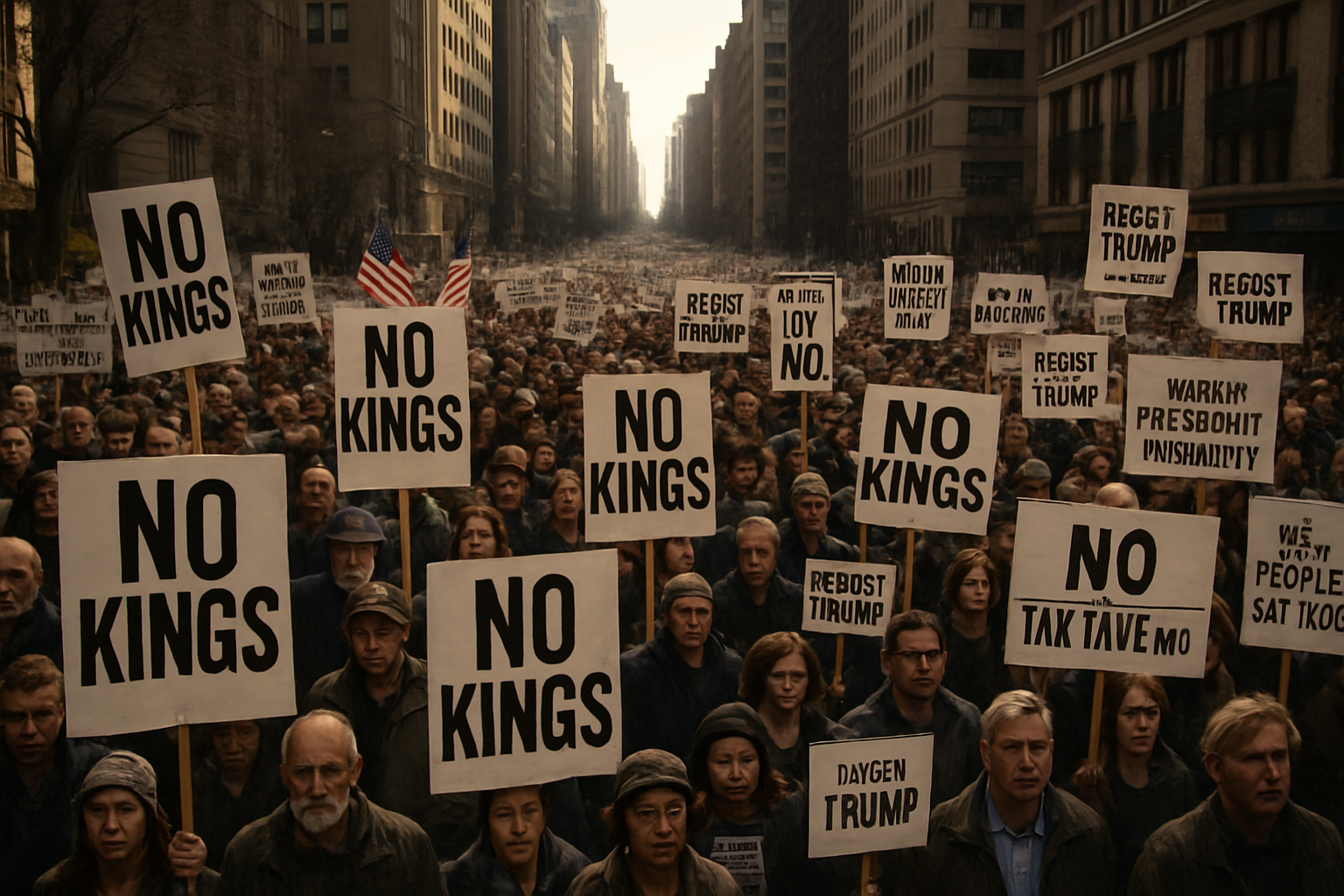
Eight million Americans took to the streets Saturday in what organizers claim as the largest single-day demonstration in US history, with "No Kings" protests spanning over 3,300 cities nationwide in unprecedented opposition to President Trump's military campaign against Iran.
The massive mobilization represents the third major wave of anti-Trump demonstrations since his return to office in January 2025, building from several million participants in June 2025 to seven million in October, culminating in Saturday's historic turnout that organizers say surpassed all previous protest movements in scale and geographic reach.
Opposition to Iran War Drives Record Turnout
The protests were primarily driven by growing opposition to "Operation Epic Fury," Trump's military engagement with Iran that began March 1 following the collapse of nuclear negotiations. The conflict has cost $11.3 billion in its first week alone, resulted in over 150 US casualties including three confirmed deaths, and triggered the most extensive global crisis since the Cold War.
"Iran posed no imminent threat to our nation. The same tactics that drew us into Iraq are being repeated,"
— Joseph Kent, Former National Counterterrorism Center Director
Only 25% of Americans support the Iran strikes according to recent polling, with 56% believing Trump is too willing to use military force—including a quarter of his Republican base. The conflict's unprecedented unpopularity has fueled the protest movement's growth beyond traditional Democratic strongholds into Republican heartland communities.
Geographic Expansion Into Small-Town America
Perhaps most significantly, two-thirds of Saturday's protests occurred outside major cities—a 40% increase in small community participation since the movement's first mobilization in June 2025. All 50 states participated, demonstrating the organizational infrastructure and sustained political engagement capacity that has developed over nearly a year of mobilization.
The movement has penetrated into traditionally conservative regions that rarely see large-scale demonstrations. From West Virginia mining towns to rural Texas communities, the "No Kings" message of constitutional governance and democratic accountability has resonated beyond partisan divisions.
Constitutional Messaging and Democratic Resistance
The "No Kings" slogan deliberately references America's founding rejection of monarchy, positioning the protests within a historical democratic resistance narrative that appeals beyond traditional partisan frameworks. This constitutional messaging has enabled the movement to mobilize diverse communities traditionally non-partisan while emphasizing institutional norms under perceived threat.
Celebrity support has amplified the movement's reach, with Bruce Springsteen performing "Streets of Minneapolis" at the St. Paul rally—referencing fatal Minneapolis shootings that sparked tactical adjustments in immigration enforcement—and Robert De Niro making multiple appearances calling Trump an "existential threat to democracy."
International Solidarity and Global Concerns
The domestic protests coincided with international solidarity demonstrations in Amsterdam, Madrid, Rome, and other European cities, with approximately 20,000 marchers in Rome alone. This global dimension reflects widespread international concern about American policies and their global implications.
European allies have notably rejected Trump's requests for naval coalition support in the Strait of Hormuz, with German Defense Minister Pistorius questioning what "a handful of European frigates" could accomplish. In response, Trump declared the US "no longer needs NATO assistance," creating additional transatlantic tensions that provide international context for the domestic resistance movement.
Strategic Sophistication and Sustained Engagement
The coordination across 50 states demonstrates unprecedented logistical capacity and resource allocation, indicating the movement's evolution from reactive protests to proactive political organizing. The largely peaceful character has been maintained despite record scale, providing legitimacy while avoiding negative publicity that could undermine support.
In some regions, organizers have adopted a "without mobilization" strategy, focusing on economic pressure through strikes and work stoppages rather than traditional street demonstrations. This tactical diversity shows the movement's capacity for sustained engagement across multiple fronts with long-term strategic planning.
Federal Response and Political Implications
The White House has dismissed the protests, with Trump calling participants "weak on security" while claiming "strong and compelling evidence" that Iran was preparing attacks. However, the resignation of counterterrorism chief Joseph Kent in protest over the Iran war—the first senior administration official to publicly break with Trump over the military campaign—suggests internal divisions.
With November 2026 midterm elections approaching, the protests serve a dual function as both a demonstration of political opposition and organizing tools for the opposition. The success in mobilizing diverse geographic and demographic communities indicates continued potential for political pressure.
International Context and Nuclear Crisis
The protests occur against the backdrop of the most serious international crisis since the Cold War. The Iran conflict has triggered 18,000+ flight cancellations worldwide, oil prices surging past $100 per barrel, and the closure of the Strait of Hormuz affecting 40% of global oil transit.
The military action came despite Geneva nuclear talks achieving "broad agreement on guiding principles"—the most diplomatic progress since the 2018 JCPOA collapse. However, fundamental disagreements over scope proved insurmountable, with Iran excluding ballistic missiles and regional proxies as "red lines" while the US demanded comprehensive agreements including missiles, armed groups, and human rights.
Federal Court Resistance and Constitutional Questions
Immigration enforcement faces mounting judicial opposition, with federal courts requiring ICE warrants and civil rights lawsuits challenging policies. The University of California confirms that deportations have quadrupled in the first nine months of Trump's second term, though tactical adjustments including Minnesota agent withdrawal and mandatory body cameras represent responses to public pressure.
The Senate voted 53-47 to block a bipartisan resolution limiting Trump's presidential war powers against Iran, ensuring executive authority remains largely unchecked during "weeks-long operations" according to Pentagon planning.
Historical Significance and Future Implications
Saturday's protests mark a critical juncture in American politics amid foreign conflicts, economic pressures, and fundamental questions about democratic institutions and presidential authority. The movement's ability to sustain mobilization, expand geographically, and maintain peaceful approaches while addressing both domestic and international concerns demonstrates continued civic engagement vitality.
Whether viewed as legitimate democratic dissent or a challenge to elected authority, the protests demonstrate the vitality of civic engagement in American democracy. The success in mobilizing diverse communities while maintaining constitutional governance messaging provides a template for sustained democratic resistance through peaceful mobilization.
As the Iran conflict enters its third week with no clear resolution, and with congressional scrutiny intensifying over ground troop deployment possibilities, the "No Kings" movement represents a significant test of democratic capacity to channel political opposition constructively while maintaining institutional stability.
The precedent established by these historic demonstrations—combining record scale, geographic diversity, strategic coordination, and constitutional messaging—will likely influence the trajectory of political confrontation, democratic institutions, and international relations for years ahead, setting a template for sustained democratic resistance in the 21st century.