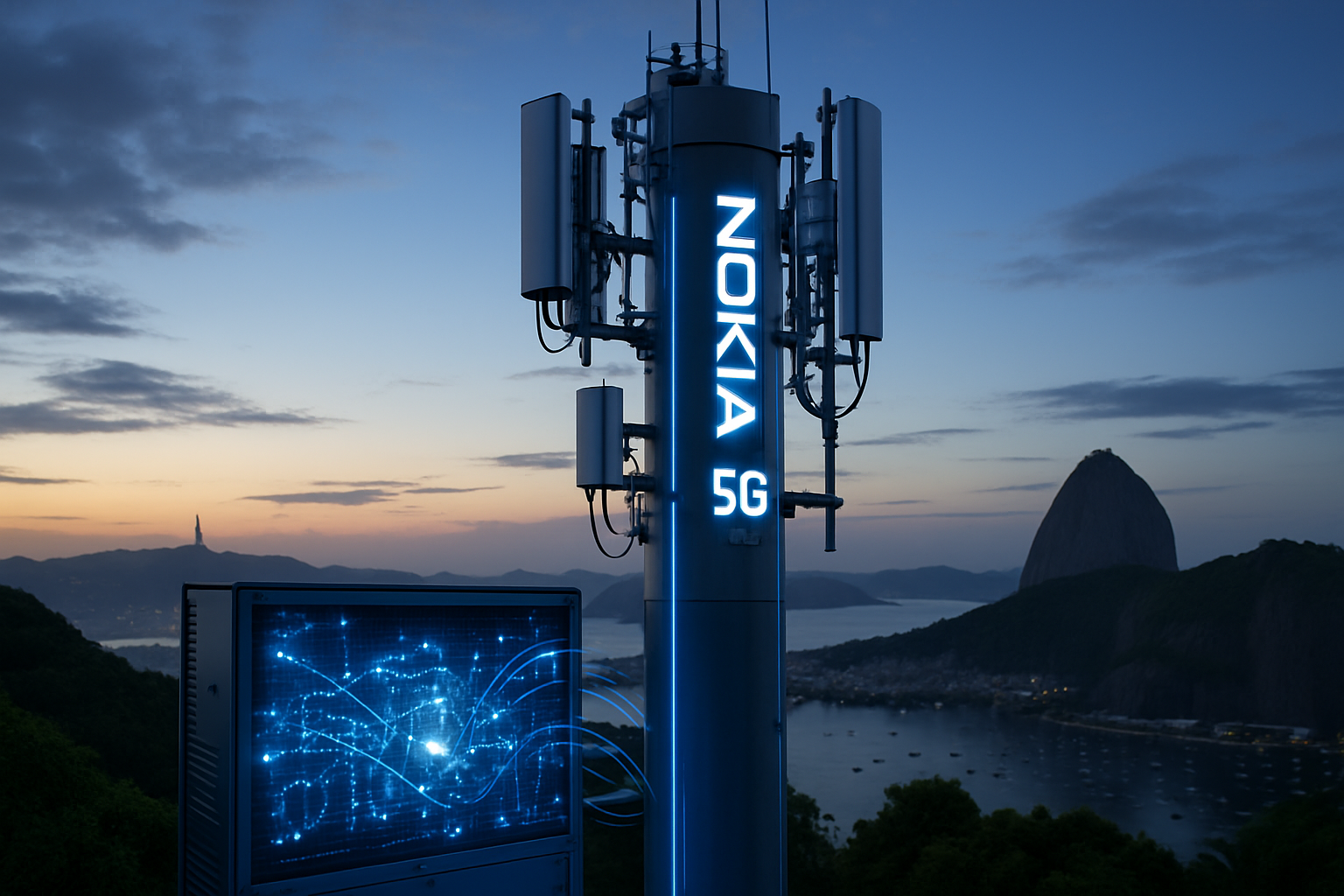
Nokia has announced a significant acceleration of its artificial intelligence development capabilities through an expanded partnership with Nvidia, positioning the Finnish telecommunications giant to deploy advanced AI-powered 5G networks in Brazil as the company seeks to reclaim global infrastructure market leadership.
The announcement, confirmed by Nokia executives on March 2, 2026, represents a strategic pivot for the company as it leverages artificial intelligence to differentiate its 5G offerings in an increasingly competitive global marketplace dominated by Chinese rivals Huawei and ZTE. The Brazilian deployment will serve as a crucial testing ground for Nokia's next-generation network technologies that integrate AI capabilities directly into cellular infrastructure.
AI-Enhanced Network Architecture
Nokia's collaboration with Nvidia centers on deploying sophisticated AI algorithms that optimize network performance in real-time, automatically adjusting signal strength, routing traffic, and predicting maintenance needs before equipment failures occur. This represents a fundamental shift from traditional 5G networks that rely on manual configuration and reactive maintenance protocols.
"The integration of artificial intelligence into our 5G infrastructure allows us to create self-optimizing networks that learn from usage patterns and environmental conditions," explained a Nokia spokesperson familiar with the Brazilian project. "This technology enables unprecedented network efficiency while reducing operational costs for our telecommunications partners."
The AI-powered systems can analyze millions of data points per second, including user behavior patterns, network traffic flows, and equipment performance metrics, to make instantaneous adjustments that improve service quality and prevent network congestion. This capability becomes particularly valuable in Brazil's diverse geographical landscape, where network conditions vary dramatically between urban centers like São Paulo and remote Amazonian regions.
Strategic Partnership with Nvidia
Nokia's deepened partnership with Nvidia leverages the American chip giant's advanced GPU technology and AI development platforms specifically designed for telecommunications applications. The collaboration builds on Nvidia's significant investments in edge computing and network processing capabilities that enable AI algorithms to run directly within cellular base stations rather than requiring centralized processing.
This distributed AI approach addresses critical latency concerns for 5G applications including autonomous vehicles, industrial automation, and real-time media streaming that require near-instantaneous response times. By processing AI algorithms at the network edge, Nokia can deliver ultra-low latency services that were previously impossible with conventional centralized cloud architectures.
The partnership comes at a critical time for both companies as they face intense competition from Chinese manufacturers who have invested heavily in AI-enhanced telecommunications equipment. Huawei and ZTE have made significant advances in integrating artificial intelligence into their 5G systems, creating pressure on Western competitors to accelerate their own AI development programs.
Brazil as Strategic Testing Ground
Brazil's selection as the deployment location for Nokia's AI-enhanced 5G networks reflects the country's status as Latin America's largest telecommunications market and its growing importance in global technology adoption. With over 220 million inhabitants and rapidly expanding digital infrastructure needs, Brazil provides an ideal environment for testing advanced network technologies at scale.
The Brazilian market presents unique challenges that make it particularly valuable for validating AI-powered network solutions. The country's vast territory includes dense urban environments, challenging terrain in mountainous regions, and remote areas with limited infrastructure, requiring networks that can automatically adapt to varying conditions without manual intervention.
Brazilian telecommunications operators have expressed strong interest in AI-enhanced network capabilities that can reduce operational expenses while improving service quality for their customers. The country's regulatory environment has also proven receptive to advanced telecommunications technologies, with government support for 5G deployment and digital infrastructure modernization initiatives.
Global Infrastructure Competition
Nokia's AI-powered 5G initiative occurs against the backdrop of intensifying global competition in telecommunications infrastructure, with significant geopolitical implications as nations seek to reduce dependence on Chinese technology suppliers. The Finnish company has positioned itself as a trusted alternative to Huawei and ZTE for countries concerned about security and supply chain reliability.
The integration of artificial intelligence into 5G networks has become a key battleground in this competition, with technological superiority potentially determining market leadership for the next decade. Nokia's partnership with Nvidia represents an effort to leverage American AI expertise while maintaining European manufacturing and design capabilities.
Industry analysts note that the success of Nokia's Brazilian deployment could influence purchasing decisions by telecommunications operators worldwide, particularly in markets where security considerations favor Western equipment suppliers over Chinese alternatives. The demonstration of superior AI capabilities could provide Nokia with a significant competitive advantage in future infrastructure tenders.
Technical Innovation and Challenges
The deployment of AI-powered 5G networks faces significant technical challenges, including the global semiconductor shortage that has driven memory chip prices up sixfold, affecting equipment manufacturers across the industry. Nokia must navigate these supply chain constraints while delivering sophisticated AI capabilities that require advanced processing power and memory resources.
Despite these challenges, Nokia's engineering teams have developed innovative approaches to optimize AI algorithm efficiency, enabling advanced network intelligence while working within hardware constraints. These optimizations include edge computing architectures that distribute AI processing across multiple network nodes and machine learning algorithms specifically designed for telecommunications applications.
The company's research and development investments in AI-powered networking have accelerated significantly over the past year, with dedicated engineering teams focused on creating proprietary algorithms for network optimization, predictive maintenance, and autonomous operation. These investments position Nokia to offer unique capabilities that competitors cannot easily replicate.
Market Implications and Future Outlook
The success of Nokia's AI-powered 5G deployment in Brazil could establish new industry standards for intelligent network infrastructure, potentially reshaping the global telecommunications equipment market. As operators worldwide seek to reduce operational costs while improving service quality, AI-enhanced networks represent a compelling value proposition.
Industry experts predict that artificial intelligence will become essential for managing the complexity of next-generation networks, including the transition to 6G technologies expected later in the decade. Nokia's early investment in AI capabilities positions the company advantageously for this technological evolution.
The Brazilian deployment timeline extends through 2026 and into 2027, providing Nokia with valuable operational experience that can inform future AI-powered network deployments globally. The company has indicated that successful implementation in Brazil could lead to expanded AI-enhanced 5G offerings in other major markets across Europe, Asia, and North America.
Economic and Strategic Significance
Nokia's AI-powered 5G expansion represents more than a technological advancement; it signals Finland's continued leadership in global telecommunications innovation despite intense competition from larger economies. The partnership with Nvidia demonstrates how strategic international collaboration can amplify the capabilities of individual companies and nations.
For Brazil, the deployment of advanced AI-enhanced 5G infrastructure supports the country's digital transformation objectives and economic development goals. Improved telecommunications capabilities enable new industries and services while enhancing the competitiveness of existing businesses across multiple sectors.
The timing of this announcement, during a period of global technological realignment and supply chain challenges, underscores the strategic importance of maintaining technological sovereignty and fostering international partnerships based on shared values and security considerations.
As the deployment progresses throughout 2026, Nokia's AI-powered 5G network in Brazil will serve as a crucial test case for the future of intelligent telecommunications infrastructure, with implications extending far beyond a single market to influence the global trajectory of network technology development.