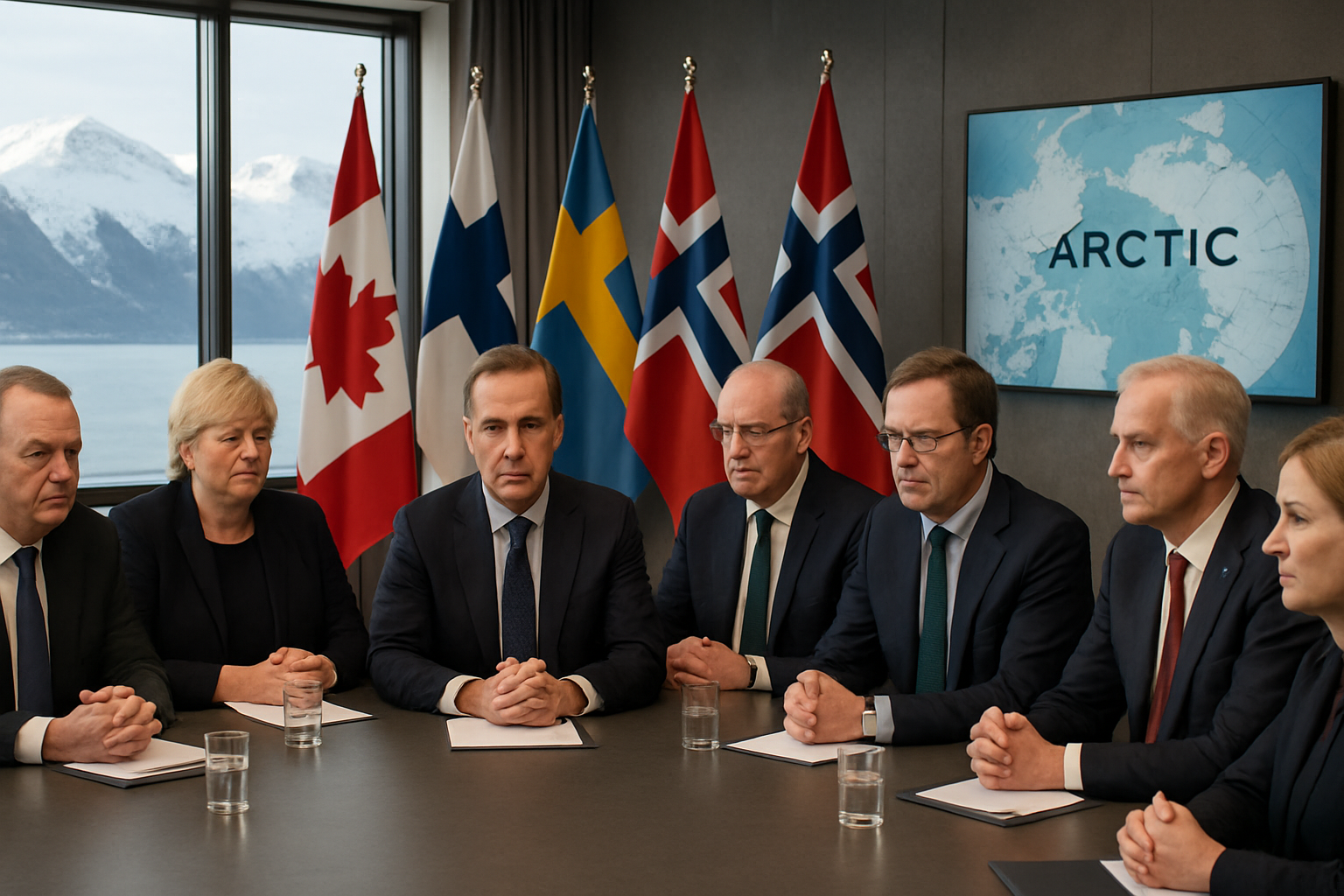
Canadian Prime Minister Mark Carney joined Nordic leaders in Oslo this weekend for an unprecedented Arctic security summit, forging deeper military and defense cooperation amid escalating tensions over Greenland sovereignty and renewed Russian military activity in the polar region.
The gathering of leaders from Canada, Finland, Sweden, Norway, Denmark, and Iceland represents the most significant expansion of Arctic security cooperation since the Cold War, coming at a critical moment when the region faces multiple geopolitical pressures. The summit follows closely on the heels of massive NATO exercises in northern Norway and occurs as climate change continues to open new shipping routes and expose valuable natural resources.
Historic Cooperation Framework Unveiled
According to sources familiar with the discussions, the six-nation partnership will encompass joint military exercises, shared intelligence gathering, coordinated surveillance operations, and enhanced cooperation in defense industrial production specifically tailored for Arctic conditions. The agreement builds upon Canada's recently announced $35 billion Arctic defense investment, representing the most significant expansion of Canadian military presence in the Arctic since the Cold War.
Finnish Prime Minister Petteri Orpo emphasized that the Nordic countries and Canada are united by "shared values, northern location, and Arctic expertise." Swedish Prime Minister Ulf Kristersson, speaking from Oslo, declared that "we must be more proactive and more forward-leaning" in Arctic security matters, signaling a new assertive posture from traditionally neutral Nordic nations.
"There is a growing list of challenges we face together in the Arctic, and our response must be equally coordinated and comprehensive."
— Mark Carney, Canadian Prime Minister
Russian Threat Assessment Drives Urgency
The timing of this cooperation is no coincidence. Intelligence reports indicate that Russian military activity in the Arctic has increased by 23% since Finland and Sweden joined NATO, with Moscow systematically reopening Cold War-era military bases and expanding reconnaissance operations. Recent incidents include Russian drone incursions near NATO assets and increased submarine activity in Arctic waters.
The partnership comes as part of NATO's broader Arctic Sentry mission, launched in February 2026 as the alliance's most comprehensive Arctic security response in decades. Under this framework, the United Kingdom has doubled its troop presence in Norway from 1,000 to 2,000 soldiers over three years, while Sweden has deployed Gripen fighter jets for Greenland exercises.
Norwegian officials have been particularly vocal about the changing threat landscape. Research from Magnus Håkenstad warns that Norway must prepare for the possibility of conflict within years, while Lithuanian intelligence predicts Moscow could be ready for "limited military conflict" within 3-5 years if a Ukraine ceasefire is achieved, potentially allowing Russia to redirect resources to Arctic operations.
Greenland Crisis Adds Urgency
The summit takes place against the backdrop of unprecedented tensions over Greenland, where U.S. territorial ambitions have created the most serious sovereignty crisis in the Arctic since the Cold War. The Trump administration's continued pressure on Denmark and Greenland through working group meetings has prompted an extraordinary international response.
France and Canada opened their first consulates in Nuuk in February 2026 in a coordinated diplomatic show of support for Danish sovereignty. Canadian Inuit delegations have explicitly told the Trump administration to "back off," while Indigenous Governor General Mary Simon has provided cultural legitimacy to Canada's Arctic diplomacy.
The crisis has strengthened European solidarity, with EU President Ursula von der Leyen planning a March visit to Greenland to announce a comprehensive support package. King Frederik X's recent three-day symbolic visit to Greenland further demonstrates Denmark's commitment to maintaining territorial integrity in the face of external pressure.
Defense Industrial Revolution
A key component of the Nordic-Canada partnership involves collaborative defense production, building upon Finland's announcement of cooperation with other Nordic countries and Canada in military industrial manufacturing. This initiative aligns with Canada's Defense Industrial Strategy, which promises to shift 70% of defense contracts to Canadian companies and create 125,000 new jobs over the next decade.
The partnership will focus on developing Arctic-specific military equipment capable of operating in extreme conditions, including surveillance systems designed for temperatures reaching -70°C and winds exceeding 200 km/h. This technology transfer represents a significant evolution from traditional arms purchases to comprehensive military-industrial cooperation.
Swedish officials have indicated their commitment to expanding defense cooperation beyond traditional frameworks, with Defense Minister Pål Jonson's recent announcement that Sweden would be willing to host nuclear weapons during wartime representing a dramatic shift from the country's historically nuclear-free policy.
Nuclear Dimension Transforms Arctic Strategy
The Nordic-Canada cooperation gains additional significance amid the most serious nuclear governance crisis in 50 years. The expiration of the New START Treaty in February 2026 has eliminated all bilateral nuclear constraints between the United States and Russia for the first time since the early Cold War, with both nations controlling 80% of global nuclear weapons.
Finland's recent decision to lift its comprehensive ban on nuclear weapons "as soon as possible" reflects the changing security calculus in the Nordic region. Defense Minister Antti Häkkänen stated that current legislation "does not meet the needs Finland has as a NATO member," marking a historic reversal of Finland's post-war nuclear policy.
These nuclear policy shifts occur alongside unprecedented European discussions about expanding France's nuclear deterrent to provide broader continental coverage, with Germany, Poland, and Finland engaging in preliminary conversations about extended deterrence arrangements.
Climate Change Accelerates Strategic Competition
The urgency of Arctic cooperation is underscored by accelerating climate change, which has seen 19 consecutive months of global temperatures exceeding 1.5°C above pre-industrial levels. As polar ice continues to retreat and new shipping routes open, the Arctic becomes increasingly accessible to both commercial and military activities.
Antarctic research has documented unprecedented ice loss rates equivalent to the area of Vienna annually, while Arctic temperatures rise at twice the global average. This environmental transformation creates new opportunities for resource extraction and transportation but also new vulnerabilities requiring military protection.
The Netherlands has deployed the most sophisticated polar monitoring network ever created, with equipment designed to operate in extreme Arctic conditions while providing real-time data transmission. This technology will be crucial for the coordinated surveillance efforts planned under the Nordic-Canada partnership.
Economic and Energy Security Implications
Beyond military cooperation, the partnership addresses critical economic and energy security concerns. Arctic regions contain substantial reserves of rare earth minerals essential for renewable energy infrastructure, currently dominated by Chinese supply chains. Finland's €800 million lithium mining investment represents an effort to reduce this dependency while supporting the green transition.
Canada's position as a potential supplier of 100 million tonnes of LNG annually aligns with Nordic energy security priorities, particularly given recent disruptions to traditional energy supplies. The partnership framework includes provisions for coordinated responses to energy supply disruptions and infrastructure attacks.
The cooperation also addresses permafrost thaw affecting traditional Arctic infrastructure, requiring hundreds of millions in adaptation investments. Technological solutions developed jointly by Nordic countries and Canada could serve as templates for other Arctic nations facing similar challenges.
Intelligence and Surveillance Integration
A crucial component of the partnership involves enhanced intelligence sharing and coordinated surveillance operations. Recent incidents, including a Russian drone intercepted near the French aircraft carrier Charles de Gaulle after launching from a Russian reconnaissance vessel, demonstrate the sophisticated nature of current Arctic intelligence operations.
The partnership will establish integrated monitoring systems capable of tracking Russian military movements, submarine activities, and aerial reconnaissance across the entire Arctic region. This represents a significant evolution from national intelligence operations to a coordinated multinational approach.
Swedish Armed Forces officials have confirmed that Russian provocations have become increasingly sophisticated, requiring enhanced defensive measures and coordinated responses. The partnership will provide frameworks for rapid information sharing and joint responses to future incidents.
Diplomatic Balance and Future Challenges
The Nordic-Canada partnership must carefully balance deterrent effects with diplomatic stability, avoiding actions that could escalate tensions while maintaining credible defense capabilities. Officials emphasize that the cooperation is defensive in nature, focused on protecting territorial sovereignty and maintaining stability in the Arctic region.
Implementation faces several challenges, including coordination across different legal systems, military traditions, and political structures. The partnership requires sustained commitment across electoral cycles and diverse stakeholder coordination, particularly given the long-term nature of Arctic infrastructure development.
Success will depend on the ability to integrate traditional Arctic knowledge with cutting-edge technology, involving Indigenous communities in policy decisions while addressing their specific security concerns. This approach recognizes that effective Arctic operations require understanding gained through generations of polar experience.
Global Template for Regional Security
The Nordic-Canada Arctic partnership represents more than regional defense cooperation; it provides a template for middle-power coordination in an era of great power competition. The initiative demonstrates how like-minded democracies can coordinate defense efforts while maintaining alliance relationships with larger powers.
The partnership's emphasis on technological innovation, environmental protection, and Indigenous rights integration could influence approaches to territorial defense in other strategically contested regions. Success would strengthen arguments for diplomatic engagement and collective action in addressing 21st-century security challenges.
The cooperation also reflects broader trends in European strategic autonomy, with Nordic countries and Canada developing capabilities that complement rather than compete with existing alliance structures. This approach allows for enhanced defense cooperation while preserving transatlantic relationships.
Implementation Timeline and Immediate Steps
The partnership will be implemented through a phased approach addressing immediate security concerns while building long-term capabilities. Initial phases focus on intelligence sharing, coordinated surveillance, and joint training exercises, with more complex integration of defense industrial cooperation following over the coming years.
Near-term priorities include establishing communication protocols, standardizing equipment where feasible, and conducting joint exercises designed specifically for Arctic conditions. The partnership will also coordinate responses to ongoing Russian provocations and potential future crises.
Medium-term goals involve expanding defense industrial cooperation, developing Arctic-specific military technologies, and creating sustainable financing mechanisms for long-term security investments. These efforts will require coordination with broader NATO planning while maintaining the partnership's specific Arctic focus.
The success of the Nordic-Canada Arctic security partnership will significantly influence global approaches to regional defense cooperation, territorial sovereignty protection, and climate change adaptation in the coming decades. As Arctic temperatures continue to rise and geopolitical tensions intensify, this unprecedented cooperation may prove crucial for maintaining stability in one of the world's most strategically important regions.