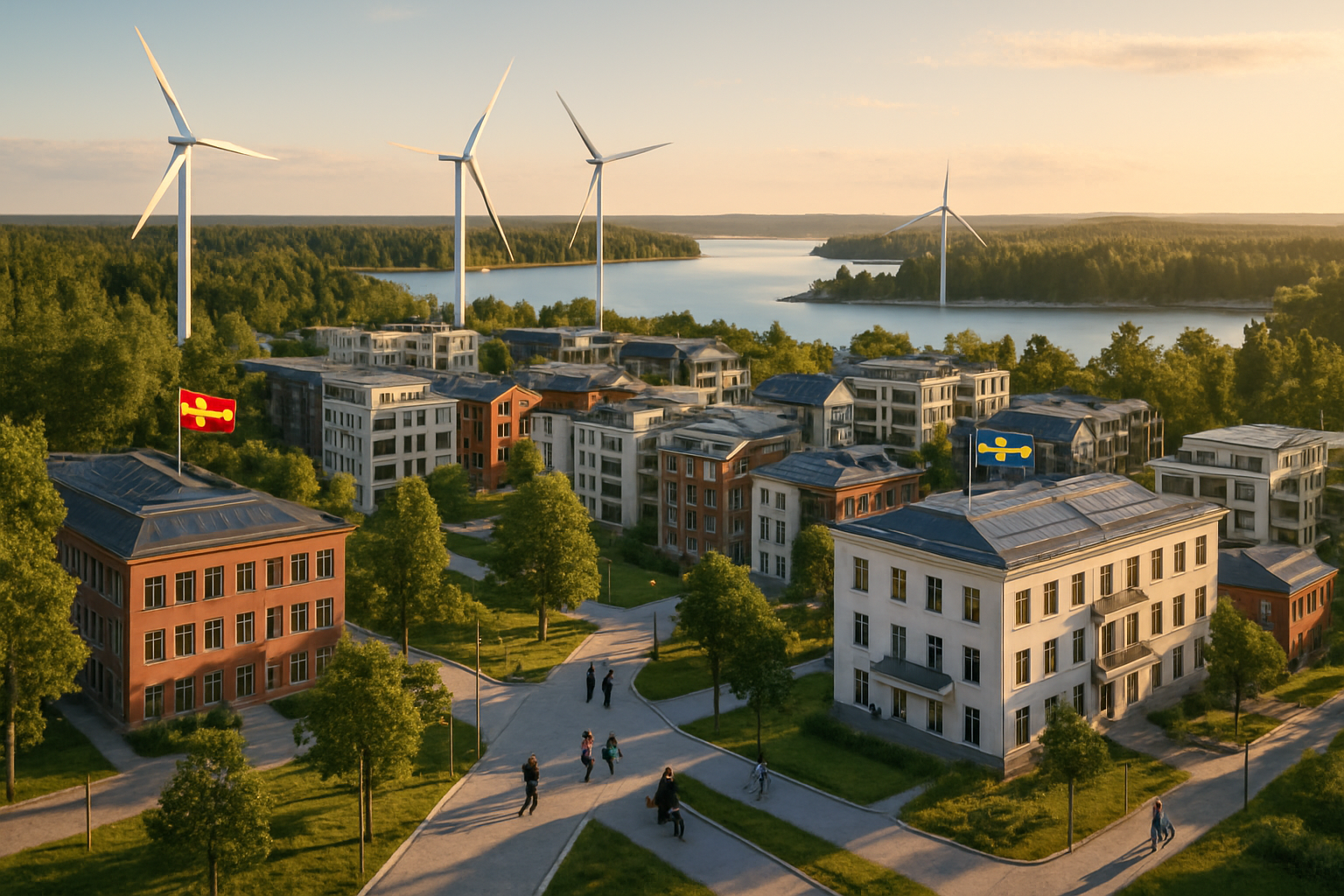
As the world grapples with the 23rd consecutive month of temperatures exceeding 1.5°C above pre-industrial levels, Nordic countries are emerging as global leaders in sustainable governance, offering hope through innovative social policies and environmental protection measures that demonstrate the possibility of comprehensive societal transformation.
Recent developments in Sweden and Denmark illustrate the sophisticated balance Nordic nations maintain between addressing immediate crises and building long-term resilience. Swedish authorities are confronting dual challenges: fuel and fertilizer rationing concerns due to Middle Eastern instability, while simultaneously developing new labor mobility programs designed to address regional employment disparities.
Sweden's Proactive Crisis Management
The Swedish County Administrative Board in Östergötland has taken the unprecedented step of considering fuel and fertilizer rationing if conditions in the Middle East deteriorate further. Defense Director Jenny Knuthammar characterized the situation as "quite serious," reflecting the broader European energy security concerns that have emerged during the ongoing global energy crisis.
This cautionary approach demonstrates Nordic crisis preparedness strategies that extend far beyond reactive measures. Sweden's comprehensive risk assessment protocols, developed through decades of strategic planning, enable authorities to anticipate supply chain vulnerabilities and implement protective measures before shortages occur.
"The situation is quite serious. We must be prepared for all contingencies to protect our essential supplies."
— Jenny Knuthammar, Defense Director, County Administrative Board
Simultaneously, Sweden's government is advancing innovative labor mobility policies through a new relocation support program under investigation. This initiative represents a fundamental evolution from the 1980s model when jobs concentrated in southern Sweden prompted northward migration. Today's transformed economic landscape sees the government exploring comprehensive relocation assistance to reduce unemployment through strategic population distribution.
Denmark's Environmental Leadership
Denmark continues its remarkable environmental leadership, recently bringing online its largest wind farm, reinforcing the nation's position as a global renewable energy pioneer. This milestone represents more than technological achievement—it demonstrates sustained political commitment, technological innovation, and community engagement overcoming complex infrastructure challenges.
The Danish renewable energy model showcases how smaller nations can achieve energy independence while contributing to global climate goals through technology export and knowledge sharing. Denmark's approach integrates advanced grid management systems with community-centered development, creating economic opportunities while meeting environmental objectives.

Nordic Model's Global Significance
The Nordic approach to sustainable development operates on multiple interconnected levels. Memory of previous environmental and social policy initiatives reveals these nations have consistently demonstrated that environmental protection functions as economic development strategy rather than regulatory burden. Countries implementing comprehensive environmental protection show greater economic resilience and attract sustainable investment across sectors including eco-tourism, green technology manufacturing, and environmental services.
Estonia's achievement of 88% renewable electricity generation, alongside continental Europe's largest battery storage facility serving 90,000 households, provides a template for the feasibility of rapid renewable transitions. However, this success requires sustained investment and political commitment, highlighting the vulnerability during interim periods that necessitate traditional energy security measures.
Integration of Technology and Tradition
Nordic environmental initiatives demonstrate sophisticated synthesis of cutting-edge technology with traditional ecological knowledge and community-based management systems. This represents a fundamental evolution in environmental protection methodology, moving beyond purely technological or traditional approaches toward comprehensive frameworks that combine scientific rigor with cultural sensitivity and community ownership.
Swedish forest policy evolution exemplifies this balance. Minister Peter Kullgren's emphasis on "more freedom, not more socialism" in forest policy reflects ongoing debates about balancing economic interests with environmental protection, particularly as current deforestation rates could eliminate remaining old-growth forests below mountain regions within 25 years.
Addressing Climate Emergency
The Nordic response to unprecedented climate conditions—with January 2026 marking the hottest month in recorded history—demonstrates how advanced democratic societies can maintain social models while adapting to 21st-century environmental pressures. The region faces the same climate volatility affecting all continents, but Nordic institutional frameworks provide resilience through comprehensive planning and adaptive management.
Recent extreme weather events across Europe, including devastating storms and unprecedented flooding, have tested traditional mutual aid mechanisms designed for sequential regional disasters. Nordic countries have pioneered coordinated responses, with Sweden and Denmark receiving €246 million in EU Civil Protection assistance—the largest coordinated European response on record—though still insufficient for the scale and simultaneity of current challenges.
Economic Development Strategy
Environmental protection in Nordic countries increasingly functions as economic development strategy rather than regulatory burden. The multiplier effects include improved public health, enhanced agricultural productivity through ecosystem services, and reduced infrastructure costs through natural disaster prevention.
Denmark's circular economy initiatives have achieved remarkable cost savings and massive CO2 emission reductions through innovative building material recycling programs. This transformation of construction industry practices from linear consumption toward sustainable resource management systems demonstrates how environmental innovation can simultaneously address climate change and economic pressures.
International Cooperation and Innovation
Nordic nations lead international environmental cooperation, recognizing that atmospheric systems, ocean currents, and species migrations transcend political boundaries. Success requires coordinated policy frameworks, shared monitoring, collaborative enforcement, and innovative financing that recognizes ecosystem services' economic value.
The diversity of Nordic approaches provides resilience against single-solution dependencies, offering multiple adaptation pathways for complex challenges. Finland's advanced seed processing and genetic analysis builds on centuries of sustainable forestry, while maintaining modern scientific standards for climate adaptation.
"Nordic countries demonstrate that organizing societies around human flourishing while maintaining environmental stewardship is not just possible, but economically advantageous."
— Environmental Policy Expert, University of Oxford
Social Policy Innovation
Beyond environmental leadership, Nordic countries maintain their position as global happiness leaders. Finland's ninth consecutive year as the world's happiest country demonstrates sustained excellence through comprehensive approaches combining social safety nets, educational excellence, and prevention-first mental healthcare.
The Nordic model proves that human flourishing is achievable through coordinated efforts integrating scientific rigor with cultural sensitivity, individual treatment with community support, and national approaches with international cooperation. This provides templates for organizing societies around human wellbeing versus purely economic metrics during digital age challenges.
Challenges and Opportunities
Despite their leadership, Nordic countries face significant challenges. Supply chain vulnerabilities persist with China controlling 60% of critical materials production and 90% of refining capacity essential for renewable energy infrastructure. Memory chip shortages have created sixfold price increases affecting smart building technologies until 2027 when new fabrication facilities come online.
However, these constraints are driving innovation in memory-efficient algorithms and sustainable deployment strategies. The diversity of Nordic approaches provides resilience, and their experience offers valuable lessons for scaling environmental protection globally through coordinated international cooperation.
Future Implications
The Nordic experience in 2026 represents a critical test case for advanced democratic societies maintaining social models while adapting to unprecedented environmental pressures. Their outcomes will influence European policy approaches for generations, demonstrating whether comprehensive environmental protection can maintain economic competitiveness and social stability.
As the world faces the narrowing window for effective climate action, Nordic innovations in crisis management, renewable energy transition, social welfare systems, and international cooperation provide practical templates that could be adapted globally while respecting local conditions and cultural priorities.
Strategic Significance for Global Development
The convergence of Nordic policy innovations during 2026's unprecedented climate challenges represents a watershed moment for sustainable development approaches worldwide. These nations demonstrate that environmental protection, social welfare, and economic prosperity are not competing objectives but rather mutually reinforcing elements of comprehensive societal resilience.
Nordic success depends on sustained international cooperation, enhanced multi-sector coordination, and financial commitments that recognize environmental protection as essential infrastructure for human prosperity and planetary sustainability. Their experience during this decisive climate action decade offers hope and practical guidance for the massive coordinated effort required to maintain planetary habitability during Earth's most environmentally challenging period in recorded history.
As additional weather systems develop and crisis conditions potentially persist, establishing a "new normal" of extreme weather frequency and intensity, the Nordic model provides crucial insights for building transformative infrastructure adaptation rather than merely reactive crisis management. The tools, knowledge, and cooperation frameworks exist for comprehensive protection—the question remains whether humanity can organize and implement solutions rapidly enough to preserve the conditions that enable communities to thrive for generations to come.