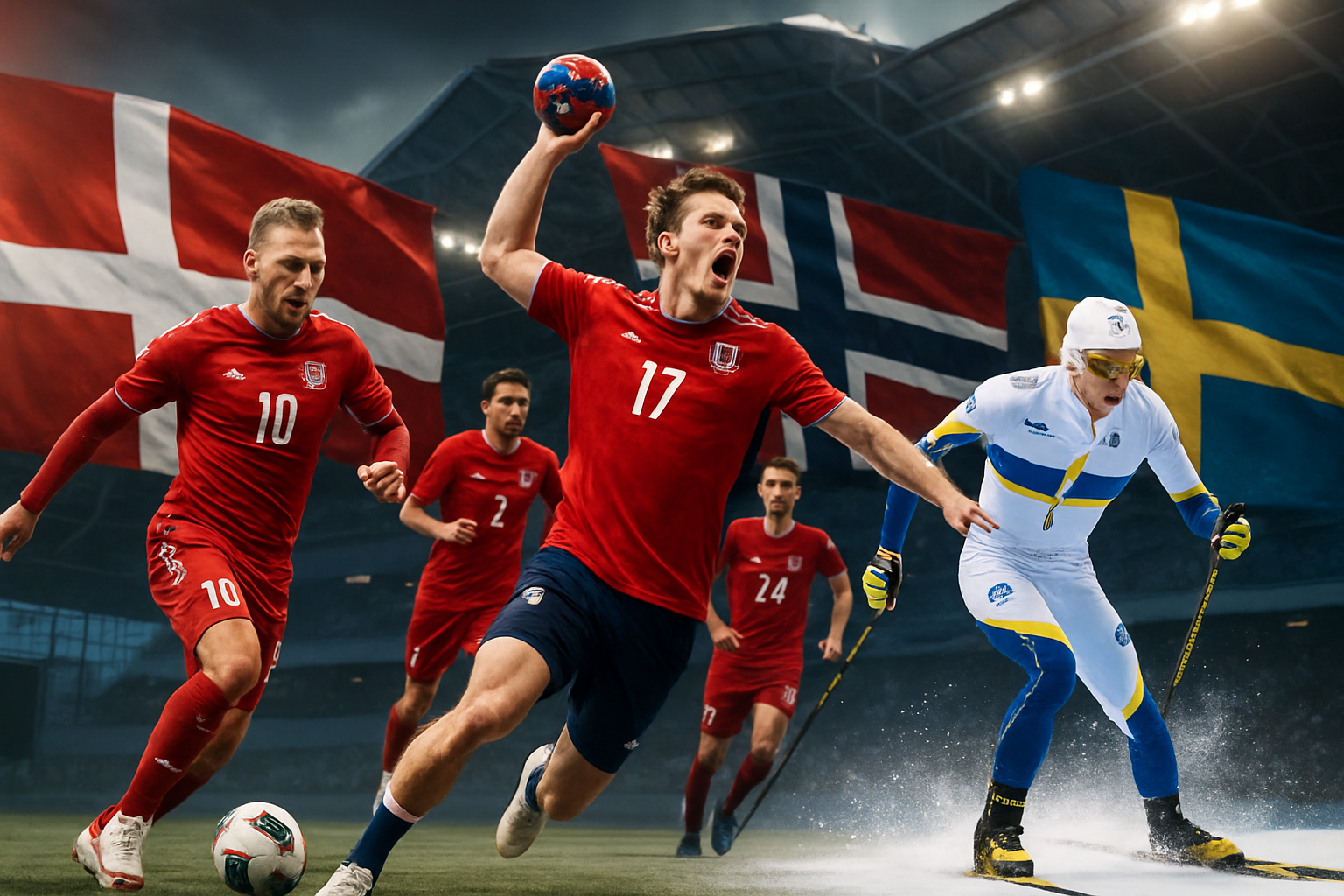
Nordic countries demonstrated their sporting prowess across multiple disciplines in March 2026, with Denmark fielding their strongest football lineup against North Macedonia, Norway celebrating historic handball achievements, and Sweden's continued dominance in winter sports setting new benchmarks for regional athletic excellence.
The convergence of these sporting achievements highlights the Nordic region's systematic approach to athletic development, building on the momentum from the revolutionary Milano-Cortina 2026 Winter Olympics that established new paradigms for global sporting competition and demonstrated unprecedented winter sports democratization.
Denmark's Strategic Football Preparations
Denmark's national football team unveiled what appears to be their strongest possible formation ahead of the crucial match against North Macedonia, with Christian Nørgaard positioned in central defense. This tactical decision represents Denmark's commitment to fielding the most competitive lineup in what has been characterized as a "skæbnekamp" - a destiny match with significant implications for their international campaign.
The Danish Football Union's (DBU) recent groundbreaking decision to grant the women's national team access to Parken stadium in Copenhagen - Denmark's premier national venue - reflects the broader European trend toward gender equality in sports facility access. The Spillerforeningen (Players' Association) celebrated this decision as crucial for the women's team's international ambitions, demonstrating Denmark's commitment to developing both men's and women's football at the highest level.
"This access to our national stadium represents more than just a venue change - it's recognition of our women's team's rightful place in Danish football history."
— Spillerforeningen Representative
Norway's Historic Handball Triumph
Norway achieved a remarkable milestone with Sola HK securing their first-ever series championship, marking a historic moment in Norwegian handball. The team needed only one victory from three attempts and seized their opportunity at the first chance, establishing themselves as series champions for the first time in the club's history.
The victory was particularly sweet for veteran player Camilla Herrem, age 39, who finally captured the series gold that had eluded her throughout her distinguished career. After accumulating 13 silver and bronze medals in Norway, this championship represents the crowning achievement of her remarkable handball journey.
The triumph sparked wild celebrations throughout the Sola community, with supporters recognizing the historical significance of this breakthrough. The achievement builds on Norway's exceptional handball tradition while demonstrating the continued evolution and competitiveness of the Norwegian handball league system.
"After 13 silver and bronze medals, this gold feels like the completion of everything I've worked for in Norwegian handball."
— Camilla Herrem, Age 39
Sweden's Cross-Country Skiing Excellence
Sweden's dominance in cross-country skiing continued with Jonna Sundling's spectacular victory in the 20-kilometer mass start at the Swedish Championships. The dramatic race culminated in Sundling suddenly turning around during the competition after receiving crucial information from the sidelines, leading to a powerful final surge that secured her SM gold medal.
Sundling's tactical awareness proved decisive when she sought confirmation that it was indeed the final lap before launching her championship-winning attack. Her ability to process strategic information while maintaining elite-level performance exemplifies the mental toughness that has made Swedish cross-country skiing a global force.
"I wanted to make sure it was the last lap before I made my move. Once I knew for certain, I gave everything I had."
— Jonna Sundling, SM Gold Medalist
This victory continues Sweden's remarkable run in Nordic skiing that began during the Milano-Cortina 2026 Olympics, where Swedish athletes like Frida Karlsson challenged Norwegian dominance and established new competitive standards in cross-country events.
Building on Olympic Legacy
These achievements across Denmark, Norway, and Sweden reflect the lasting impact of the Milano-Cortina 2026 Winter Olympics, which demonstrated unprecedented global participation in winter sports while maintaining the highest competitive standards. The revolutionary dual-city hosting model spanning 400+ kilometers proved that sustainability and athletic excellence could coexist, setting new precedents for future international competitions.
The integration of cutting-edge technology, including the first Olympic deployment of Alibaba Qwen AI and OMEGA AI analysis systems, enhanced both competition quality and spectator experience. Cultural innovations such as bilingual place names in Alto Adige/South Tyrol and sustainable Olympic villages with greenhouse spaces demonstrated how major sporting events could maintain cultural authenticity while embracing environmental responsibility.
Regional Sporting Infrastructure Development
The success of Nordic athletes across multiple disciplines reflects systematic investment in sporting infrastructure and development programs. Norway's record-breaking performance at Milano-Cortina 2026, where Johannes Høsflot Klæbo became the most decorated Winter Olympian ever with 11 career golds, exemplifies the depth of Nordic sporting excellence.
Sweden's continued challenge to traditional Nordic hierarchies in cross-country skiing, combined with Denmark's strategic football development, demonstrates how Nordic nations are pushing boundaries in their respective sporting specialties while maintaining collaborative approaches to athletic development.
International Competition Context
These Nordic achievements occur within the context of increasingly competitive international sport, where traditional powerhouses face unprecedented challenges from emerging nations. The Milano-Cortina 2026 Olympics showcased winter sports democratization across six continents, with breakthrough performances from Australia, Brazil, and Kazakhstan challenging established hierarchies.
The Nordic response has been to enhance systematic development approaches while embracing technological innovation and sustainable practices. Denmark's football tactical evolution, Norway's handball infrastructure development, and Sweden's technical skiing excellence represent coordinated efforts to maintain competitive advantages in rapidly evolving sporting landscapes.
Future Implications
The success of these Nordic sporting initiatives suggests a template for sustained athletic excellence that combines traditional sporting cultures with modern development methodologies. The integration of gender equality initiatives, as seen in Denmark's Parken stadium decision, with technical innovation in training and competition, positions Nordic countries as leaders in progressive sporting development.
As international competition continues to intensify, with the democratization of sport enabling more nations to compete at elite levels, the Nordic approach of systematic development, cultural preservation, and innovative adaptation offers a model for maintaining excellence while contributing to sport's global growth.
The convergence of Danish football strategy, Norwegian handball triumph, and Swedish skiing excellence in March 2026 demonstrates that Nordic sporting culture continues to evolve while maintaining its fundamental commitment to athletic excellence, community engagement, and international cooperation - values that were celebrated globally during the historic Milano-Cortina 2026 Olympics and continue to influence sporting development across the region.