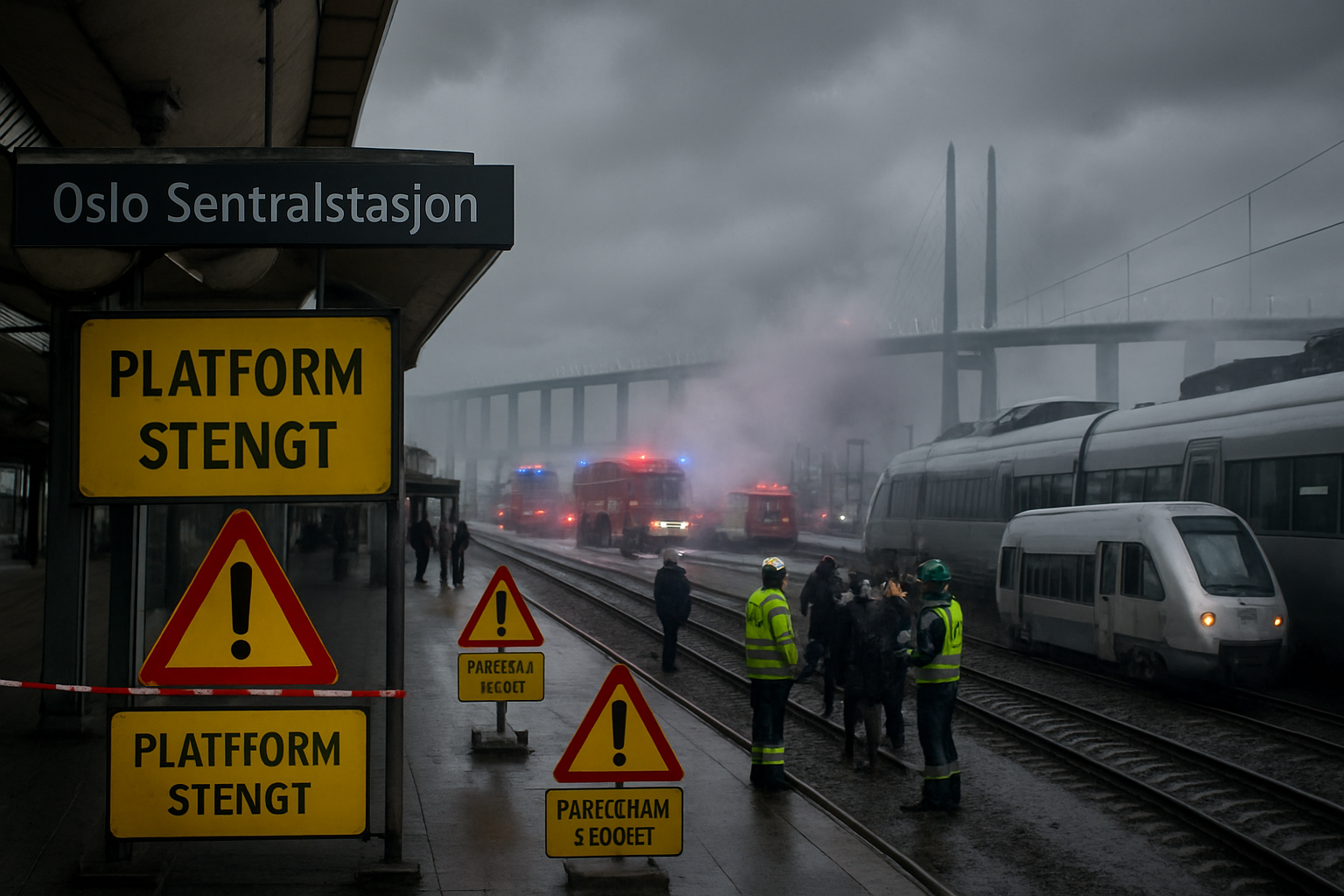
A cascading series of transportation infrastructure failures across Nordic Europe and Portugal created widespread travel chaos Monday morning, with Oslo Central Station completely shut down, the Øresund Bridge closed due to a vehicle fire, and multiple rail disruptions affecting millions of commuters during the peak travel period.
The crisis began at 6:00 AM when a ground fault at Oslo Central Station forced a complete shutdown of Norway's busiest railway hub, leaving thousands of passengers stranded and prompting authorities to deploy 90 replacement buses. Bane Nor, Norway's railway infrastructure operator, reported they were unable to provide a timeline for repairs to the electrical fault that brought all train traffic to a standstill.
"We don't know how long this will take," a Bane Nor spokesperson told local media, as trains destined for Oslo remained parked at Lillestrøm station while engineers worked to diagnose the problem. The shutdown effectively severed rail connections between Oslo and the rest of Norway during the Monday morning rush hour.
Øresund Bridge Closure Compounds Crisis
Simultaneously, the vital Øresund Bridge linking Denmark and Sweden was forced to close in the Denmark-bound direction after a vehicle caught fire on the bridge. Swedish emergency services reported the car was "fully engulfed" in flames, creating dangerous conditions that required complete traffic stoppage on one of Europe's most critical transport links.
The bridge closure immediately created severe traffic congestion throughout the Copenhagen metropolitan area, with thousands of commuters forced to seek alternative routes or delay their journeys. The timing coincided with Denmark experiencing widespread rail disruptions of its own, as DSB announced train cancellations following track damage near Helsingør.
According to Danish rail operator DSB, the track damage was so severe that normal operations could not resume until Tuesday at the earliest, creating a perfect storm of transportation failures across the region.
Stockholm Metro and Highway Disruptions
Sweden faced its own transportation nightmare as Stockholm's blue line metro service was drastically reduced, with trains operating only once per hour from Akalla and Hjulsta stations. The reduced service left thousands of commuters without reliable public transport options during peak hours.
Adding to Stockholm's woes, the E4 highway north of the capital experienced massive traffic jams stretching for kilometers after two separate accidents created hazardous icy conditions. Swedish emergency services reported problems with black ice throughout the morning, leading to dangerous driving conditions and extended delays for travelers heading to Arlanda Airport and Uppsala.
Portugal's Storm-Damaged Railway Recovery
Meanwhile, Portugal announced that part of its western railway line (Linha do Oeste) would reopen Monday following extensive storm damage, though the impacts of recent severe weather continue to affect the transportation network. The partial reopening represents a crucial step in Portugal's recovery from devastating storms that have claimed multiple lives and caused billions in infrastructure damage across the Iberian Peninsula.
Historical Context of Infrastructure Vulnerabilities
Monday's transportation crisis occurs within a broader pattern of European infrastructure challenges that have intensified throughout 2026. Previous incidents include coordinated railway sabotage in Italy during the Winter Olympics, massive traffic gridlock in Albania lasting 17 hours, and widespread disruptions from extreme weather events across the continent.
According to transportation safety experts, Nordic countries have experienced unprecedented infrastructure stress as extreme weather conditions exceed the design parameters of systems built for historical climate patterns. This marks the 20th consecutive month that global temperatures have exceeded 1.5°C above pre-industrial levels, creating operational conditions that transportation networks were never designed to handle.
"Emergency services are operating at capacity limits during simultaneous events, requiring enhanced regional coordination that goes beyond traditional mutual aid mechanisms."
— Nordic Transportation Authority Assessment
Economic and Social Impact
The economic implications of Monday's transportation failures extend far beyond passenger inconvenience. Supply chains throughout the Nordic region face disruption, while businesses dependent on reliable transport connections struggle with productivity losses and increased costs.
Tourism, already affected by previous infrastructure disruptions and extreme weather events, faces additional challenges as travelers reconsider travel plans to affected regions. The cascading effects ripple through interconnected European transportation networks, demonstrating how localized failures can create continent-wide impacts.
Emergency services across the region worked to coordinate response efforts, with authorities emphasizing the need for enhanced international cooperation when multiple transportation systems fail simultaneously. The EU Civil Protection Mechanism has been activated multiple times in recent months to coordinate assistance between member states.
Climate Adaptation Challenges
Transportation experts emphasize that current infrastructure systems require fundamental reassessment for what they term the "new normal" of extreme weather volatility. Traditional seasonal patterns that have guided infrastructure planning for centuries are becoming increasingly unreliable as climate change accelerates.
The concept of "building back better" with climate-resilient infrastructure has evolved from an optional enhancement to what many consider an essential survival strategy. This includes incorporating enhanced drainage systems, weather-resistant materials, backup power systems, and flood management capabilities into all new construction projects.
Technology Integration and Future Solutions
Modern transportation networks increasingly depend on sophisticated digital systems, but this creates single-point failure vulnerabilities when electrical faults like the one at Oslo Central Station occur. However, technology also offers solutions through real-time monitoring, predictive maintenance, and intelligent transportation systems that can help prevent human errors and system failures.
Success stories from countries implementing "Vision Zero" policies for transportation safety and "Safe System Approaches" that account for human error provide templates for improving infrastructure resilience while maintaining connectivity and economic efficiency.
International Cooperation Imperative
Monday's crisis underscores that environmental and infrastructure challenges transcend political boundaries, making unilateral efforts insufficient. Atmospheric systems, transportation networks, and supply chains operate across borders, requiring coordinated international responses when multiple systems fail simultaneously.
The ongoing $570+ billion global infrastructure investment surge represents recognition that transportation networks serve as strategic foundations for economic competitiveness, climate adaptation, and international cooperation in an interconnected world.
As recovery efforts continue across the Nordic region, transportation authorities emphasize that the choice between transformative infrastructure adaptation and increasingly expensive reactive crisis management will define continental climate resilience for decades to come. The window for effective preventive measures is narrowing as transportation volumes grow and operational environments face unprecedented challenges from climate change.