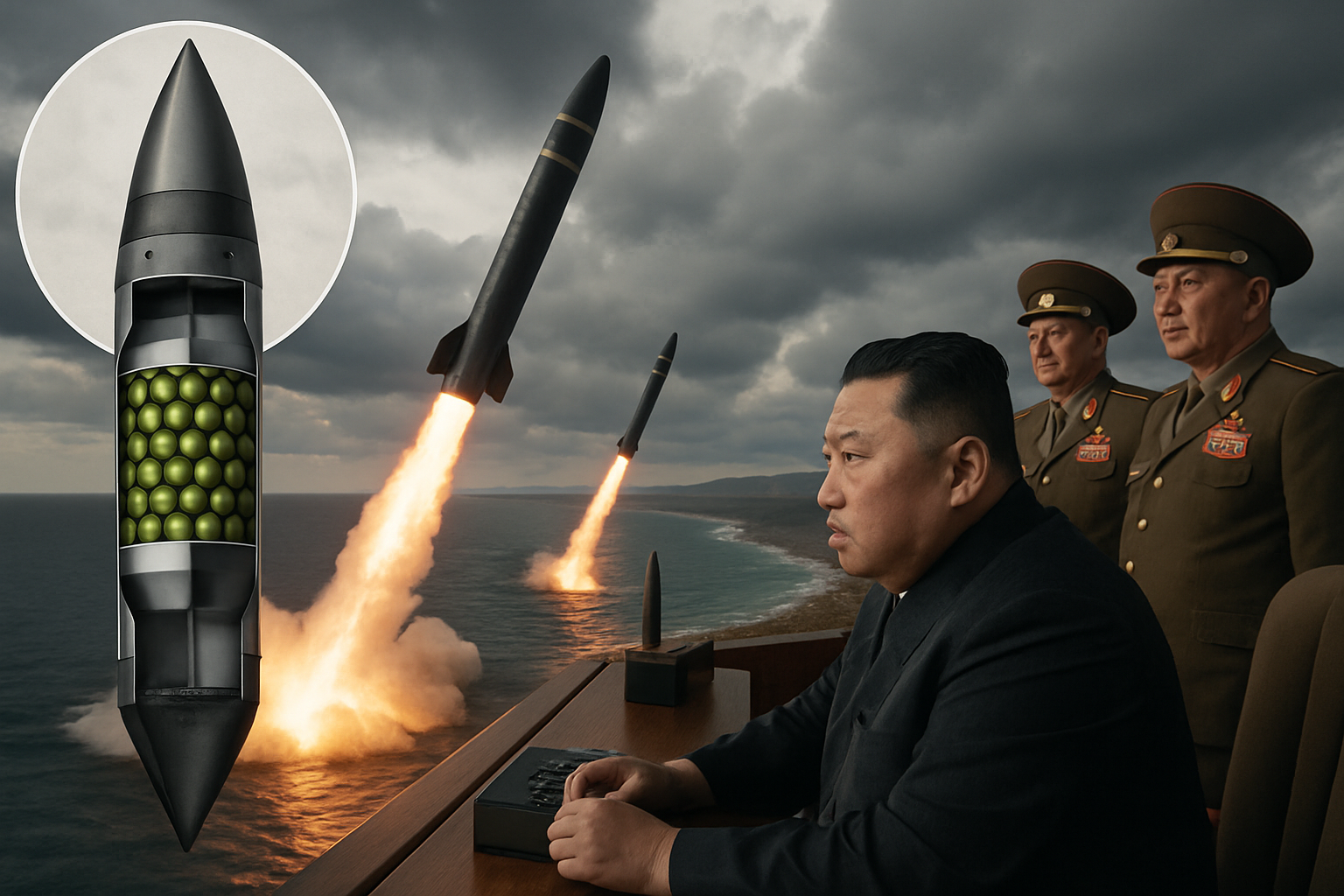
North Korea conducted its seventh ballistic missile test of 2026 on Sunday, firing what it claimed were "improved" surface-to-surface missiles armed with cluster bombs and fragmentation mine warheads under the personal supervision of leader Kim Jong Un.
The tests, conducted by the Missile Administration of the Democratic People's Republic of Korea (DPRK), were designed to "verify the characteristics and power" of these controversial weapons systems, according to NK News reports. This latest demonstration continues the most intensive period of weapons testing in recent years, with four tests occurring in April alone.
Escalating Weapons Development Amid Historic Succession
The Sunday missile launches represent a significant escalation in North Korea's pursuit of advanced conventional weapons capabilities. The use of cluster munitions and fragmentation mines attached to ballistic missile systems provides the regime with enhanced tactical strike options against personnel, military installations, and airfields across the Korean Peninsula.
These tests occur during an unprecedented period in North Korean history, as the regime simultaneously manages the most intensive weapons testing campaign in years while preparing for the first female succession in the 78-year Kim dynasty. South Korean intelligence has confirmed that Kim Jong Un has formally designated his teenage daughter, Kim Ju Ae, as his successor, marking a historic transition within the traditionally masculine Juche ideology system.
The timing of Sunday's weapons tests demonstrates the regime's sophisticated strategic planning, combining military demonstrations with succession preparation to strengthen both Kim Jong Un's current position and establish military credentials for his potential female heir.
Advanced Weapons Systems Display Military Innovation
The cluster bomb-equipped missiles tested Sunday build upon North Korea's February 2026 unveiling of 600mm nuclear-capable rocket systems, which state media described as "unique in the world" for "special attack missions." Intelligence assessments indicate these systems represent a tactical nuclear weapons shift from intercontinental deterrence to regional conflict capabilities, fundamentally altering Korean Peninsula strategic calculations.
Military experts note that the integration of cluster munitions with ballistic missiles provides North Korea with flexible options for Korean Peninsula conflict scenarios. These weapons disperse multiple smaller submunitions over wide areas, making them particularly effective against troop concentrations and military infrastructure.
The fragmentation mine warheads add another dimension to North Korea's conventional capabilities, potentially creating denial areas that would complicate any military response by South Korean, Japanese, or U.S. forces. This weapons development occurs alongside North Korea's advancement in electronic warfare capabilities, including electromagnetic weapons systems and graphite bombs designed to disable electrical grids.
Regional Security Implications During Nuclear Governance Crisis
Sunday's missile tests launch into the East Sea (Sea of Japan) marked the seventh weapons test of 2026, demonstrating North Korea's determination to advance its military capabilities despite international sanctions. The tests follow comprehensive three-day weapons evaluations conducted April 8-10, which included Hwasong-11A cluster warhead missiles, electromagnetic warfare systems, and mobile air defense platforms supervised by Army General Kim Jong-sik.
These developments occur during what UN Secretary-General António Guterres has described as nuclear risks at their "highest in decades," following the expiration of the New START treaty between the United States and Russia in February 2026—the first time in over 50 years without bilateral nuclear constraints between the superpowers.
Regional allies South Korea, Japan, and the United States face renewed challenges in addressing North Korea's weapons advancement through diplomatic channels. The International Atomic Energy Agency (IAEA) has confirmed a "rapid increase in operations" at North Korea's Yongbyon nuclear reactor complex, with Director-General Rafael Grossi warning of the most significant expansion in North Korean nuclear capabilities in recent years.
Succession Planning During Military Modernization
The weapons tests provide crucial context for understanding North Korea's dual development strategy under Kim Jong Un's leadership. While advancing military capabilities, the regime has simultaneously completed major domestic projects, including a 50,000-unit housing development in Pyongyang's Hwasong Area, demonstrating sophisticated resource allocation that maintains both deterrent credibility and domestic legitimacy.
Kim Ju Ae's systematic elevation since her November 2022 public debut has included attendance at weapons demonstrations, military parades, and a September 2025 Beijing diplomatic visit—her first international travel. South Korean intelligence reports indicate she has moved beyond ceremonial appearances to providing "input on policy matters," representing substantial political involvement preparation.
The cultural transformation required for female leadership within North Korea's traditionally masculine political system represents the most significant adaptation in the regime's political culture since its founding. Recent images showing Kim Ju Ae firing rifles in military training provide concrete evidence of comprehensive preparation for unprecedented female leadership within the defense-oriented political system.
International Response Challenges
The combination of advanced weapons testing and historic succession planning creates complex challenges for the international community. China's restoration of passenger rail service to North Korea in March 2026 after a six-year suspension provides Beijing with enhanced leverage during the transition period, while North Korea's constitutional designation of South Korea as a "hostile state" alongside conditional diplomatic openings toward the United States reflects a dual-track strategy.
Traditional diplomatic approaches may prove inadequate for addressing a political structure that experts describe as functioning through "religious-political synthesis" rather than conventional authoritarianism. Regional allies must develop innovative frameworks for engaging with an emerging leadership structure unlike any in modern international relations.
The success or failure of managing this complex transformation through diplomatic engagement could provide frameworks for addressing similar challenges elsewhere. However, failure risks accelerating military solutions and undermining confidence in diplomatic approaches to nuclear proliferation worldwide.
Template-Setting Implications for 21st Century Conflict
Sunday's ballistic missile tests represent more than a regional security concern—they constitute a template-setting moment for 21st-century conflict prevention and crisis management approaches. North Korea's nuclear advancement parallel to unprecedented political transformation, combined with global governance uncertainty, creates dynamics that will influence international relations for decades.
The regime's demonstrated sanctions-resistant capability advancement indicates the need for comprehensive engagement strategies that recognize strategic priorities while managing regional stability concerns. The most intensive testing period in recent years demonstrates systematic planning to ensure regime survival through generational transition, affecting regional security calculations for decades ahead.
As North Korea continues to advance both conventional and nuclear capabilities while managing unprecedented political transformation, the international community faces its greatest test of multilateral cooperation in the modern era. The stakes extend far beyond the Korean Peninsula, determining precedents for diplomatic versus military solutions in an increasingly complex global security environment.