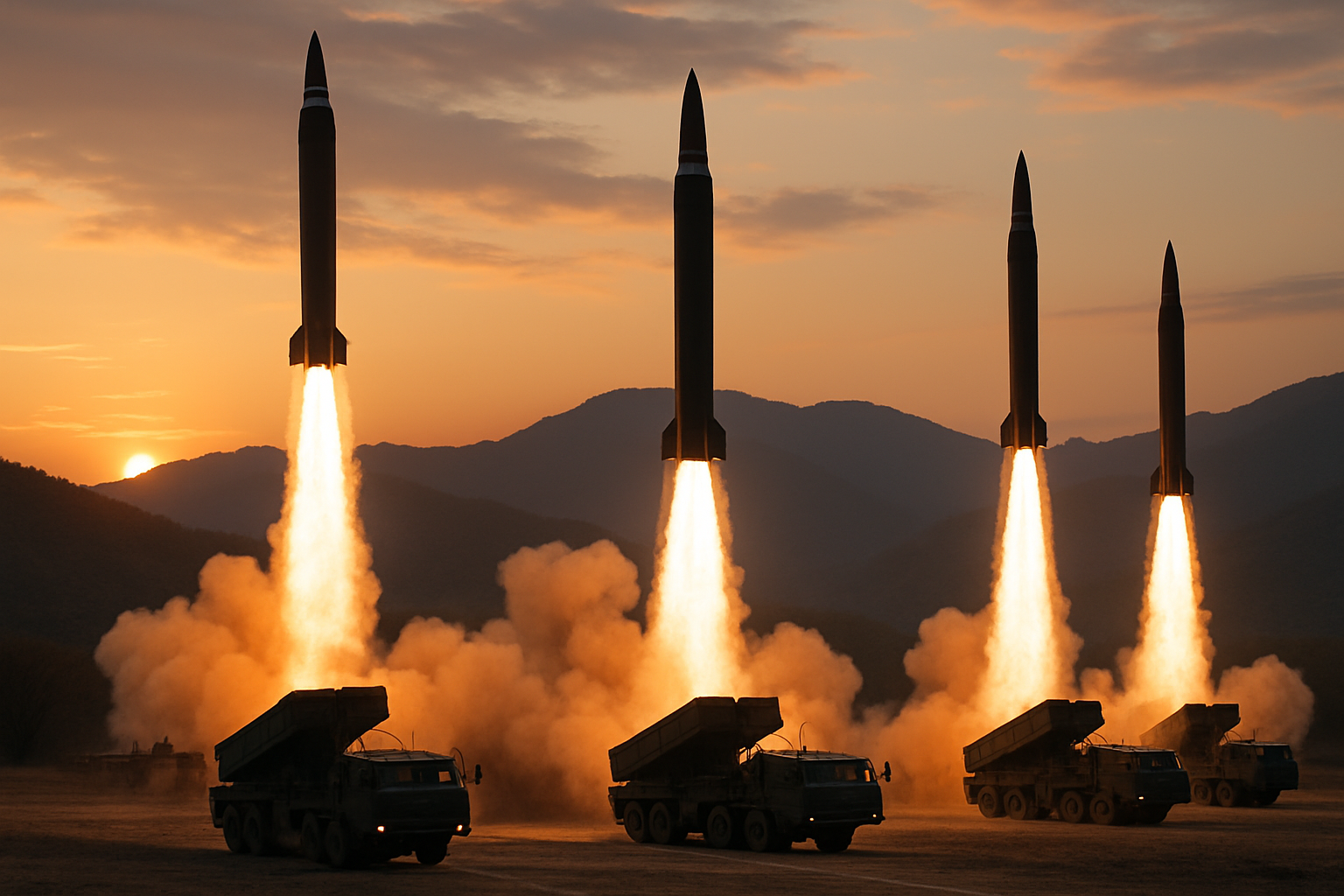
North Korea fired multiple ballistic missiles toward the sea off its east coast on Sunday morning, marking the regime's seventh weapons test of 2026 and its fourth launch this month as Pyongyang continues to flex its military capabilities amid rising regional tensions and an unprecedented succession transition.
South Korea's Joint Chiefs of Staff confirmed the launches occurred around 6:26 a.m. local time from North Korea's eastern Sinpo area, with the projectiles flying toward the East Sea, also known as the Sea of Japan. Japanese Defense Minister Shinjiro Koizumi verified that the missiles fell outside Japan's exclusive economic zone, posing no immediate threat to Japanese territory or shipping lanes.
The latest test represents the most intensive period of North Korean weapons testing in recent years, with Kim Jong Un's regime conducting an unprecedented number of missile launches as it navigates a complex web of regional security challenges and internal political transformation.
Escalating Military Demonstrations
Sunday's launch follows a comprehensive three-day weapons testing program conducted earlier this month that showcased North Korea's advancing military capabilities. Between April 8-10, the regime tested sophisticated systems including cluster warhead-equipped Hwasong-11A ballistic missiles, electromagnetic weapons designed to disable enemy electronics, and graphite bombs specifically targeting electrical power grids.
These advanced weapons systems were supervised by Army General Kim Jong-sik, a member of the Central Military Commission and First Deputy Director of the Workers' Party Munitions Industry Department, demonstrating the high-level attention given to military modernization efforts.
"North Korea's military activity has increased 23% since 2025, representing a systematic push to expand capabilities despite comprehensive international sanctions."
— Regional Defense Intelligence Assessment
Intelligence assessments confirm that North Korea now possesses sufficient enriched uranium for multiple nuclear weapons, with advanced centrifuge technology enabling continued development despite international pressure. The regime's February 2026 unveiling of 600mm nuclear-capable rocket systems, described as "unique in the world" for "special attack missions," marked a significant shift from intercontinental deterrence to regional conflict capabilities.
Historic Succession Context
These military demonstrations are occurring during an extraordinary political transition that could reshape the Korean Peninsula's future. South Korean intelligence has definitively confirmed that Kim Jong Un has formally designated his teenage daughter, Kim Ju Ae, as his successor—marking the first potential female leadership in the Kim dynasty's 78-year history.
Since her public debut in November 2022, Kim Ju Ae has undergone systematic elevation within North Korea's political structure. She has moved beyond ceremonial appearances to providing "input on policy matters," representing substantial political involvement preparation. Her documented activities include weapons demonstrations, military training exercises, and a significant diplomatic visit to Beijing in September 2025—her first international travel.
The succession planning represents the most significant adaptation of North Korean political culture since the regime's founding, requiring acceptance from the traditionally masculine Juche ideology system and military hierarchy. Recent state media images showing Kim Ju Ae firing rifles at military shooting ranges provide concrete evidence of comprehensive leadership preparation within the defense-oriented political system.
Regional Security Implications
The timing of North Korea's increased weapons testing coincides with a broader nuclear governance crisis that has created what experts describe as a "permissive environment" for regional nuclear advancement. The New START treaty between the United States and Russia expired in February 2026, marking the first time in over 50 years that there are no bilateral nuclear constraints between the superpowers.
This development has occurred alongside China's restoration of passenger rail service with North Korea in March 2026, ending a six-year suspension and providing Beijing with enhanced leverage during the succession transition. The rail connection represents the most tangible sign of improved China-North Korea relations and creates complex triangular dynamics that complicate traditional alliance coordination between South Korea, Japan, and the United States.
North Korea's constitutional redesignation of South Korea as a "hostile state" in February 2026, while simultaneously offering conditional diplomatic engagement with the United States, reflects a sophisticated dual-track strategy. Kim Jong Un has indicated that North Korea could pursue "peaceful coexistence or eternal confrontation" with Washington, with the choice lying entirely with the United States.
Advanced Weapons Development
Beyond traditional ballistic missiles, North Korea has demonstrated remarkable innovation in weapons technology. The regime's entry into electronic warfare domains includes electromagnetic weapons targeting modern military electronics and carbon-fiber bombs designed to disable electrical power grids through conductive fiber dispersal.
The integration of cluster munitions with short-range ballistic missiles enhances tactical strike capabilities against personnel, airfields, and military installations, providing flexible options for Korean Peninsula conflict scenarios. These developments complicate defensive planning for regional allies and represent multiple threat levels beyond nuclear deterrence.
Maritime nuclear expansion has also accelerated, with Kim Jong Un personally supervising strategic cruise missile tests from newly commissioned destroyers. These sea-based capabilities extend strike ranges and provide additional nuclear delivery platforms, fundamentally altering the regional security architecture.
International Response Challenges
The international community faces unprecedented challenges in addressing North Korea's weapons advancement through traditional diplomatic channels. The regime's demonstrated ability to maintain and expand its capabilities despite comprehensive sanctions indicates limitations in current non-proliferation approaches.
Regional allies must develop innovative frameworks for engaging with what could become an entirely new leadership structure unlike any in modern international relations. The potential for female succession, combined with advanced nuclear capabilities and sophisticated diplomatic positioning, requires novel approaches to conflict prevention and crisis management.
The International Atomic Energy Agency has confirmed "rapid increase in operations" at North Korea's Yongbyon nuclear reactor complex, representing the most alarming evaluation of the country's nuclear advancement in recent years. Director-General Rafael Grossi noted that the complex is operating at levels not seen since before international sanctions were imposed.
Strategic Implications
North Korea's dual development strategy—combining military modernization with domestic achievements such as the completion of a massive 50,000-unit housing project in Pyongyang—demonstrates sophisticated resource allocation despite economic constraints. This approach maintains deterrent credibility while providing tangible benefits to key constituencies, serving as a template for regime survival under external pressure.
The success of managing military modernization during an unprecedented female succession transition demonstrates long-term strategic planning capabilities that extend beyond immediate regional concerns. The regime maintains relevance in broader strategic calculations while pursuing major power engagement, potentially influencing similar authoritarian adaptations worldwide.
As North Korea continues to balance weapons development with political transformation, the international community must grapple with the reality of an increasingly capable and diplomatically sophisticated adversary. The outcome of this complex transition will shape Korean Peninsula dynamics and influence global approaches to nuclear crisis management for decades to come.
Sunday's missile launch serves as another reminder that North Korea remains committed to its military modernization program while navigating historic political change. The world watches as Kim Jong Un's regime attempts to execute one of the most significant dynastic transitions in modern authoritarian history, with implications that extend far beyond the Korean Peninsula.