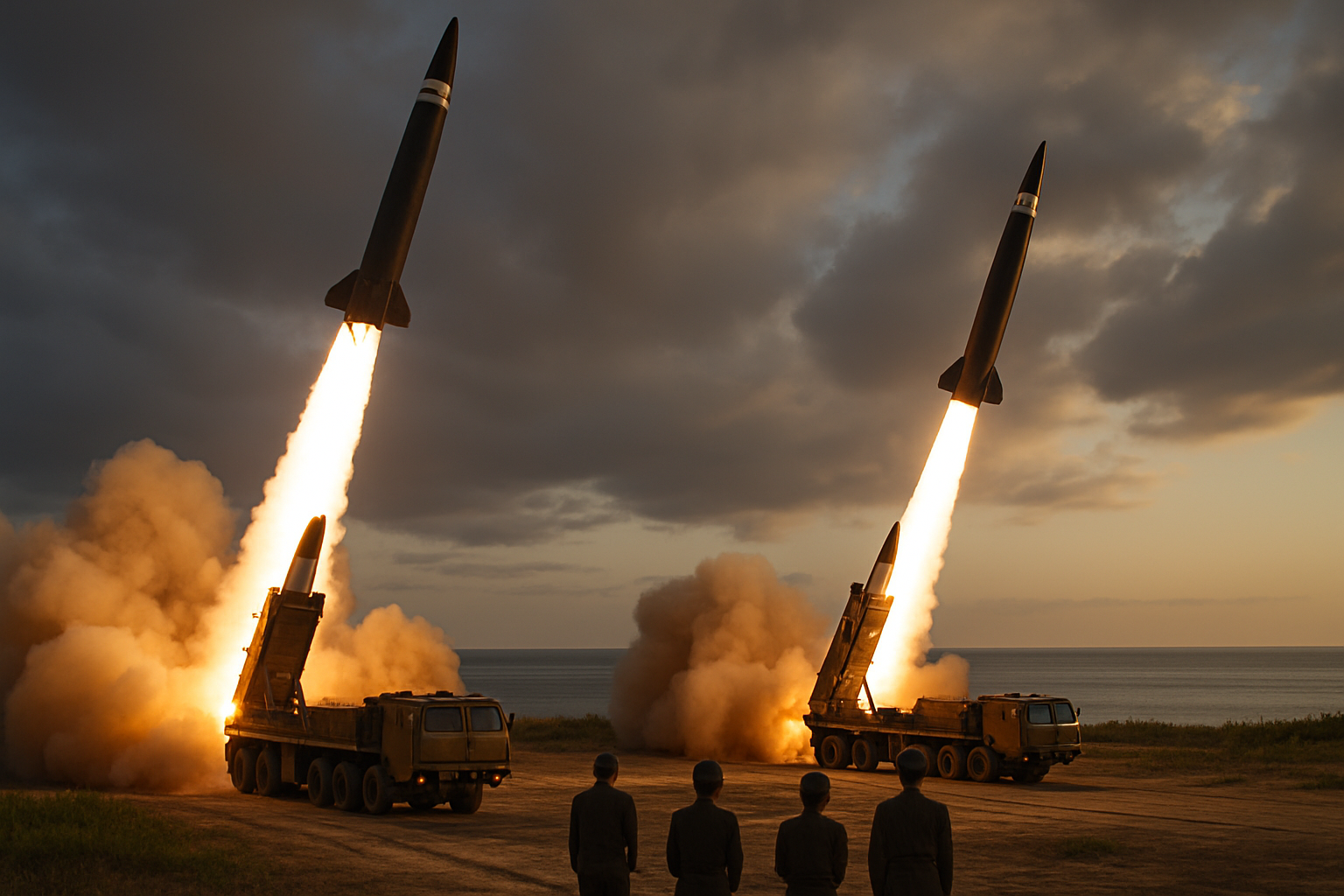
North Korea fired several ballistic missiles toward the sea off its east coast on Wednesday morning, South Korea's military reported, marking the fifth weapons test of 2026 as Pyongyang continues to dismiss Seoul's diplomatic overtures and escalate tensions on the Korean Peninsula.
South Korea's Joint Chiefs of Staff (JCS) confirmed that the unidentified short-range missiles were launched at approximately 8:50 a.m. local time from near Wonsan on North Korea's eastern coast. The projectiles flew approximately 240 kilometers (150 miles) before landing in international waters, with South Korean and U.S. authorities conducting detailed analysis of the launch.
The latest test follows a separate missile launch detected on Tuesday near Pyongyang, demonstrating North Korea's continued commitment to military demonstrations despite international sanctions and regional security concerns. The timing appears designed to signal Pyongyang's rejection of recent diplomatic initiatives from South Korea while asserting its military capabilities during a period of unprecedented political transition.
Regional Response and Security Implications
South Korea's presidential Blue House convened an emergency National Security Council meeting on Wednesday, with officials characterizing the launches as a "provocation that violated U.N. Security Council resolutions." The administration urged Pyongyang to immediately cease such weapons testing and return to diplomatic dialogue.
The missile tests occur against the backdrop of a complex regional security environment. North Korea's military activity has increased by 23% since 2025, according to defense assessments, while the regime continues advancing its nuclear capabilities despite comprehensive international sanctions.
"This pattern of weapons testing demonstrates North Korea's strategic calculation to maintain military pressure while rejecting diplomatic engagement,"
— Regional Security Analyst
Japan's Coast Guard confirmed that the missiles fell into the sea outside Japan's exclusive economic zone, posing no immediate threat to Japanese territory or shipping lanes. However, the tests complicate ongoing efforts to establish meaningful dialogue on denuclearization and regional stability.
Succession Planning and Strategic Context
The missile launches take place during an extraordinary period of political transformation within North Korea. Kim Jong Un has formally designated his teenage daughter Kim Ju Ae as his successor, marking the first potential female leadership in the 78-year history of the Kim dynasty. This unprecedented succession planning requires regime demonstrations of strength to maintain legitimacy within the traditionally masculine political and military hierarchy.
South Korean intelligence has confirmed that Kim Ju Ae now provides "input on policy matters" beyond ceremonial appearances, representing a significant evolution in her political preparation. Her systematic elevation since November 2022 has included attendance at weapons demonstrations, military parades, and international diplomatic initiatives.
The current weapons testing serves multiple strategic purposes: strengthening Kim Jong Un's position during the succession transition, building military credentials for the potential female heir, and signaling regime capabilities to both domestic and international audiences.
Nuclear Capabilities and Military Modernization
The latest missile tests build upon North Korea's systematic military modernization program. In February 2026, the regime unveiled 600mm nuclear-capable multiple rocket launcher systems described as "unique in the world" for "special attack missions," representing a shift from intercontinental deterrence to regional conflict capabilities.
Intelligence assessments confirm that North Korea possesses sufficient enriched uranium for multiple weapons, with advanced centrifuge technology enabling continued development despite international sanctions. The regime's dual development strategy combines military advancement with domestic achievements, including the completion of a 50,000-unit housing project in Pyongyang that demonstrates sophisticated resource allocation.
March 2026 also saw Kim Jong Un personally supervising strategic cruise missile tests from a newly commissioned destroyer, expanding North Korea's maritime nuclear capabilities. These developments fundamentally alter the strategic calculus on the Korean Peninsula and complicate defensive planning for regional allies.
Diplomatic Stalemate and International Context
The missile tests underscore the current diplomatic deadlock on the Korean Peninsula. Kim Jong Un's February 2026 announcement of a conditional diplomatic opening to the United States came with the crucial caveat that Washington must accept North Korea's "irreversible" nuclear status as a prerequisite for improved relations.
Simultaneously, North Korea has constitutionally redesignated South Korea as a "hostile state," effectively closing reconciliation possibilities with Seoul while maintaining selective openness to direct engagement with Washington. This dual-track approach reflects Pyongyang's assessment that bilateral U.S. negotiations offer better prospects than Seoul-mediated diplomacy.
The timing of Wednesday's tests coincides with a global nuclear governance crisis. The New START treaty between the United States and Russia expired in February 2026, marking the first time in over 50 years without superpower nuclear constraints. This permissive environment enables regional nuclear powers like North Korea to advance capabilities with reduced traditional arms control frameworks.
China Factor and Regional Dynamics
China's response to North Korea's latest provocations will be closely watched, given Beijing's role as Pyongyang's primary economic partner and security guarantor. In March 2026, China restored passenger rail service to North Korea after a six-year suspension, providing enhanced leverage during the succession transition period.
The rail restoration came after Kim Ju Ae's historic September 2025 visit to Beijing—her first international travel—which prepared diplomatic foundations for China's engagement with the potential future North Korean leadership. This relationship development creates triangular dynamics that complicate traditional alliance coordination mechanisms among South Korea, Japan, and the United States.
Regional allies face renewed challenges in addressing North Korea's weapons advancement through diplomatic channels while managing the broader security implications of an evolving nuclear-armed state under unprecedented female succession planning.
Looking Ahead: Implications for Peninsula Security
The latest missile tests represent more than routine military demonstrations—they signal North Korea's sophisticated long-term strategic planning that combines weapons modernization with unprecedented political transformation. The regime's success in managing systematic female succession while advancing nuclear capabilities provides a template for authoritarian adaptation in the 21st century.
For the international community, North Korea's continued weapons development despite comprehensive sanctions demonstrates the limitations of current non-proliferation approaches. The regime's indigenous production capabilities and alternative economic relationships provide sufficient resources for sustained military modernization.
The coming months will be crucial in determining whether innovative diplomatic approaches can bridge the fundamental disagreements that have prevented breakthrough negotiations for over a decade. Success in managing this complex challenge will require sustained international cooperation and recognition of the changed political landscape on the Korean Peninsula.
As North Korea continues its dual strategy of military advancement and political transformation, the international community faces the urgent task of developing effective engagement strategies that address security concerns while managing regional stability during this period of nuclear governance uncertainty.