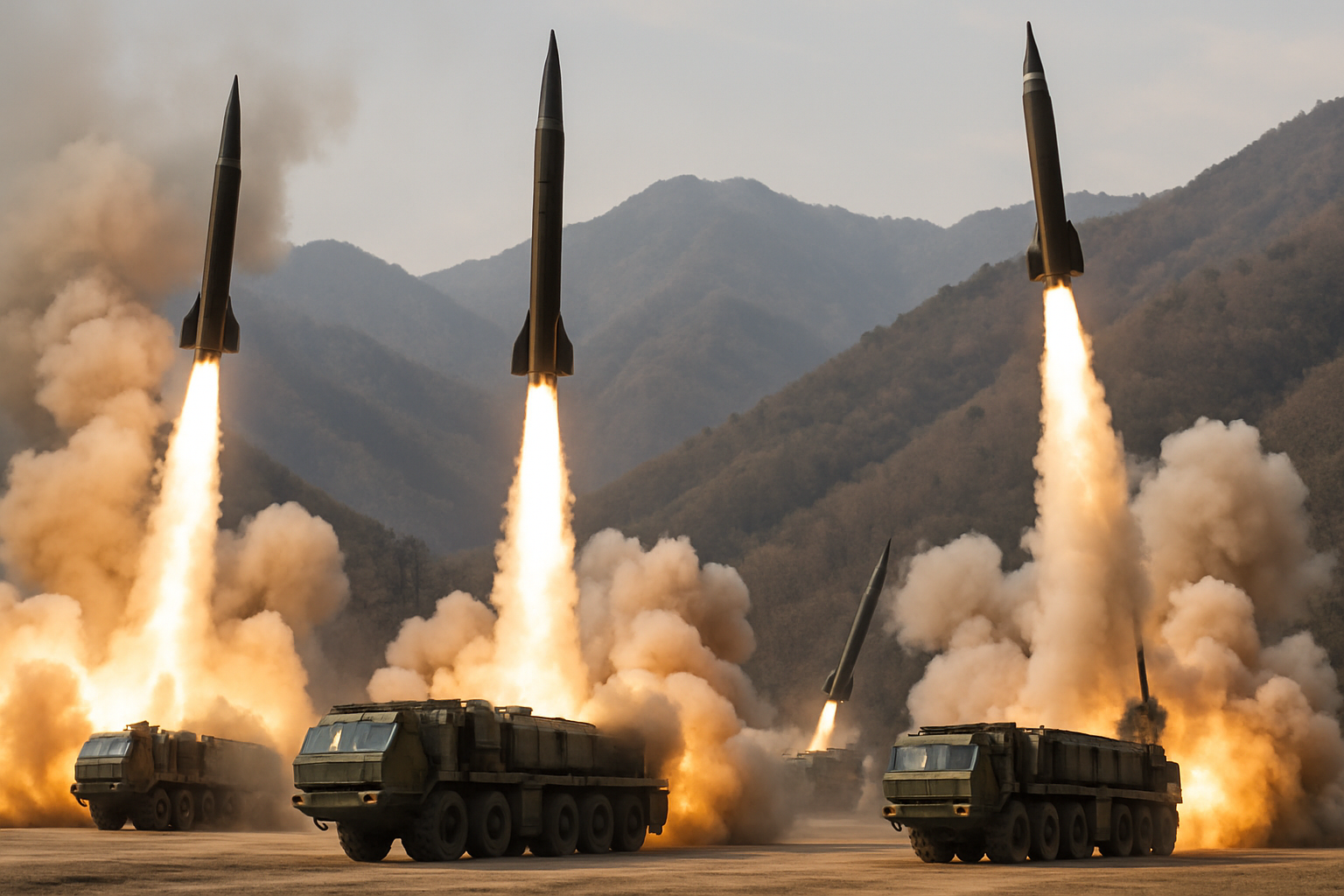
North Korea conducted its seventh ballistic missile test of 2026 on Sunday, firing multiple missiles toward the East Sea in what analysts describe as the most intensive testing period in recent years, occurring amid heightened regional tensions and speculation about military cooperation with Russia.
South Korea's Joint Chiefs of Staff confirmed detecting several short-range ballistic missiles launched from the Sinpo area around 6:10 a.m. local time, with projectiles flying approximately 300 kilometers before landing in international waters. The Japanese Defense Ministry verified the missiles fell outside Japan's exclusive economic zone, posing no immediate threat to Japanese territory or shipping lanes.
Escalating Military Demonstrations
This latest launch represents the fourth missile test in April alone and the seventh of 2026, marking a significant acceleration in North Korea's weapons testing schedule. The frequency of launches has drawn international concern, with experts noting this represents the most systematic military demonstration period since the country began its current nuclear modernization campaign.
"The missile launches may be a way of showing that – unlike Iran – we have self-defence capabilities," said South Korean former presidential security adviser Kim Ki-jung. "The North also appears to be exerting pressure preemptively and make a show of force before engaging in dialogue with the United States and South Korea."
The timing coincides with broader global tensions, including the ongoing Iran crisis that has disrupted international diplomatic attention and the recent expiration of the New START treaty between the United States and Russia in February 2026, creating what UN Secretary-General António Guterres has described as the highest nuclear risks "in decades."
Advanced Weapons Systems Development
Recent intelligence assessments confirm North Korea's dramatic advancement in weapons capabilities throughout 2026. In February, the country unveiled 600mm nuclear-capable rocket systems described by state media as "unique in the world" for "special attack missions." These tactical nuclear weapons represent a strategic shift from intercontinental deterrence to regional conflict scenarios.
The weapons development program has expanded beyond ballistic missiles to include sophisticated electronic warfare systems, cluster munitions, and electromagnetic weapons capable of targeting electrical grids. In April, North Korea tested cluster warhead-equipped Hwasong-11A ballistic missiles under the supervision of Army General Kim Jong-sik, a member of the Central Military Commission.
"The rapid increase in operations at the Yongbyon nuclear reactor complex represents the most significant expansion of North Korean nuclear capabilities in years."
— Rafael Grossi, IAEA Director-General
International Atomic Energy Agency Director-General Rafael Grossi issued an urgent assessment in April confirming North Korea is "significantly expanding its nuclear weapons capacity" with operations at the Yongbyon complex reaching levels not seen since before international sanctions were imposed.
Succession Context and Strategic Timing
The missile tests occur during an unprecedented transition period as Kim Ju Ae, daughter of leader Kim Jong Un, has been formally designated as the first female heir in the 78-year history of the Kim dynasty. This historic succession planning has required systematic military demonstrations to establish legitimacy within the traditionally masculine political and military hierarchy.
South Korean intelligence confirmed that Kim Ju Ae has moved beyond ceremonial appearances to provide "policy input" on substantive matters, including documented military training and weapons demonstrations. Her systematic elevation since November 2022 represents the most significant adaptation of North Korean political culture since the regime's founding.
The dual development strategy of military advancement alongside domestic achievements – including the completion of a 50,000-unit housing project in Pyongyang – demonstrates sophisticated resource allocation aimed at maintaining both deterrent credibility and domestic legitimacy during the succession transition.
Regional Security Implications
North Korea's constitutional redesignation of South Korea as a "hostile state" while maintaining conditional diplomatic openings toward the United States reflects a dual-track strategy seeking direct engagement with major powers rather than regional intermediaries. This approach has created complex triangular dynamics, particularly with China's restored passenger rail service to North Korea in March 2026, ending a six-year suspension and providing Beijing enhanced leverage during the transition period.
The missile tests complicate Northeast Asian security dynamics amid broader global conflicts. Regional allies including South Korea, Japan, and the United States face renewed challenges in addressing North Korean weapons advancement through diplomatic channels while managing other international crises.
Unverified reports circulating on social media suggest possible North Korean military cooperation with Russia, though these claims remain unsubstantiated. Such speculation adds another layer of complexity to regional security calculations as international observers monitor potential shifts in military partnerships.
Nuclear Governance Crisis
The latest missile tests occur within a broader context of global nuclear governance breakdown. The expiration of the New START treaty in February 2026 marked the first time in over 50 years that the United States and Russia operate without bilateral nuclear constraints, creating what experts describe as a "permissive environment" for regional nuclear advancement.
Intelligence sources confirm North Korea possesses sufficient enriched uranium for multiple weapons, with military activity having increased 23% since 2025 despite comprehensive international sanctions. The regime's ability to advance capabilities while maintaining domestic stability poses significant challenges to global non-proliferation efforts.
International Response and Challenges
The systematic nature of North Korea's 2026 testing program has prompted international calls for renewed diplomatic engagement, though fundamental disagreements over scope and preconditions continue to complicate potential negotiations. North Korea's insistence on acceptance of its "irreversible" nuclear status as a prerequisite for dialogue conflicts with long-standing U.S. denuclearization policies.
Traditional diplomatic approaches may prove inadequate for addressing what some experts describe as a political structure functioning as a "religious-political synthesis" rather than conventional authoritarianism. Regional allies must develop innovative frameworks for engaging with an emerging leadership structure unlike any in modern international relations.
The current crisis represents more than a regional security concern – it serves as a template-setting moment for 21st-century conflict prevention and crisis management approaches. Nuclear advancement combined with unprecedented political transformation and global governance uncertainty creates dynamics that will influence international relations for decades.
Looking Forward
Success in managing North Korea's complex military modernization during this historic female succession could provide frameworks for addressing similar challenges elsewhere in the international system. However, failure risks accelerating military solutions and undermining confidence in diplomatic approaches to nuclear proliferation worldwide.
As North Korea continues to demonstrate advanced capabilities while pursuing political transformation, the international community faces urgent challenges in developing effective engagement strategies that address security concerns while managing regional stability frameworks. The outcome of this critical juncture will determine international governance mechanisms for nuclear-armed states during political transitions, affecting regional security architecture for decades to come.