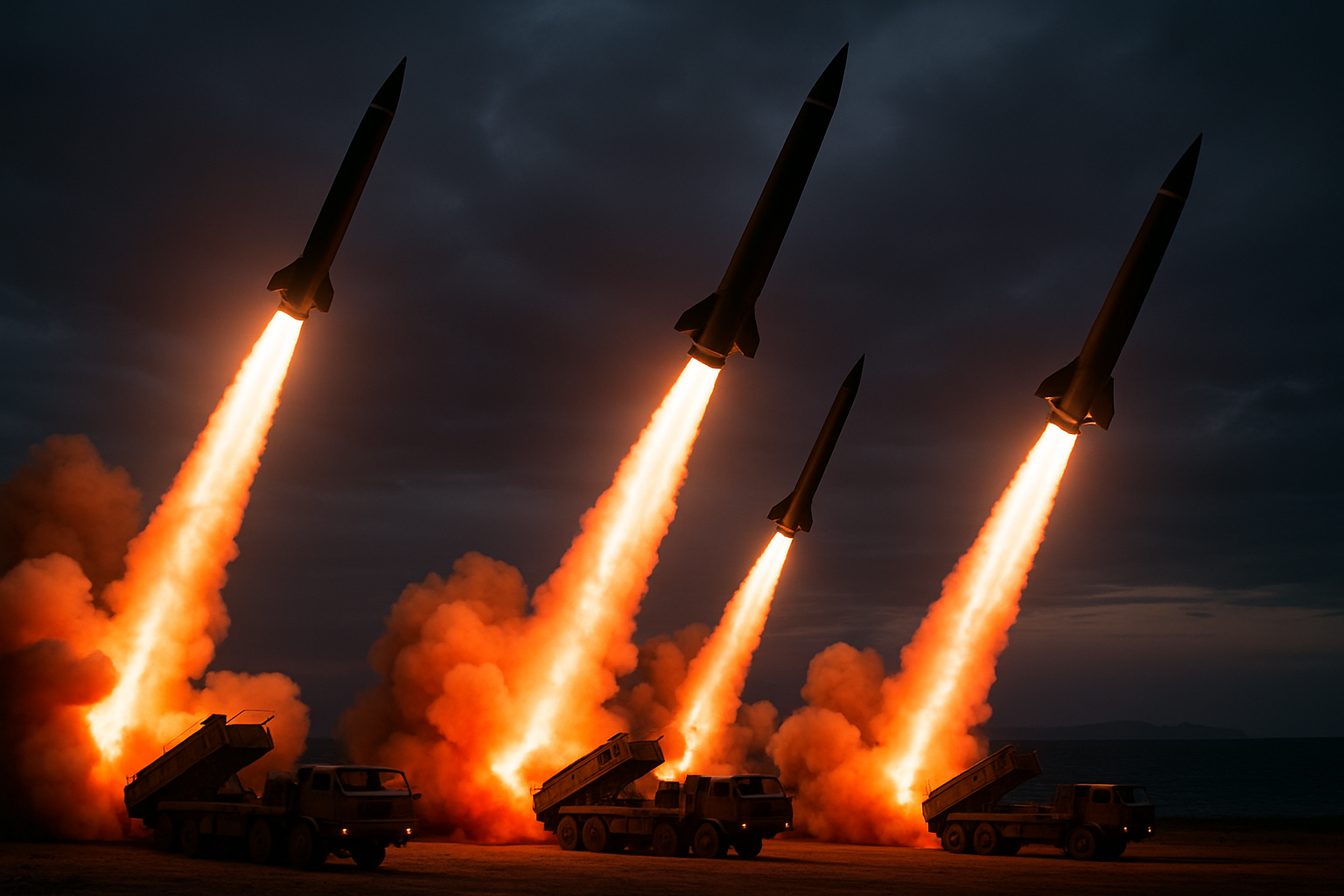
North Korea fired approximately ten ballistic missiles toward the East Sea on Saturday, marking the third missile launch of 2026 as the United States and South Korea conduct their annual spring military exercises involving thousands of troops.
South Korea's Joint Chiefs of Staff detected the missile launches early Saturday morning, with the projectiles fired eastward from North Korean territory. While initial reports confirmed at least one projectile, subsequent analysis by regional defense authorities indicated around ten ballistic missiles were launched in what represents the most significant North Korean weapons test since February's unveiling of nuclear-capable rocket systems.
The timing of Saturday's launches coincides with the ongoing US-South Korea joint military exercises that began five days earlier. These annual spring drills, which Pyongyang routinely denounces as rehearsals for invasion, involve thousands of troops and are designed to test readiness against potential North Korean military threats.
Regional Detection and Response
Japan's Coast Guard reported that the projectiles appeared to have fallen into the sea, with preliminary assessments indicating they landed outside Japan's exclusive economic zone. Japanese public broadcaster NHK, citing defense ministry sources, confirmed the missiles posed no immediate threat to Japanese territory or shipping lanes.
The launches occurred as both South Korean and Japanese defense systems maintained heightened surveillance during the sensitive period of US-South Korea military cooperation. Regional allies have coordinated their monitoring capabilities to track North Korean missile activity more effectively, particularly given the regime's advanced weapons development in recent months.
Escalating Weapons Program
Saturday's missile tests follow a pattern of increased North Korean military activity that has accelerated since the beginning of 2026. In February, the regime unveiled massive 600-millimeter nuclear-capable multiple rocket launcher systems described by state media as "unique in the world" and suitable for "special attack missions" – terminology indicating nuclear operations capability.
These developments represent a significant advancement in North Korea's tactical nuclear weapons capabilities, shifting from intercontinental deterrence to regional conflict scenarios that fundamentally alter the Korean Peninsula's strategic calculus. Intelligence assessments suggest the regime maintains sufficient enriched uranium for multiple weapons, with advanced centrifuge technology enabling continued development despite comprehensive international sanctions.
The weapons program advancement occurs during a critical period of succession planning, with Kim Jong Un having formally designated his teenage daughter Kim Ju Ae as his successor – an unprecedented female leadership transition in the 78-year Kim dynasty history that requires demonstrating regime strength and military credibility.
Diplomatic Context and International Response
The missile launches come against a backdrop of shifting diplomatic dynamics on the Korean Peninsula. In February, Kim Jong Un issued a conditional diplomatic opening to the United States, stating that North Korea-US relations prospects depend "entirely on the attitude of the United States," while simultaneously designating South Korea as a "hostile state" in the constitution.
This dual approach reflects North Korea's assessment that direct engagement with Washington offers better prospects than Seoul-mediated negotiations, while the continued weapons demonstrations serve to strengthen the regime's bargaining position for any future diplomatic initiatives.
The international community faces renewed challenges addressing North Korea's advancing weapons capabilities through diplomatic channels, particularly amid the current global nuclear governance crisis following the expiration of the New START treaty between the United States and Russia in February – the first time in over 50 years without superpower nuclear constraints.
Broader Security Implications
Saturday's missile tests underscore the growing complexity of Northeast Asian security dynamics, where North Korea's military modernization intersects with broader regional tensions involving China's increased military activity around Taiwan and ongoing US strategic competition in the Indo-Pacific.
The timing during US-South Korea exercises demonstrates North Korea's continued strategy of combining military demonstrations with diplomatic positioning, maintaining relevance in regional security calculations while pursuing potential engagement opportunities with major powers.
For regional allies, the launches necessitate continued coordination on defensive measures while developing frameworks for potential future engagement with an unprecedented North Korean leadership structure that may soon include the world's first female leader of a nuclear-armed state.
As the international community grapples with multiple simultaneous crises affecting global stability, North Korea's latest missile tests serve as a reminder of the Korean Peninsula's central role in 21st-century security challenges, requiring innovative diplomatic approaches that balance deterrence with conflict prevention in an increasingly complex multipolar world.