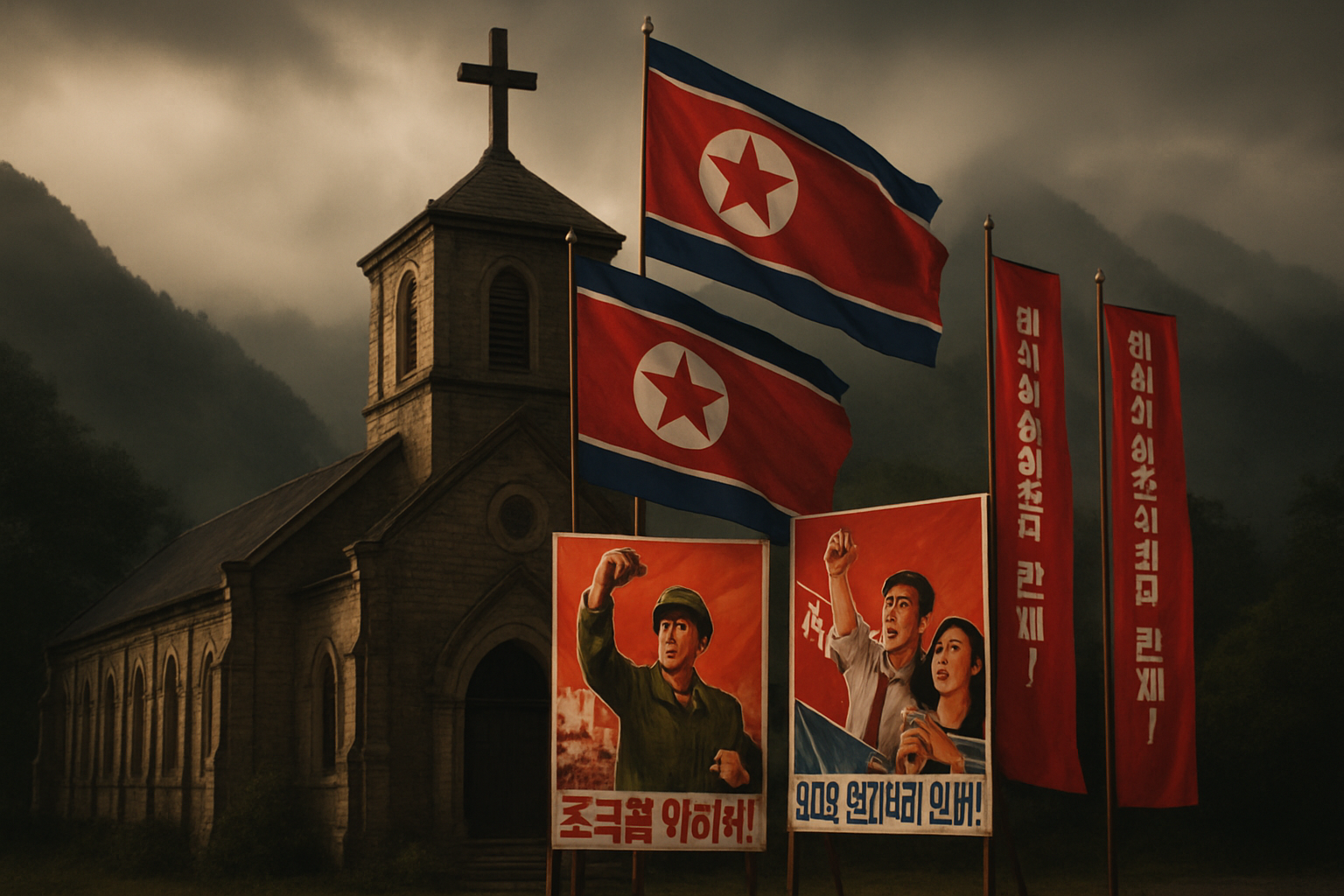
North Korea's elaborate personality cult surrounding the Kim dynasty has deep historical roots in Christian missionary traditions that swept through Korea in the early 20th century, according to new analysis that traces how religious organizational structures were adapted into political control mechanisms.
The revelation comes as North Korea enters a critical succession period with Kim Ju Ae being systematically prepared as the first female leader in the regime's 78-year history, raising questions about how traditional ideological frameworks will adapt to unprecedented political transformation.
Christian Missionary Legacy in Korean Political Structure
The connection between Christian evangelism and North Korean political organization runs deeper than previously understood, with missionary practices providing a template for mass mobilization, hierarchical authority, and devotional loyalty that would later characterize the Juche ideology system.
During the Japanese colonial period (1910-1945), Christian missionaries established extensive networks of churches, schools, and social organizations throughout Korea. These institutions pioneered techniques of community organization, collective worship, and absolute devotion to religious authority that bear striking similarities to North Korea's political structures.
"The missionary movement created organizational blueprints for mass political mobilization that Kim Il Sung would later adapt for revolutionary purposes."
— Jonathan Cheng, China Bureau Chief
Christian educational institutions in colonial Korea emphasized moral instruction, collective identity formation, and unwavering loyalty to divine authority - principles that would be secularized and redirected toward political leadership after 1948.
From Religious Devotion to Political Worship
The transformation of Christian devotional practices into political ritual represents one of the most sophisticated adaptations of religious methodology for secular purposes in modern history. North Korean state ceremonies, mass gatherings, and loyalty demonstrations draw heavily from Protestant revival traditions.
Key elements borrowed from Christian practice include:
- Collective confession and self-criticism sessions derived from evangelical testimony traditions
- Mass rallies modeled on religious revival meetings
- Hierarchical authority structures based on church organization
- Devotional literature and hymns adapted for political purposes
- Pilgrimage sites and sacred locations for leader veneration
The concept of divine succession, central to North Korean dynastic legitimacy, also reflects Christian theological principles about hereditary spiritual authority and blessed lineage transmission.
Ideological Control Through Religious Framework
The Juche ideology system functions remarkably similarly to totalitarian religious movements, demanding absolute faith, unquestioning obedience, and complete life dedication to the leader. This mirrors the evangelical Christian emphasis on total spiritual surrender and lifetime commitment to divine authority.
North Korea's elaborate mythology surrounding the Kim family - including supernatural birth narratives, miraculous achievements, and divine guidance - directly parallels Christian hagiographical traditions used to establish religious authority through miraculous validation.
The regime's extensive use of martyrdom narratives, sacrifice for the greater good, and suffering for ideological purity draws from Christian concepts of redemptive suffering and spiritual purification through hardship.
Contemporary Succession and Christian Influence
The current succession planning for Kim Ju Ae takes place within this Christian-influenced framework, where dynastic authority is understood as divinely ordained rather than politically constructed. This religious conception of leadership provides stability during unprecedented political transition.
South Korean intelligence confirmed in February 2026 that Kim Ju Ae has moved from ceremonial appearances to providing "input on policy matters," representing substantial political involvement preparation. Her systematic elevation since November 2022 includes weapons demonstrations, military parades, and international diplomatic engagement.
The challenge of preparing North Korea's first female dynastic leader requires adapting masculine Juche ideology systems while maintaining Christian-influenced concepts of blessed succession and divine authority that transcend gender limitations through spiritual rather than temporal power.
Global Implications of Religious-Political Synthesis
North Korea's successful adaptation of Christian organizational principles for political control provides a template that influences authoritarian movements worldwide. The regime demonstrates how religious devotional practices can be secularized while maintaining their emotional and psychological effectiveness.
This synthesis of Christian methodology with political ideology creates particularly resilient control mechanisms because it addresses human needs for meaning, community, and transcendence while serving state power interests.
The current succession period tests whether this Christian-influenced system can adapt to female leadership without losing its fundamental characteristics of absolute devotion, divine authority, and unquestioning loyalty.
Historical Continuity and Modern Adaptation
Recent military developments, including February 2026 unveiling of nuclear-capable rocket systems and March 2026 naval weapons tests, occur within this religious-political framework where technological advancement serves spiritual as well as strategic purposes.
The regime's dual approach of military modernization alongside domestic achievements like the completed 50,000-unit Hwasong housing project reflects Christian principles of temporal and spiritual improvement working together for community benefit.
Kim Jong Un's February 2026 conditional diplomatic opening to the United States while constitutionally designating South Korea as a "hostile state" demonstrates the sophisticated political calculations possible within this Christian-influenced ideological framework.
Theological Politics in Practice
The intersection of Christian organizational principles with political control creates unique challenges for international engagement. Traditional diplomatic approaches may prove inadequate when dealing with a system that functions more like a political theology than conventional authoritarianism.
Understanding North Korea's Christian foundations helps explain the regime's remarkable durability despite severe economic constraints and international isolation. The religious-political synthesis provides meaning and purpose that transcends material hardship through spiritual interpretation of political loyalty.
As North Korea prepares for unprecedented female leadership transition, the Christian-influenced framework may prove more adaptable than purely secular authoritarian systems because religious authority often transcends gender limitations through spiritual rather than temporal power concepts.
The global implications of this analysis extend beyond Korean Peninsula dynamics to broader questions about how religious organizational principles influence modern political movements and authoritarian resilience in the 21st century.