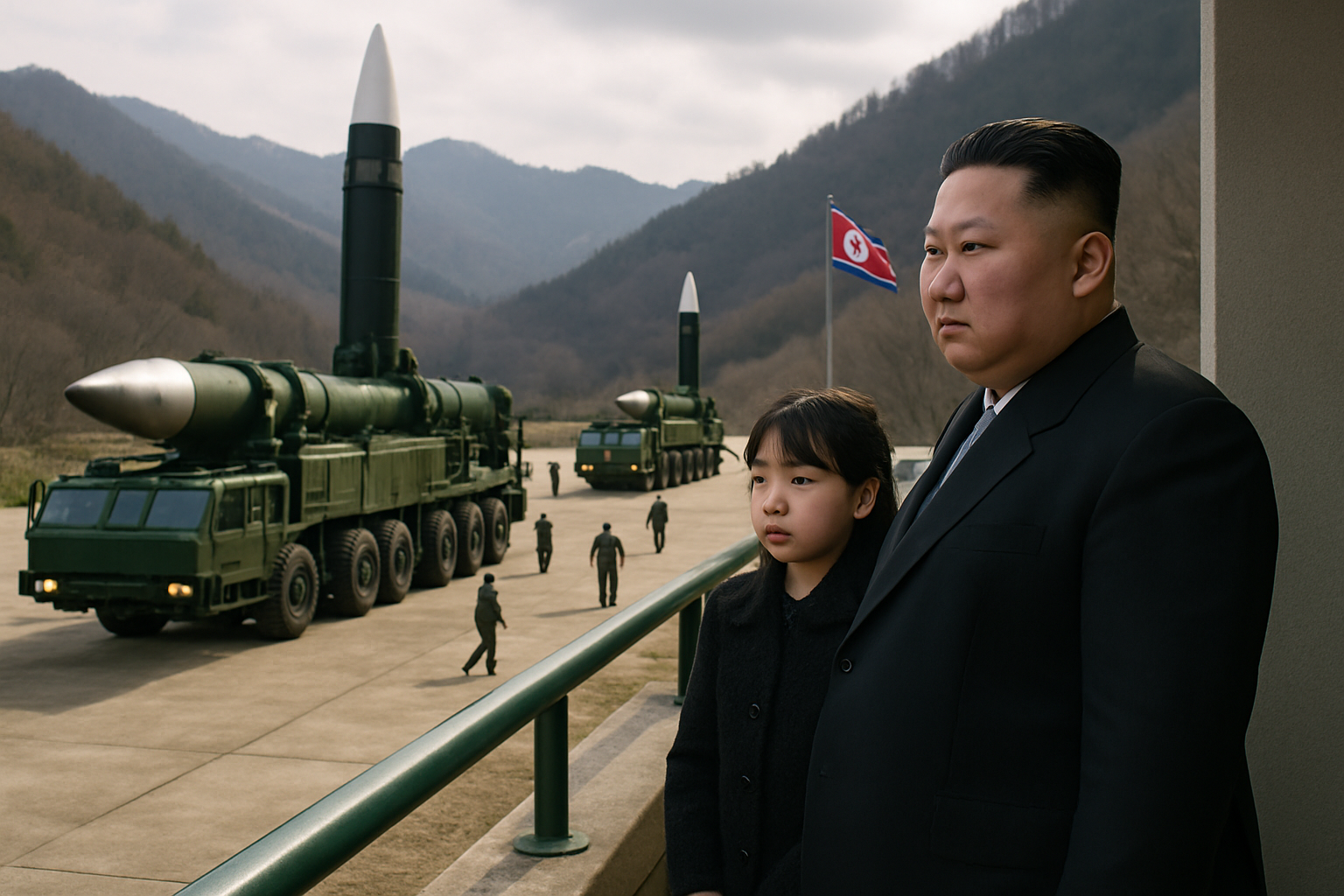
North Korea has conducted new tests of cluster munitions and advanced weapons systems, with Kim Jong Un and his daughter Kim Ju Ae personally observing the launches, marking the latest escalation in Pyongyang's intensive military testing program amid unprecedented succession planning and regional tensions.
The weapons tests, conducted in recent days, represent the continuation of North Korea's most intensive testing period in years, following a pattern that has seen seven weapons tests in 2026 alone. The presence of Kim Ju Ae at these military demonstrations underscores the systematic preparation for her unprecedented role as the first female successor in the 78-year history of the Kim dynasty.
Advanced Cluster Munitions Development
According to intelligence assessments and state media reports, North Korea has been developing cluster munitions integrated with ballistic missile systems, significantly enhancing its tactical strike capabilities. These weapons, described by KCNA as part of "special attack missions," represent a shift toward regional conflict capabilities rather than purely intercontinental deterrence.
Laboratory analyses reveal what Austrian sources describe as "crude manufacturing with old methods from the Soviet Union," yet the electronics are modern, obtained through circumvention of Western sanctions. This combination of dated manufacturing techniques with sophisticated guidance systems demonstrates North Korea's adaptive approach to weapons development under international pressure.
"The Iran war may have prompted North Korea to display it has cluster munitions, which Iran fired at Israeli cities during the war"
— Regional Security Observers
The timing of these tests appears strategically calculated, occurring during the ongoing Middle East conflict where cluster munitions have been prominently used. Observers suggest this demonstration serves multiple purposes: showcasing military capabilities, signaling regional relevance, and building credentials during the critical succession transition.
Kim Ju Ae's Military Credentials Building
The presence of Kim Jong Un's teenage daughter at weapons testing represents a continuation of her systematic elevation within North Korea's political and military hierarchy. Since her public debut in November 2022, Kim Ju Ae has progressed from ceremonial appearances to what South Korean intelligence confirms as providing "input on policy matters."
Her attendance at weapons demonstrations serves multiple strategic purposes within North Korea's traditionally masculine Juche ideology system. Military credibility is essential for regime legitimacy in the defense-oriented political structure, making these appearances crucial for establishing her credentials among the political elite and military hierarchy.
Recent developments have included documented military training, with state media releasing images of Kim Ju Ae firing rifles at military shooting ranges. This systematic approach to building military legitimacy represents the most significant adaptation of North Korean political culture since the regime's founding.
Technical Weapons Advancements
The cluster munitions tests build upon a series of advanced weapons developments throughout 2026. In February, North Korea unveiled 600mm nuclear-capable multiple rocket launcher systems described as "unique in the world" for "special attack missions." These systems represent a tactical nuclear weapons shift from intercontinental to regional conflict scenarios.
Additional weapons systems tested this year include:
- Electromagnetic warfare systems targeting modern electronics and communications networks
- Graphite bombs designed to disable electrical power grids through conductive fiber dispersal
- Mobile short-range anti-aircraft missile systems
- Strategic cruise missiles launched from naval destroyers
- High-thrust solid-fuel engine technology for ICBMs
Intelligence assessments confirm North Korea possesses sufficient enriched uranium for multiple weapons, with military activity having increased 23% since 2025 despite comprehensive international sanctions. The IAEA has confirmed a "rapid increase in operations" at the Yongbyon nuclear reactor complex, operating at levels not seen since before sanctions were imposed.
Regional Security Implications
The weapons testing occurs during a broader nuclear governance crisis, following the expiration of the New START treaty between the United States and Russia in February 2026. This marks the first time in over 50 years without superpower nuclear constraints, creating what experts describe as a "permissive environment" for regional nuclear advancement.
North Korea's constitutional designation of South Korea as a "hostile state" while maintaining conditional diplomatic overtures toward the United States reflects a dual-track strategy. The regime seeks direct engagement with Washington while bypassing Seoul-mediated negotiations, calculating that major power engagement offers better prospects than regional diplomatic frameworks.
China's role has become increasingly significant, with the restoration of passenger rail service between Beijing and Pyongyang in March 2026 after a six-year suspension. This enhanced connectivity provides Beijing with greater leverage over North Korean policy during the succession transition, creating complex triangular dynamics that complicate traditional alliance coordination.
Succession Planning and Cultural Transformation
The weapons testing program serves as a crucial component of Kim Ju Ae's succession preparation, requiring her to demonstrate competence within a traditionally masculine political system. The systematic approach includes not only weapons demonstrations but also international diplomatic exposure, with her September 2025 Beijing visit marking her first international travel.
This unprecedented female succession in Kim dynasty history requires adaptation of the Juche ideology system while maintaining regime stability. Success depends on sustained legitimacy building among the political elite and military hierarchy, representing the most significant political transformation in North Korean history.
"This is a historic moment for the entire North Korean political system, requiring cultural adaptation unlike any previous transition in the dynasty's history"
— Regional Security Experts
International Response Challenges
The combination of advanced weapons capabilities, unprecedented succession planning, and complex regional dynamics presents significant challenges for international diplomatic engagement. Traditional approaches may prove inadequate when dealing with what experts describe as a "religious-political synthesis" rather than conventional authoritarianism.
Regional allies face difficulties addressing weapons advancement through diplomatic channels amid the broader global nuclear governance crisis. The regime's demonstrated ability to advance capabilities while maintaining domestic stability challenges existing non-proliferation frameworks and requires innovative engagement strategies.
The success of North Korea's systematic approach to managing military modernization during an unprecedented female succession provides a template for authoritarian adaptation in the 21st century. This development is being closely watched globally as a potential model for regime survival under external pressure.
Broader Geopolitical Context
The current testing program occurs amid heightened global tensions, including the ongoing Middle East conflict and increased Chinese military activity around Taiwan. North Korea's positioning demonstrates sophisticated understanding of regional dynamics while pursuing strategic autonomy through nuclear capabilities and diplomatic flexibility.
The regime's dual development strategy—maintaining military advancement parallel with domestic achievements like the completed 50,000-unit Hwasong housing project in Pyongyang—shows sophisticated resource allocation despite economic constraints. This approach provides both deterrent credibility and domestic legitimacy during the transition period.
The coming months will be critical for determining whether this complex transformation can be managed through diplomatic engagement or will lead to increased military tensions. The international community faces the challenge of developing effective strategies that address security concerns while managing regional stability in an era of unprecedented political change in Pyongyang.
The cluster munitions testing, conducted under the watchful eyes of both Kim Jong Un and his designated successor, represents more than a military demonstration—it symbolizes North Korea's sophisticated long-term planning for regime survival through generational transition, with implications extending far beyond the Korean Peninsula into global approaches to nuclear crisis management and diplomatic engagement in an increasingly multipolar world.