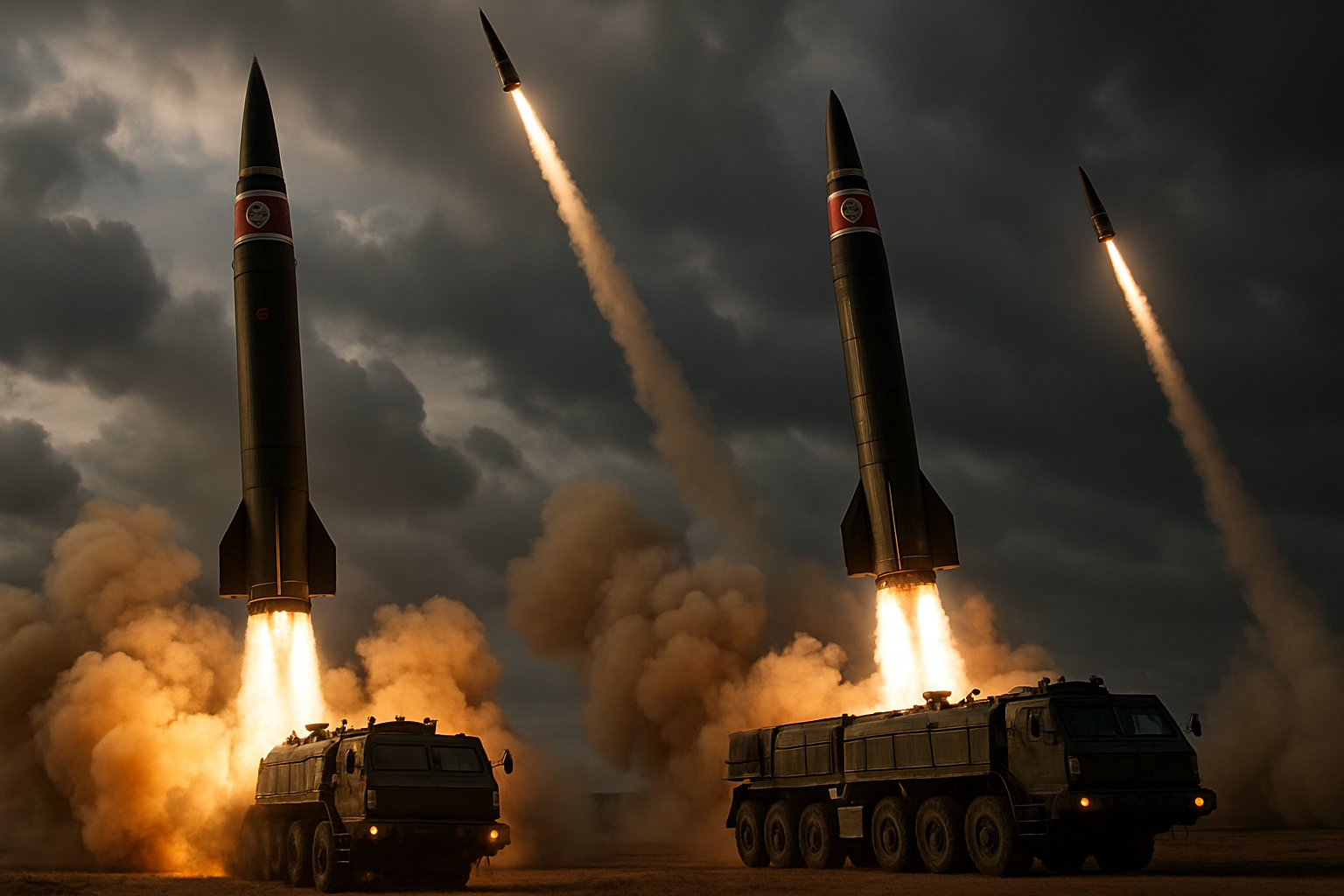
North Korea fired multiple suspected ballistic missiles toward the East Sea on Sunday morning, marking the seventh weapons test of 2026 and the fourth this month alone, according to Japanese and South Korean authorities.
The launches, detected around 6:26 a.m. Korea Standard Time, represent a significant escalation in North Korea's military demonstrations as the regime continues what experts describe as the most intensive testing period in recent years. Japanese Defense Minister Shinjiro Koizumi confirmed that the missiles fell outside Japan's exclusive economic zone, posing no immediate threat to Japanese territory.
The timing of these tests is particularly significant, occurring during an extraordinary period of political transformation within North Korea, as Kim Jong Un prepares his teenage daughter Kim Ju Ae for an unprecedented female succession in the 78-year history of the Kim dynasty.
Systematic Military Escalation
Sunday's launches build upon North Korea's accelerating weapons development program throughout 2026. Intelligence assessments confirm the regime now possesses sufficient enriched uranium for multiple nuclear weapons, with military activity increasing by 23% since 2025 despite comprehensive international sanctions.
The current testing surge follows several major weapons demonstrations this year, including the February unveiling of 600mm nuclear-capable multiple rocket launchers that Pyongyang described as "unique in the world" for "special attack missions." These systems represent a strategic shift from intercontinental deterrence to regional conflict capabilities, fundamentally altering Korean Peninsula security calculations.
Earlier this month, North Korea conducted comprehensive three-day weapons testing that included cluster warhead-equipped ballistic missiles, electromagnetic warfare systems, and graphite bombs designed to target electrical grids. The tests, supervised by Army General Kim Jong-sik, demonstrated the regime's expanding conventional capabilities alongside its nuclear program.
Regional Responses and Security Implications
South Korea's Joint Chiefs of Staff characterized the launches as violations of UN Security Council resolutions and convened an emergency National Security Council meeting. Japanese authorities confirmed enhanced surveillance of North Korean activities, with Prime Minister Sanae Takaichi stating that the weapons "were believed to have fallen outside Japan's exclusive economic zone."
The tests complicate an already tense security environment in Northeast Asia, where China's military activity around Taiwan has increased by 23% over the past year, and broader great power competition continues to reshape regional dynamics.
"These systematic demonstrations serve multiple purposes during North Korea's unprecedented political transformation,"
— Regional Security Analyst
Succession Planning Backdrop
The missile tests occur against the backdrop of the most significant political transformation in North Korean history. South Korean intelligence has definitively confirmed that Kim Jong Un has formally designated his daughter Kim Ju Ae as his successor, marking what would be the first female leadership in the Kim dynasty.
Kim Ju Ae's systematic elevation since her public debut in November 2022 has included attendance at weapons demonstrations, military parades, and most recently, documented military training including rifle practice. Her September 2025 visit to Beijing marked her first international travel, providing crucial diplomatic preparation for potential leadership responsibilities.
This unprecedented succession planning requires cultural adaptation within North Korea's traditionally masculine Juche ideology system, necessitating sustained legitimacy building among the political elite and military hierarchy.
Nuclear Governance Crisis Context
The latest tests occur during what UN Secretary-General António Guterres has described as the highest nuclear risks "in decades." The expiration of the New START treaty between the United States and Russia in February 2026 marked the first time in over 50 years without superpower nuclear constraints, creating what experts term a "permissive environment" for regional nuclear advancement.
Recent assessments by the International Atomic Energy Agency confirm North Korea is "significantly expanding its nuclear weapons capacity" with "rapid increase in operations" at the Yongbyon nuclear reactor complex. The facility is now operating at levels not seen since before international sanctions were imposed, suggesting a systematic push to expand the nuclear arsenal.
Diplomatic Positioning and International Relations
North Korea's military demonstrations coincide with a complex diplomatic strategy that includes both regional partnerships and conditional overtures to major powers. The restoration of China-North Korea passenger rail service in March 2026, after a six-year suspension, has enhanced Beijing's leverage during this transition period.
Meanwhile, Kim Jong Un has pursued a dual-track approach, offering conditional diplomatic engagement with the United States while constitutionally redesignating South Korea as a "hostile state." This strategy reflects calculations that direct engagement with major powers offers better prospects than multilateral regional frameworks.
Economic and Strategic Implications
Despite severe international sanctions, North Korea has demonstrated sophisticated resource allocation, maintaining military advancement while achieving domestic milestones such as the completion of a 50,000-unit housing project in Pyongyang. This dual development strategy serves both deterrent credibility and domestic legitimacy during the succession transition.
The regime's indigenous production capabilities and alternative economic relationships have provided sufficient resources for sustained military modernization, demonstrating the limitations of current non-proliferation approaches and sanctions frameworks.
Looking Ahead
The current testing surge represents more than tactical military demonstrations—it reflects North Korea's systematic approach to maintaining regional relevance during a period of unprecedented political transformation. The combination of advancing nuclear capabilities, sophisticated conventional weapons development, and historic succession planning creates new dynamics that will shape Korean Peninsula security for decades.
Regional allies face renewed challenges in developing effective diplomatic responses to weapons advancement while managing broader security concerns. The template that North Korea's success or failure in managing this transition provides will be closely watched globally as a precedent for authoritarian adaptation in the 21st century.
As North Korea continues to demonstrate its military capabilities amid this historic succession planning, the international community confronts the complex challenge of balancing deterrence with diplomatic engagement, seeking to prevent escalation while addressing the fundamental security concerns posed by one of the world's most isolated nuclear-armed states.