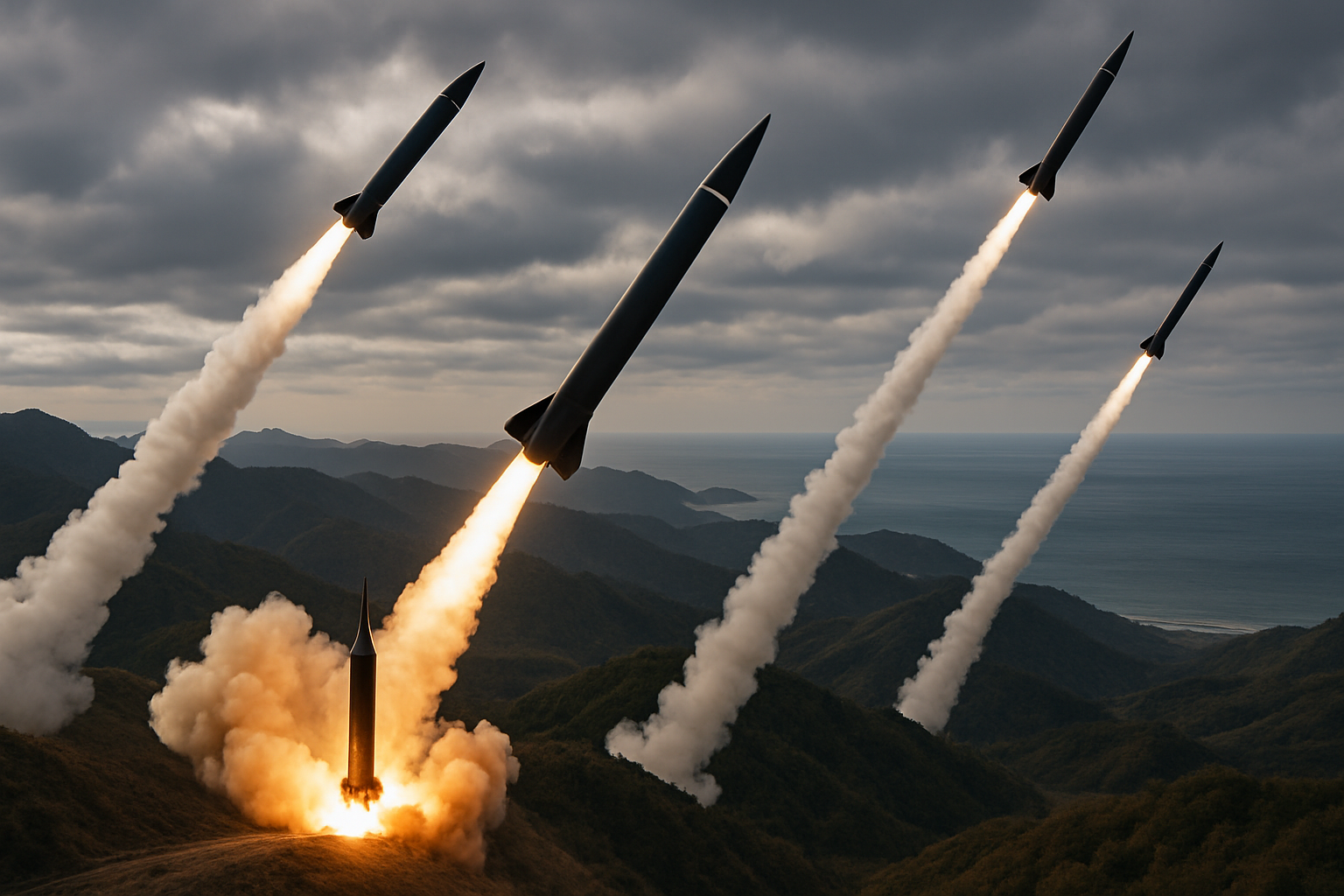
North Korea fired approximately ten ballistic missiles toward the Sea of Japan on Saturday morning, marking the most significant weapons test of 2026 as the isolated nation stages its own show of force during ongoing US-South Korea joint military exercises.
South Korea's Joint Chiefs of Staff (JCS) confirmed the launches occurred around 1:20 p.m. local time (0420 GMT) from the Sunan area near Pyongyang, with the projectiles traveling eastward toward what Seoul calls the East Sea. Japan's Defense Ministry also verified the launches, stating on social media that "what is possibly a ballistic missile was launched from North Korea."
Timing Coincides with US-South Korea Military Drills
The missile launches come during the fifth day of annual spring military exercises between Washington and Seoul, which North Korea routinely denounces as invasion rehearsals. Kim Jong Un's powerful sister, Kim Yo Jong, had warned earlier this week of "terrible and unimaginable consequences" in response to the joint drills involving thousands of troops.
This represents the third major North Korean weapons test of 2026, following the February unveiling of nuclear-capable 600mm rocket systems that Pyongyang described as "unique in the world" for "special attack missions," and March naval destroyer cruise missile tests personally supervised by Kim Jong Un.
"This latest provocation demonstrates North Korea's continued disregard for international norms while regional allies conduct legitimate defensive exercises."
— South Korean Defense Official
Strategic Context of Historic Succession Planning
The weapons tests occur amid unprecedented developments in North Korean leadership, with South Korean intelligence confirming in February that Kim Jong Un has formally designated his teenage daughter Kim Ju Ae as his successor - marking the first female leadership transition in the 78-year history of the Kim dynasty.
Intelligence reports indicate Kim Ju Ae now provides "input on policy matters" beyond ceremonial appearances, representing a systematic elevation since her November 2022 public debut. Her preparation has included attendance at weapons demonstrations, military parades, and a September 2025 diplomatic visit to Beijing - her first international travel.
This succession planning represents the fourth generation of Kim family rule (Kim Il Sung 1948-1994, Kim Jong Il 1994-2011, Kim Jong Un 2011-present), requiring unprecedented cultural adaptation within North Korea's traditionally masculine Juche ideology system.
Regional Security Implications
Japan's Coast Guard confirmed the missiles fell into the sea outside Japan's exclusive economic zone, posing no immediate threat to Japanese territory or shipping lanes. However, the launches underscore North Korea's evolving tactical nuclear capabilities that fundamentally alter Korean Peninsula strategic calculations.
The timing during US-South Korea exercises demonstrates Pyongyang's continued strategy of combining military demonstrations with diplomatic positioning. Recent developments include:
- Advanced tactical nuclear weapons development with sufficient enriched uranium for multiple weapons
- Naval cruise missile integration expanding strike capabilities
- February constitutional changes designating South Korea as a "hostile state"
- Conditional diplomatic opening to the United States while bypassing Seoul
International Response and Nuclear Governance Crisis
The launches occur during a broader global nuclear governance crisis, following the February 5 expiration of the New START treaty between the United States and Russia - the first time in over 50 years without superpower nuclear constraints. This more permissive environment enables regional nuclear powers to advance capabilities without traditional arms control frameworks.
China, North Korea's primary economic partner, resumed passenger rail service to Pyongyang in March for the first time since 2020, providing enhanced leverage over North Korean policy during this critical transition period. Beijing's early engagement with Kim Ju Ae's succession suggests strategic patience with dynastic change over regime instability risks.
Advanced Weapons Capabilities
North Korea's military modernization continues despite international sanctions, demonstrating sophisticated survival strategies through indigenous production capabilities. The February 600mm multiple rocket launcher systems represent a shift from intercontinental deterrence to regional conflict scenarios, creating new challenges for defensive planning.
Military activity increased 23% in 2025, indicating acceleration of weapons development programs. The regime's dual development strategy maintains military deterrence while providing domestic achievements like the completed 50,000-unit Hwasong housing project in Pyongyang.
Future Implications
The successful management of unprecedented female succession planning while advancing nuclear capabilities demonstrates sophisticated long-term strategic planning for regime survival through generational transition. This template could influence global authoritarian adaptation models, with international observers closely monitoring innovations in dynastic transition approaches.
Regional allies face renewed challenges in addressing continued weapons advancement through diplomatic channels amid the broader global nuclear governance crisis. The combination of succession dynamics, military modernization, and diplomatic repositioning creates complex scenarios requiring innovative international engagement frameworks.
"North Korea's strategy combining military demonstrations with succession planning shows calculated positioning for future negotiations while maintaining deterrent credibility."
— Regional Security Analyst
Broader Northeast Asian Dynamics
The missile launches contribute to increasingly complex Northeast Asian security dynamics, with Chinese military activity around Taiwan up 23% in 2025 and broader US-China strategic competition affecting regional calculations. North Korea maintains relevance in regional security frameworks while pursuing potential major power engagement opportunities.
Success in managing the unprecedented political transformation while advancing nuclear capabilities could provide a framework for 21st-century authoritarian adaptation, affecting international approaches to nuclear-armed state engagement for decades beyond the immediate regional security concerns.