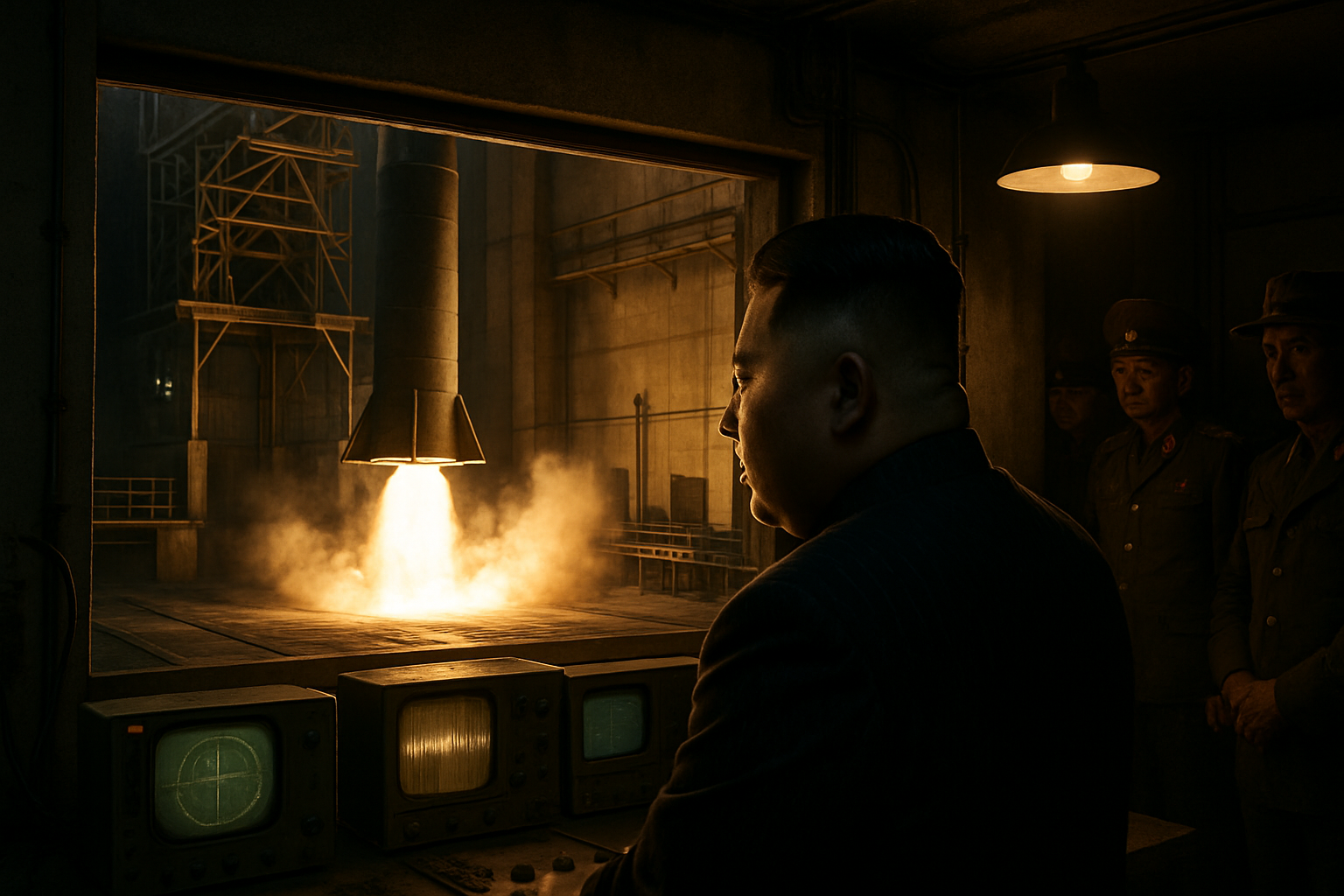
North Korean leader Kim Jong Un personally supervised the ground testing of a newly upgraded "high-thrust solid-fuel engine" designed for long-range missiles, state media reported Sunday, in what analysts describe as the most significant advancement in the regime's intercontinental ballistic missile capabilities in years.
The Korean Central News Agency (KCNA) announced that the test involved advanced solid-fuel propulsion technology described as part of North Korea's "national defence development plan in the period of the new five-year plan." The timing of the test, conducted amid ongoing tensions with South Korea and the United States, underscores Pyongyang's commitment to advancing its strategic weapons program despite international sanctions.
Strategic Military Advancement
Multiple international sources confirmed the test represents a significant leap forward in North Korea's missile capabilities. The solid-fuel engine technology offers several tactical advantages over liquid-fuel systems, including faster deployment times and reduced vulnerability to preemptive strikes. Intelligence assessments suggest the upgraded engine could power missiles capable of reaching the continental United States.
The test occurred alongside Kim Jong Un's inspection of special operations forces training and evaluation of a new main battle tank, demonstrating the regime's comprehensive approach to military modernization. This systematic enhancement of both strategic and conventional forces reflects North Korea's long-term defense planning amid regional security tensions.
Succession Planning Context
The missile engine test takes place during an unprecedented period in North Korean political history. South Korean intelligence has confirmed that Kim Jong Un has formally designated his teenage daughter, Kim Ju Ae, as his successor—marking the first female leadership transition in the 78-year history of the Kim dynasty. This historic succession planning adds additional significance to military demonstrations as the regime seeks to project strength during a critical transition period.
"The systematic elevation of Kim Ju Ae from ceremonial appearances to providing input on policy matters represents a fundamental shift in North Korean political culture."
— South Korean National Intelligence Service Assessment
Kim Ju Ae's presence at weapons demonstrations and military parades since November 2022, including a diplomatic visit to Beijing in September 2025, indicates a deliberate strategy to build her credentials within the traditionally masculine political and military hierarchy of the Juche ideology system.
Regional Security Implications
The timing of the engine test coincides with several destabilizing factors in Northeast Asian security dynamics. Regional intelligence reports indicate that North Korean military activity has increased by 23% throughout 2025, suggesting an acceleration of weapons development programs despite comprehensive international sanctions.
The test follows the February 2026 unveiling of 600mm nuclear-capable multiple rocket launcher systems that KCNA described as "unique in the world" and "suitable for special attack missions." This progression from tactical to strategic weapons capabilities demonstrates North Korea's shift from regional deterrence to potential intercontinental strike capabilities.
International Response Challenges
The missile engine advancement occurs during a global nuclear governance crisis, with the New START treaty between the United States and Russia having expired in February 2026—the first time in over 50 years without superpower nuclear constraints. This permissive international environment may embolden further North Korean weapons development.
Regional allies including South Korea, Japan, and the United States face renewed challenges in addressing North Korea's advancing weapons programs through diplomatic channels. The regime's demonstrated ability to continue technological advancement despite sanctions raises questions about the effectiveness of current non-proliferation frameworks.
Technological Capabilities Assessment
Defense analysts note that solid-fuel rocket engines represent a significant technological achievement for North Korea's indigenous weapons program. Unlike liquid-fuel systems that require extended preparation times and are vulnerable to detection, solid-fuel missiles can be launched with minimal warning, complicating defensive planning by potential adversaries.
Intelligence assessments confirm that North Korea possesses sufficient enriched uranium for multiple nuclear weapons, with advanced centrifuge technology enabling continued development despite international pressure. The combination of improved delivery systems and nuclear warhead capabilities fundamentally alters Korean Peninsula strategic calculations.
Diplomatic Positioning Strategy
The missile test reflects North Korea's dual-track approach of military advancement alongside selective diplomatic engagement. In February 2026, Kim Jong Un offered conditional diplomatic opening to the United States while constitutionally redesignating South Korea as a "hostile state," indicating a strategy of pursuing direct engagement with Washington rather than Seoul-mediated negotiations.
The restoration of China-North Korea passenger rail service in March 2026 after a six-year suspension provides Beijing with enhanced leverage over North Korean policy during this transition period, creating triangular diplomatic dynamics that regional allies must navigate carefully.
Domestic Development Balance
Despite prioritizing military capabilities, the North Korean regime continues to demonstrate sophisticated resource allocation toward domestic achievements. The completion of a 50,000-unit housing project in Pyongyang's Hwasong area showcases the regime's ability to provide tangible benefits to key constituencies while maintaining defense capabilities under severe economic constraints.
This dual development strategy serves multiple purposes: maintaining military deterrent credibility, providing domestic legitimacy through material improvements, and demonstrating state capacity during the unprecedented succession transition to female leadership.
Historical Significance and Future Implications
The March 2026 missile engine test represents more than a technical military advancement—it demonstrates the regime's sophisticated long-term strategic planning during a period of unprecedented political transformation. The success of managing female succession preparation while advancing nuclear capabilities provides a template for authoritarian regime adaptation in the 21st century.
The test's timing during global nuclear governance uncertainty, regional security tensions, and internal succession planning creates a complex challenge for the international community. Success in containing North Korea's weapons advancement will likely require innovative diplomatic approaches that address security concerns while managing regional stability in an increasingly multipolar world.
As Kim Jong Un continues to balance military modernization with political transformation, the international community faces the challenge of developing effective engagement strategies that recognize the regime's strategic priorities while maintaining pressure for denuclearization. The outcome of this diplomatic balancing act will have implications extending far beyond the Korean Peninsula, influencing global approaches to nuclear crisis management and conflict prevention for decades to come.