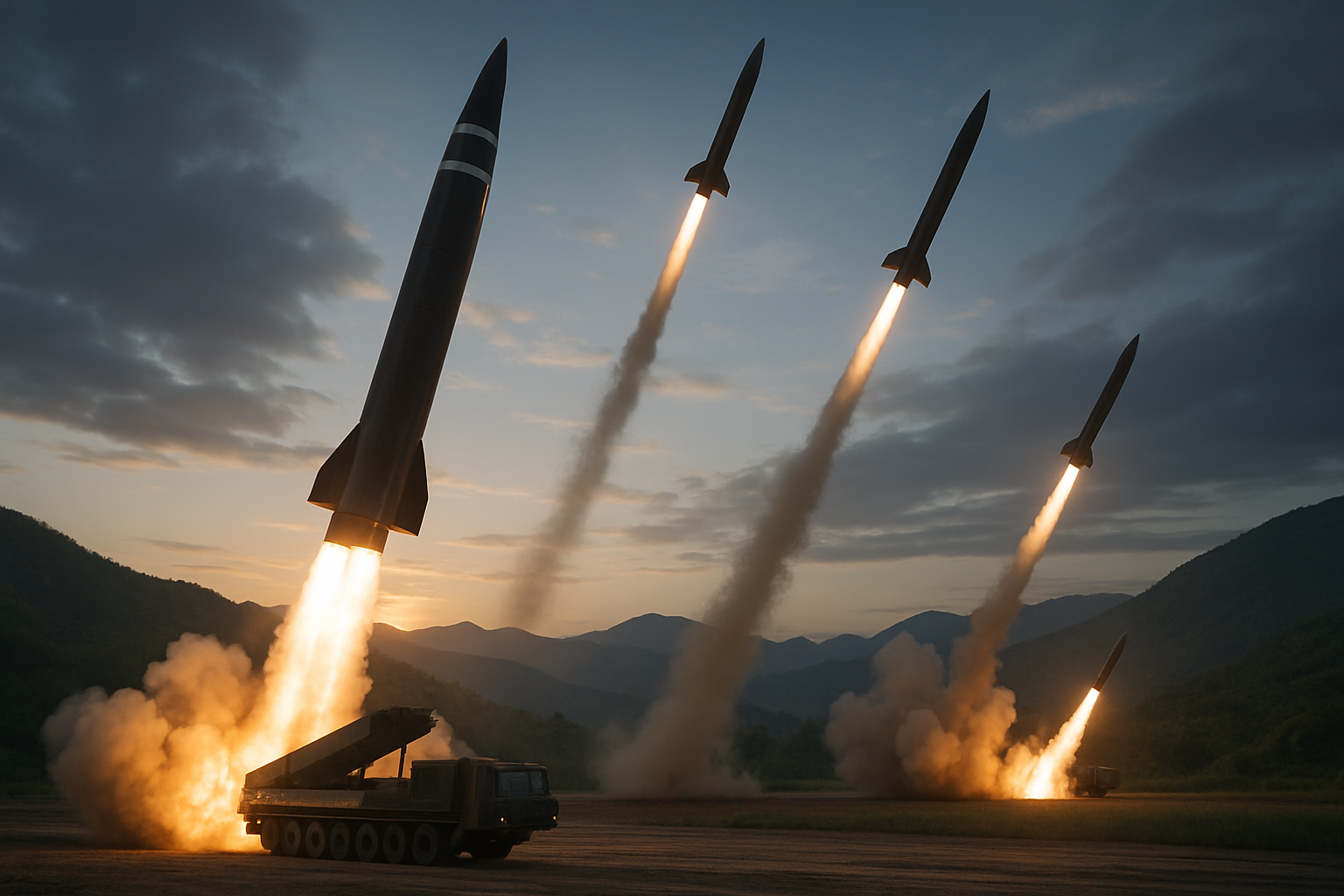
North Korea fired more than ten ballistic missiles toward the East Sea on Saturday, March 14, 2026, marking the regime's most significant weapons test in months as US and South Korean forces conduct their annual joint military exercises.
South Korea's Joint Chiefs of Staff confirmed the launches occurred Saturday morning, with projectiles fired eastward from North Korean territory toward the Sea of Japan. The missiles fell into international waters outside Japan's exclusive economic zone, posing no immediate threat to Japanese territory or shipping, according to Tokyo's Coast Guard.
The timing of the missile tests coincides directly with the ongoing US-South Korea joint military exercises that began five days earlier, involving approximately 18,000 South Korean troops and an undisclosed number of American forces. The exercises are scheduled to continue through March 19, 2026.
Strategic Context and Escalation
This latest missile launch represents the third weapons test by North Korea in 2026 and the most significant demonstration of military capabilities since February's unveiling of nuclear-capable 600mm rocket systems, which state media described as "unique in the world" for "special attack missions."
The missile tests occur during a critical period for North Korean leadership dynamics. Intelligence sources confirm that Kim Jong Un has formally designated his teenage daughter, Kim Ju Ae, as his successor—marking an unprecedented transition to female leadership in the 78-year history of the Kim dynasty.
"These military demonstrations serve multiple purposes during the succession planning period," noted regional security analyst Dr. Sarah Kim. "They reinforce regime strength while building Kim Ju Ae's credentials within the traditionally masculine political and military hierarchy."
— Dr. Sarah Kim, Northeast Asia Security Expert
Kim Ju Ae has been systematically elevated since her November 2022 public debut, including attendance at weapons demonstrations, military parades, and her first international diplomatic trip to Beijing in September 2025. South Korean intelligence indicates she now provides "input on policy matters" beyond ceremonial appearances.
Nuclear Capabilities and Regional Security
The missile tests demonstrate North Korea's continued advancement of tactical nuclear capabilities, representing a strategic shift from intercontinental deterrence to regional conflict scenarios. This evolution fundamentally alters Korean Peninsula security calculations and complicates defensive planning for regional allies.
Recent developments have showcased sophisticated weapons integration across multiple platforms. In March 2026, Kim Jong Un personally supervised strategic cruise missile tests from the newly commissioned Choe Hyon destroyer, expanding North Korea's maritime nuclear capabilities.
The regime's February 2026 Workers' Party Congress emphasized that nuclear-based "war deterrence" had been "radically improved" under Kim Jong Un's leadership, despite comprehensive international sanctions that have failed to halt weapons program advancement.
International Response and Diplomatic Challenges
The missile launches occur during a broader global nuclear governance crisis following the expiration of the New START treaty between the United States and Russia on February 5, 2026—the first time in over 50 years without superpower nuclear constraints.
UN Secretary-General António Guterres has warned that nuclear risks are at their "highest in decades," creating a permissive environment for regional nuclear powers to advance capabilities without traditional arms control frameworks.
Regional allies face renewed challenges in addressing North Korea's weapons development through diplomatic channels. The tests complicate efforts to engage Pyongyang constructively while maintaining security cooperation among South Korea, Japan, and the United States.
Kim Jong Un's Diplomatic Strategy
The missile tests follow Kim Jong Un's conditional diplomatic opening to the United States announced in February 2026, where he stated that prospects for improved relations depend "entirely on the attitude of the United States" and preparations for either "peaceful coexistence or eternal confrontation."
However, North Korea has simultaneously hardened its stance toward South Korea, constitutionally redesignating Seoul as a "hostile state" and effectively closing possibilities for inter-Korean reconciliation while signaling openness to direct Washington engagement.
This dual approach reflects strategic calculations about changing global dynamics, with Kim Jong Un apparently assessing that direct great power engagement offers better prospects than regional diplomatic frameworks involving South Korean intermediaries.
Economic Development Amid Military Priorities
Despite resource constraints from international sanctions, North Korea continues demonstrating sophisticated resource allocation strategies. The regime recently completed a massive 50,000-unit housing project in Pyongyang's Hwasong Area, providing modern amenities while maintaining military capability investments.
This dual development approach serves regime survival by maintaining defensive capabilities while ensuring domestic support through tangible benefits to key constituencies, particularly in the capital where political elite reside.
Regional Security Architecture Implications
The missile tests contribute to increasingly complex Northeast Asian security dynamics, occurring alongside increased Chinese military activity around Taiwan and broader US-China strategic competition in the Indo-Pacific region.
North Korea's ability to maintain relevance in regional security calculations while pursuing potential major power engagement demonstrates sophisticated strategic planning despite international isolation.
The timing of weapons demonstrations alongside succession planning and diplomatic positioning suggests a coordinated strategy combining military credibility with negotiating leverage for future engagement opportunities.
Looking Forward
The success of North Korea's unprecedented female succession transition depends on sustained legitimacy building among political and military elites within the traditionally masculine Juche ideology system. Military demonstrations provide crucial credentials during this historic adaptation.
As the international community grapples with containing nuclear proliferation amid the broader governance crisis, North Korea's continued weapons advancement despite comprehensive sanctions highlights the limitations of current non-proliferation approaches.
The March 14 missile tests represent another chapter in North Korea's sophisticated survival strategy, combining military modernization with diplomatic positioning and historic political transformation that will influence regional security dynamics for decades to come.