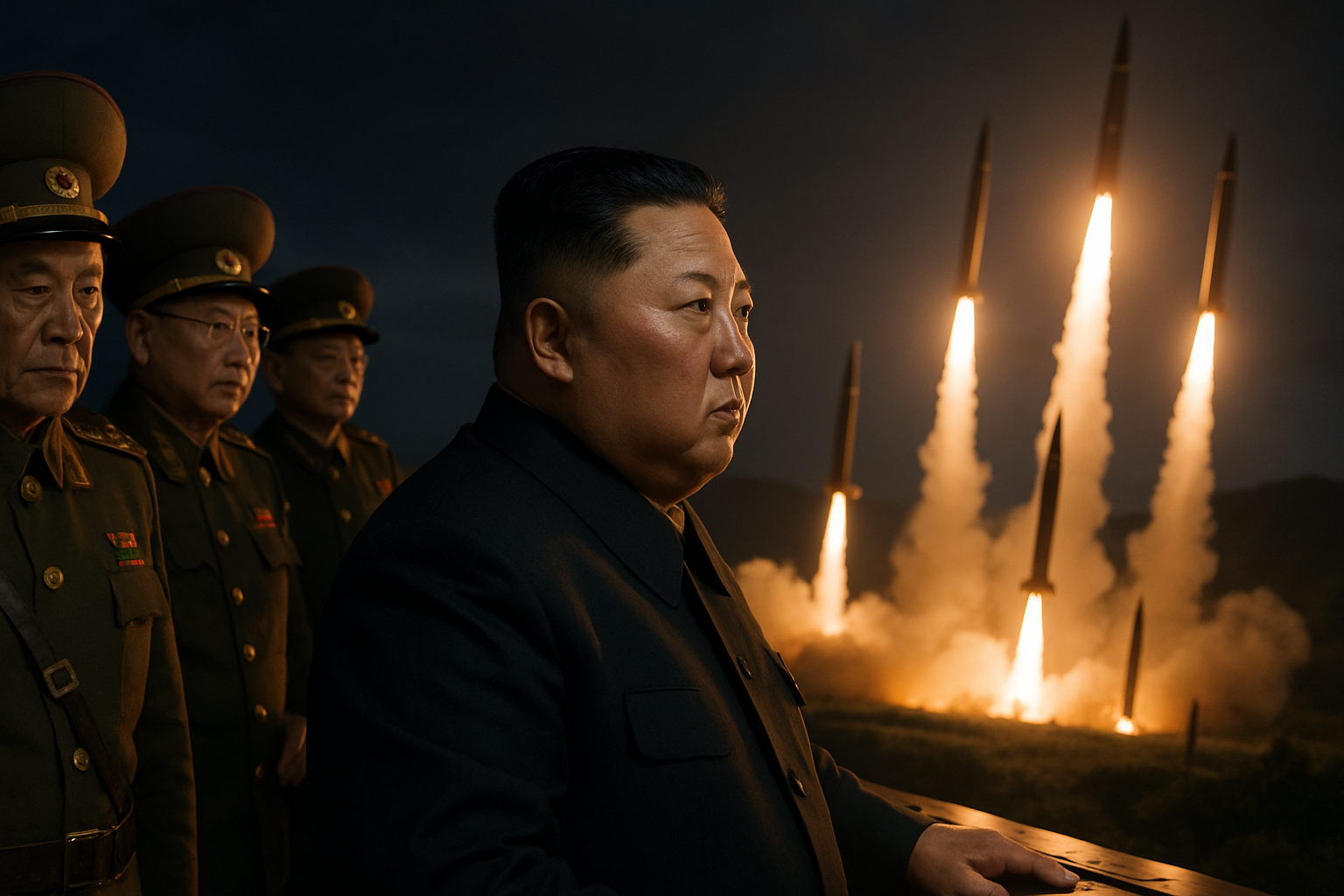
North Korea conducted its seventh ballistic missile test of 2026 on April 20, firing short-range missiles with cluster bomb capabilities in the most intensive testing period in recent years, as Kim Jong Un oversees an unprecedented female succession transition amid a deteriorating global nuclear governance framework.
The latest weapons demonstration, personally supervised by Kim Jong Un alongside his teenage daughter Kim Ju Ae, involved testing of "improved" surface-to-surface ballistic missiles armed with cluster bombs and fragmentation mine warheads. According to state media, the Missile Administration of the DPRK conducted the tests to "verify characteristics and power" of the controversial weapons systems.
Unprecedented Succession Planning During Military Escalation
The missile tests occur during the most significant political transformation in North Korean history, with Kim Ju Ae confirmed by South Korean intelligence as the formally designated successor—making her the first potential female leader in the Kim dynasty's 78-year reign. This represents what analysts describe as the most dramatic adaptation of North Korean political culture since the regime's founding.
Kim Ju Ae's systematic elevation since her November 2022 public debut has included attending weapons demonstrations, military parades, and providing "input on policy matters" beyond ceremonial appearances. Her documented military training, including rifle practice photographed in February 2026 and tank driving exercises in April, demonstrates the regime's understanding that military credibility is essential within North Korea's defense-oriented political system.
"This represents unprecedented female leadership preparation within traditionally masculine Juche ideology requiring sustained legitimacy building among political elite and military hierarchy."
— South Korean National Intelligence Service Assessment
Advanced Weapons Systems Development
The April missile tests build upon a comprehensive 2026 weapons program that has included nuclear-capable 600mm rocket systems unveiled in February and described as "unique in the world" for "special attack missions." The cluster munitions integration with ballistic missiles enhances tactical strike capabilities against personnel, airfields, and military installations.
Previous tests this year have demonstrated electronic warfare capabilities, including electromagnetic weapons targeting modern electronics and carbon-fiber bombs designed to disable electrical grids. Maritime nuclear expansion through destroyer-based cruise missiles has fundamentally altered the Korean Peninsula's strategic calculus, shifting from intercontinental deterrence to regional conflict scenarios.
Intelligence assessments confirm North Korea possesses sufficient enriched uranium for multiple weapons, with military activity increasing 23% since 2025 despite comprehensive international sanctions. The International Atomic Energy Agency reported a "rapid increase in operations" at the Yongbyon nuclear reactor complex, reaching levels not seen before sanctions were imposed.
Nuclear Governance Crisis Context
These developments unfold against the backdrop of a global nuclear governance crisis following the New START treaty's expiration in February 2026—the first time in over 50 years that the world lacks bilateral nuclear constraints between major powers. UN Secretary-General António Guterres has described current nuclear risks as the "highest in decades."
This "permissive environment" for regional nuclear advancement, combined with North Korea's constitutional redesignation of South Korea as a "hostile state" while maintaining conditional diplomatic opening to the United States, reflects a sophisticated dual-track strategy. The regime appears to be pursuing direct engagement with Washington while bypassing Seoul as an intermediary.
China's restoration of passenger rail service to North Korea in March 2026, ending a six-year suspension, provides Beijing with enhanced leverage during the succession transition and creates complex triangular dynamics that complicate traditional alliance coordination.
Regional Security Implications
The combination of advanced weapons capabilities, unprecedented succession planning, and global nuclear governance uncertainty creates multiple security challenges for Northeast Asia. South Korea, Japan, and the United States face renewed difficulties in addressing weapons advancement through diplomatic channels while managing the implications of potential female leadership unlike any in modern international relations.
The regime's dual development strategy—maintaining military deterrence while completing domestic projects like the 50,000-unit Hwasong housing development—demonstrates sophisticated resource allocation despite economic constraints. This approach suggests understanding that long-term survival requires both defensive capabilities and tangible benefits for citizens.
"Traditional diplomatic approaches may prove inadequate for dealing with a political structure functioning as religious-political synthesis rather than conventional authoritarianism."
— Regional Security Analysis
International Response Challenges
Regional allies face unprecedented challenges in developing effective engagement strategies that address security concerns while managing regional stability during nuclear governance uncertainty. The success or failure of North Korea's systematic female succession planning is being closely watched globally as a potential template for authoritarian adaptation in the 21st century.
The April 20 tests represent the fourth weapons demonstration this month alone, indicating an acceleration in military development that coincides with broader geopolitical tensions. Traditional arms control frameworks appear increasingly inadequate for addressing the intersection of advanced weapons development, political transformation, and succession planning.
Template-Setting Implications
North Korea's current trajectory represents more than a regional concern—it's a template-setting moment for conflict prevention and crisis management approaches in an era of great power competition and nuclear proliferation challenges. The regime's ability to manage military modernization during unprecedented political transformation demonstrates sophisticated long-term planning under external pressure.
Success in managing this complex transformation through diplomatic engagement could provide frameworks for addressing similar challenges elsewhere. However, failure risks accelerating military solutions that could undermine confidence in diplomatic approaches to nuclear proliferation worldwide.
As the international community grapples with these unprecedented circumstances, the coming months will be critical in determining whether innovative diplomatic frameworks can emerge to address security concerns while managing regional stability in an increasingly complex global environment. The implications of North Korea's current path extend decades beyond the immediate crisis, affecting international governance mechanisms and diplomatic precedents for the multipolar era.